|
|
ANTE UP: The Collection of Robert Eisenstadt |
|
|
We welcome you to take part in Ante Up, the auction of the Robert Eisenstadt's incredible collection. The auction takes place on January 30, 2021 at 10:00AM CT. You can visit the auction website by clicking here.
You can also view the collection that is up for auction as a PDF.
If you have any questions about the auction, please contact Joseph Slabaugh (joeslabaugh@potterauctions.com, 773-472-1442) at Potter & Potter Auctions.
|
|
|
IN MEMORIAM: Robert Eisenstadt 1942 - 2020 |
|
|
On June 5, 2020, Robert Eisenstadt died peacefully at home, in the loving presence of his sister Nancy and his sister's family. He will be dearly missed by all of us who loved and appreciated him. If you would like to leave a story about Robert, write a message, or read what others have written, please click here.
He took pride in his collection and loved sharing it with fellow enthusiasts; please have a look and enjoy.
|
|
Robert Eisenstadt's
Antique Gambling
Chips & Gambling Memorabilia
Web Site
Home Page: ordering info.,policies
(satisfaction
guaranteed, etc.), e-mail,
etc.
Site
Map
My email address:
(removed email address)
MAIN
AGUA CALIENTE PAGE:
Agua
Caliente Hotel and
Casino, Tijuana, Mexico (1928
- 1935)
Gambling Chips -- those I need and
those I can
trade or sell.
Historical tidbits, photos, postcards and artifacts.
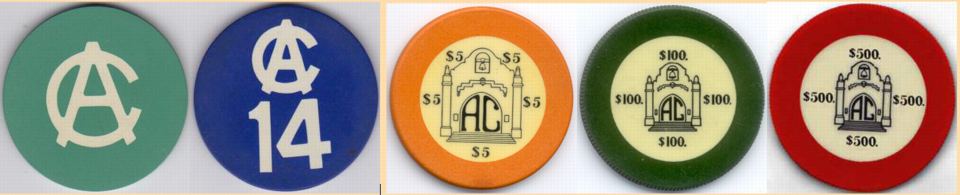
TABLE OF CONTENTS AND LINKS TO MY SECOND AGUA CALIENTE PAGE:
� 1.
Hotel -- building's entrance, square courtyard,
and wings
� 2.
Casino -- Wishing Well at entrance,
Casino Patio, casino rooms and views
� 3. Horse
and Dog Racetracks;
Timeline of gambling in Mexico and Agua Caliente; and Current
Situation: Caliente Casino, sportsbooks, slots, video
terminals, chips, etc. Estadio (Stadium) Caliente
� 4. Spa,
Baths and Pool
� 5. Bell
Tower -- then and now
� 6.
Hollywood and Other Celebrities at Agua Caliente;
Scenes of the resort from movies made on location there.
� 7. Miscellaneous
� 8. Present-day
remains of the resort
� 9. Menus
-- Agua Caliente Menu adorned with
Xavier Cugat caricatures, and other Lunch and Dinner menus
|
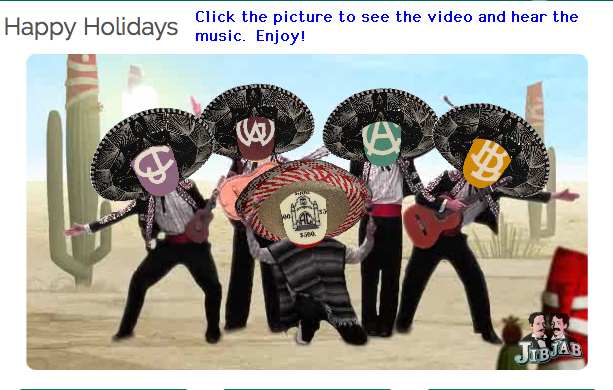 Note that this
animated cartoon JibJab eGreeting Card is made with
Agua Caliente chips
Note that this
animated cartoon JibJab eGreeting Card is made with
Agua Caliente chips
for the musicians
faces!!! After you click the picture, you may have
to wait up to a minute for the
video to download!
PART A: Brief
Introduction to Agua Caliente, Tijuana, Mexico
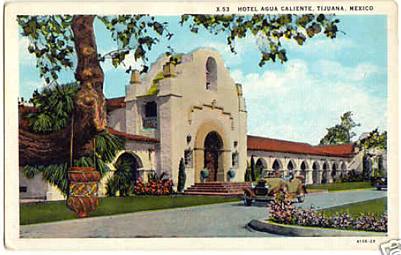
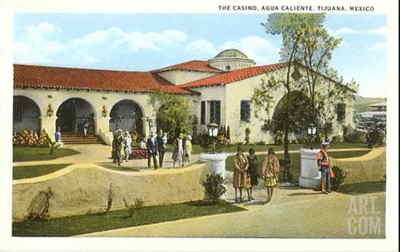
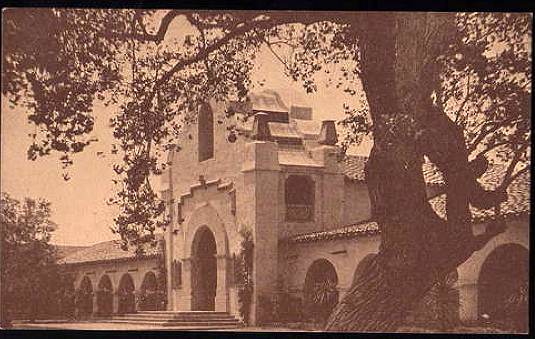
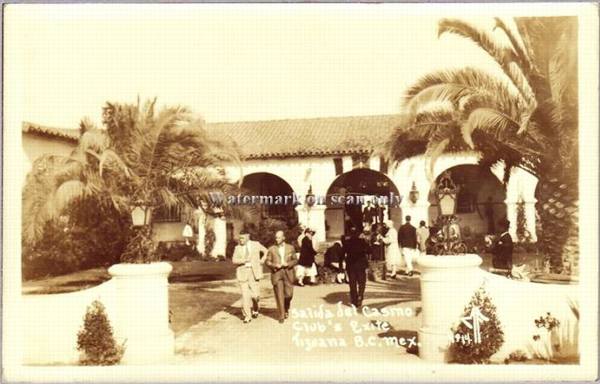
Agua Caliente
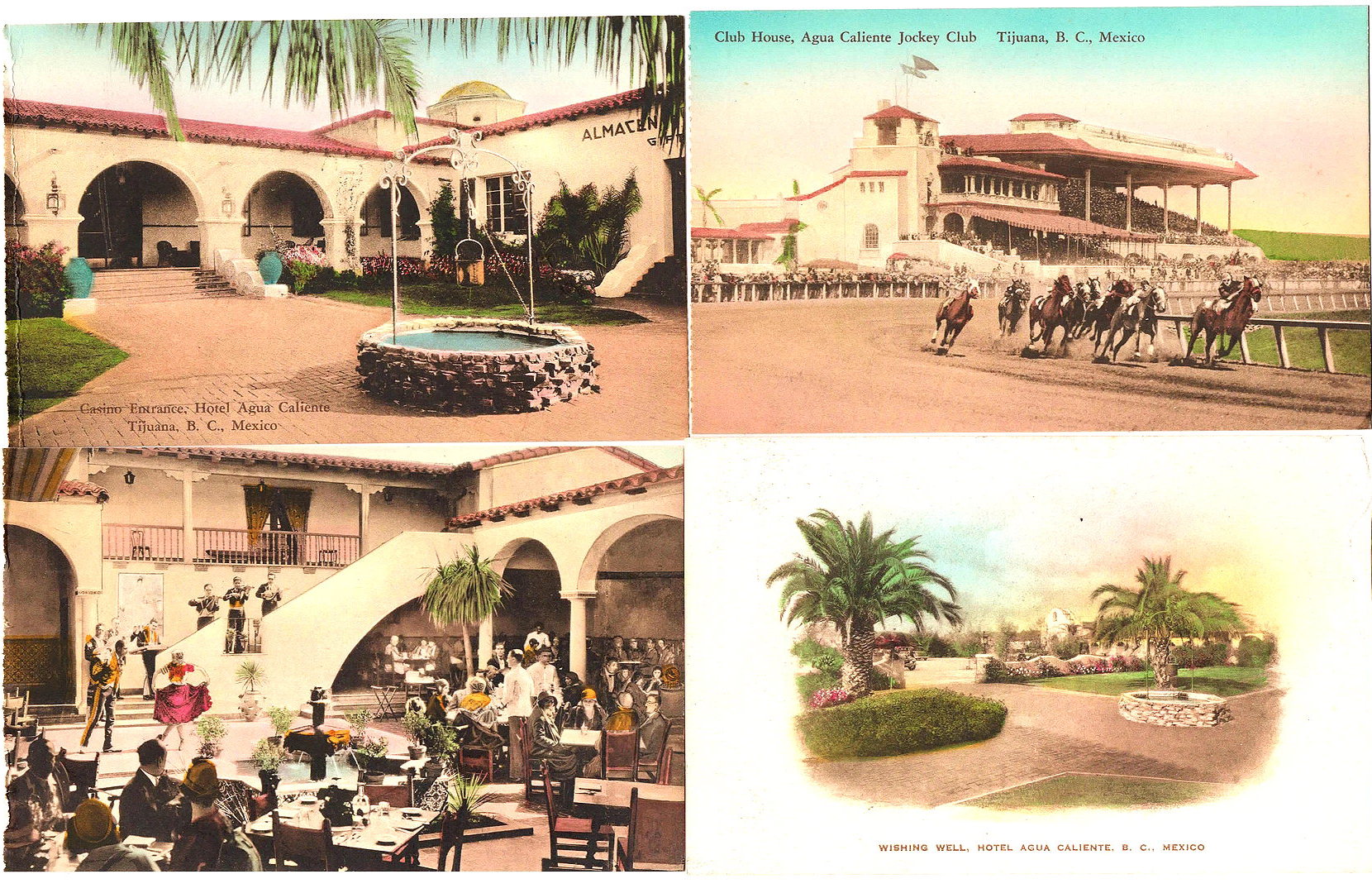
hotel entrance
is shown in the left postcard, and the casino
entrance is shown in
the right postcard. They were separate
buildings at the resort (as shown on
the sketch maps just below and in Part E on this page).
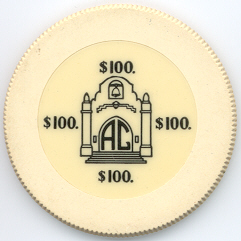
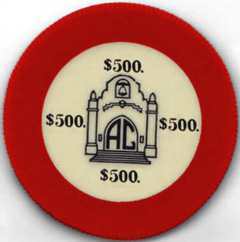
Note that it is the gothic Mission-style
structure of the hotel entrance
that adorns the crest and seal casino chips,
as pictured above on three chips.
|
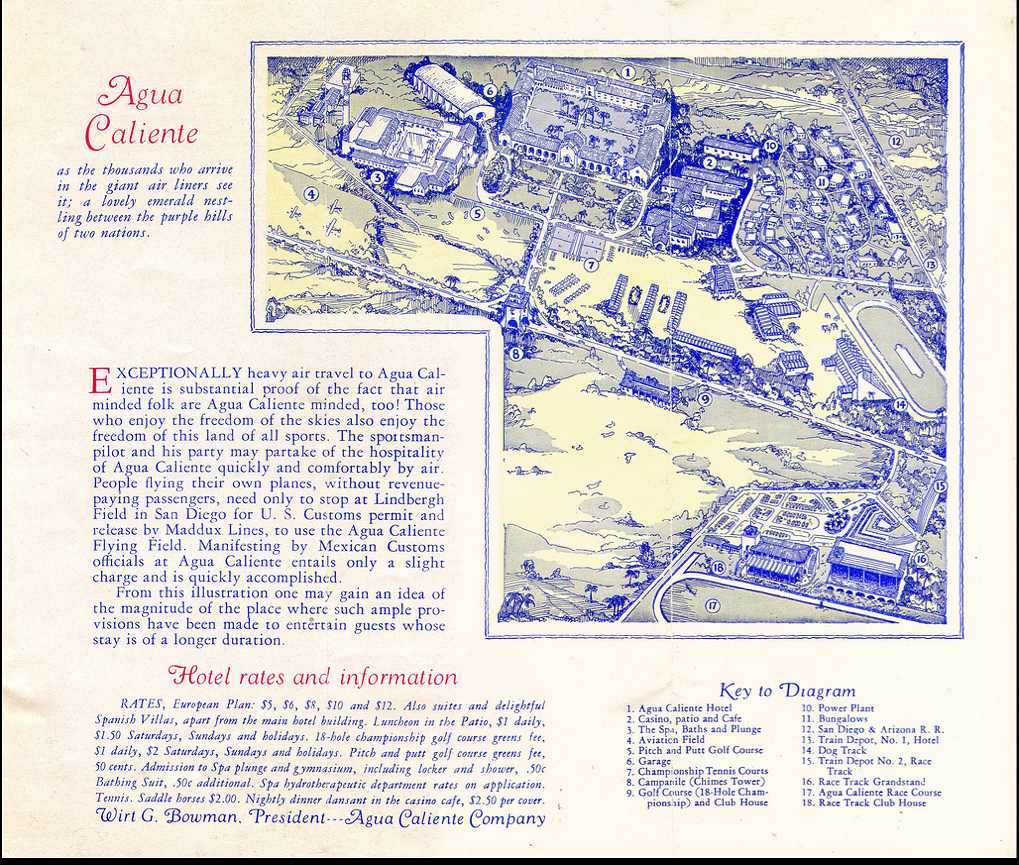
The best sketch layout map of the
resort is below -- click
here to see it.
BRIEF HISTORY OF AGUA CALIENTE:
"From 1919 to 1933, alcohol, casinos, prostitution, narcotics
and horse race betting were all forbidden or tightly
restricted in California, and all were easily available
in Tijuana, Mexico. The Agua Caliente casino-hotel resort
was opened in Tijuana in 1928. It lay only six miles south of
the border, less than 20 miles from San Diego, accessible
by train, a one hour plane ride from Los Angeles. It
covered 655 acres and cost about $10 million at the time.
It became the most lavish and popular resort in the Western Hemisphere,
a vacation destination for the Hollywood elite, other celebrities
and ordinary Americans. The place had everything, and everything
was first-rate: 500-room hotel, extensive casino, the richest golf
and horse-racing prizes in the world, health spa, hot springs, an "olympic
size" swimming pool, health clinics, golf putting course, horseback riding,
deep sea fishing, wild game hunting, horse racing and greyhound race tracks,
gardens and tropical aviary, bungalows, private radio station, airport
facility and railroad link. All this came to an end with the
legalization of casino gambling in Nevada in 1931; the repeal in
1933 of Prohibition's 18th Amendment in the U.S.; the legalization
of pari-mutuel wagering at California racetracks in 1933 and
the building of the lavish Santa Anita racetrack in 1934;
and, finally and most important, the criminalization of gambling
in Mexico in 1935."
|
PART B: the Chips Issued by Agua
Caliente
B1: Chip orders from the U. S. Playing
Card Co. ( of Cincinnati, Ohio, who manufactured
and sold
these chips) to Agua Caliente in Tijuana, Mexico.
(Shown below are actual chips,
which were holed
and stitched to the page. The
white labels show who
ordered the chips, where they
were shipped to, the date of the order,
and sometimes
the quantities ordered. Not
every chip in an order
was shown. I have not scanned every re-order page I
have of these chips. And the USPC Co. pages show only sample orders,
so
they are not necessarily complete. The
Baja California Co. was the name under which the
Agua Caliente enterprise was legally incorporated.
These shipping records
were kept in the U S Playing Card Co's. museum in
Cincinnati.)
The records below are in chronological
order.
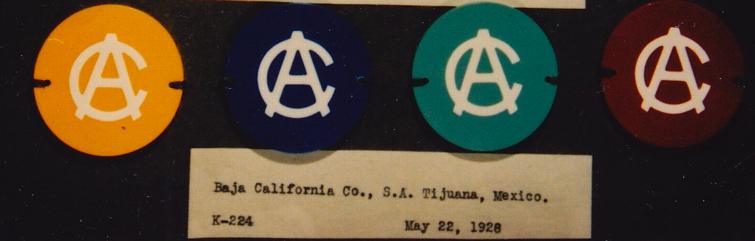
May 22, 1928 ~ Baja Calif Co ~ no-table-number AC
(Agua Caliente) roulette chips
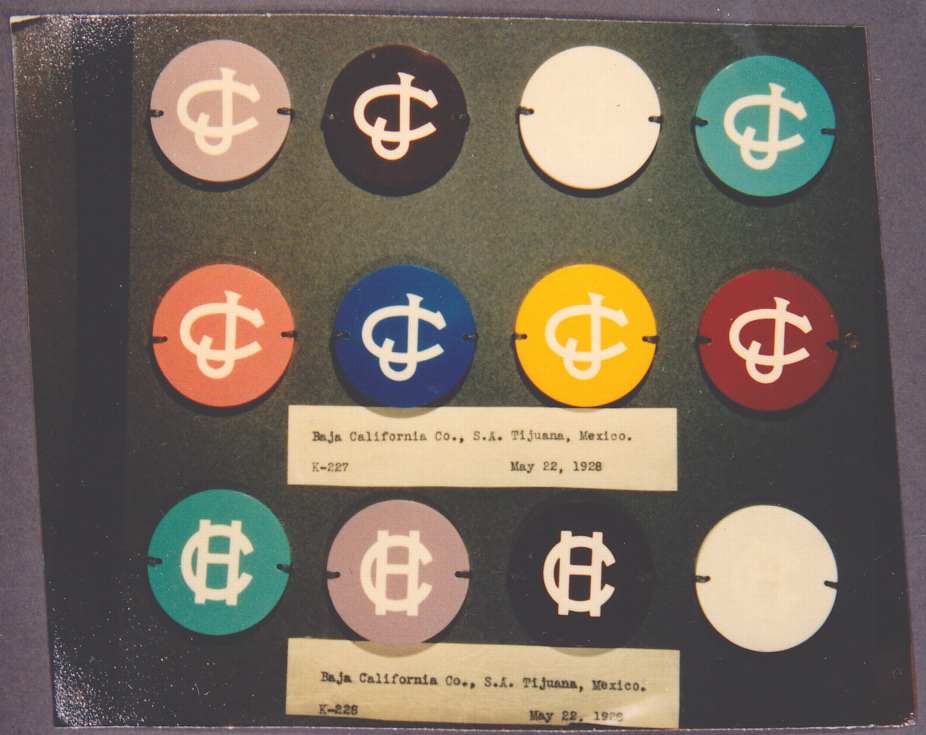
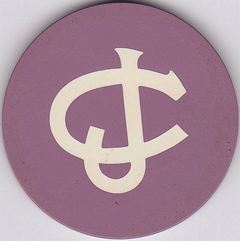
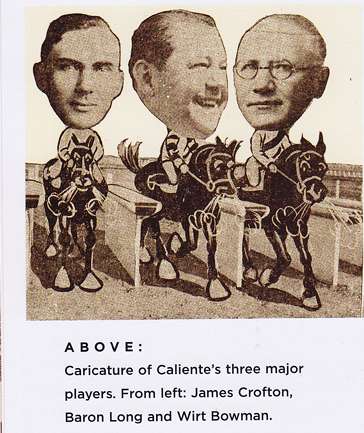
May 22, 1928 ~ Baja Calif Co ~ JC (owner James Crofton)
and CH (unidentified). Crofton ran the gambling
of the Foreign Club,
an older
gambling hall in Tijuana.
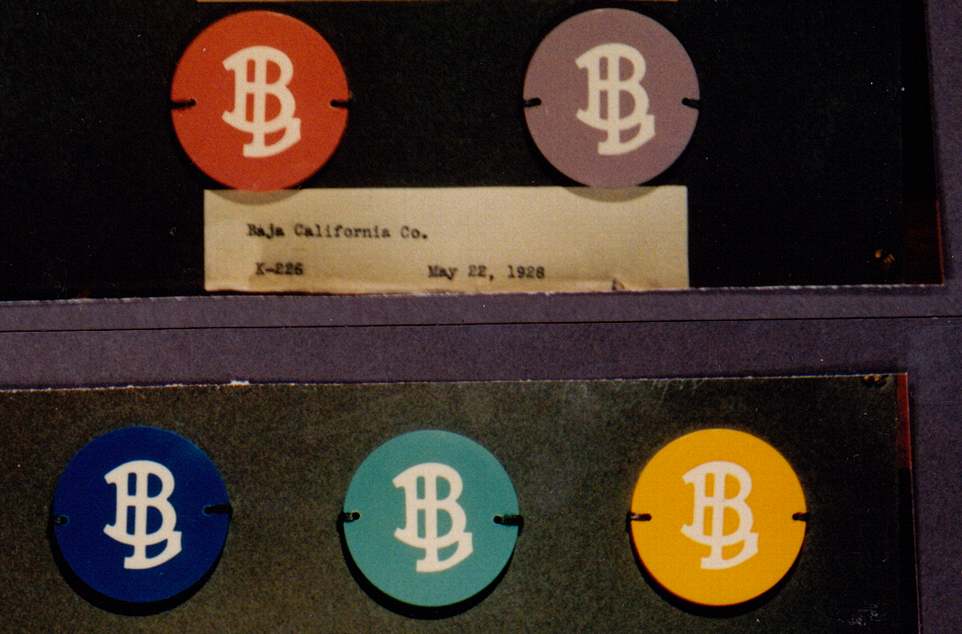
May 22, 1928 ~ Baja Calif Co ~ BL (owner Baron Long).
Long came to Los Angeles as a fight promoter,
and then
invested in many restaurants and night spots including: nightclubs (eg., Vernon Country Club, Vernon CA), boxing arenas,
major hotels (egs, U.S. Grant in San Diego,Biltmore in Los Angeles), the Monte Carlo in Mexico, and of course
was a partner in the $10 million Agua Caliente hotel, casino, and racetrack resort in Tijuana.
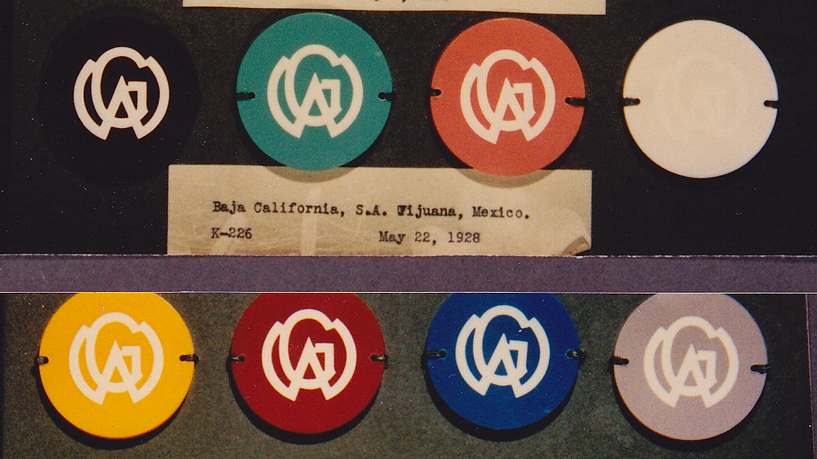
May 22, 1928 ~ Baja Calif ~ WG (owner Wirt G. Bowman).
Bowman owned and operated the Foreign (gambling)
Club in
Tijuana,
a rancher in Mogales, Mexico, and a banker in Nogales,
Arizona, and was the primary financier
for American
projects in Mexico.
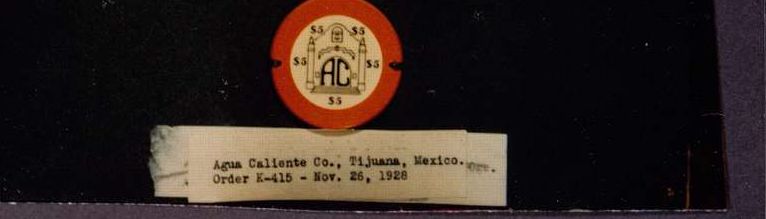
November 26, 1928 ~ Agua Caliente Co ~ $5 chips
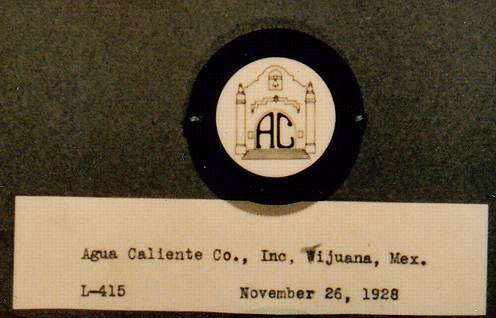
November 26, 1928 ~ Agua Caliente Co. ~ No-denomination
chip
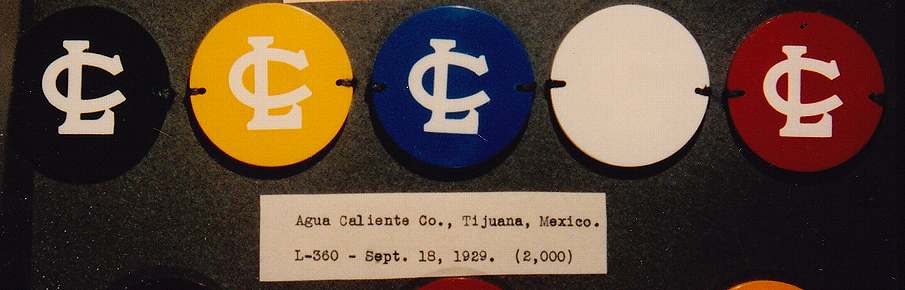
September
18, 1929 ~ Agua Caliente Co. ~ CL (or LC)
chips unknown ID
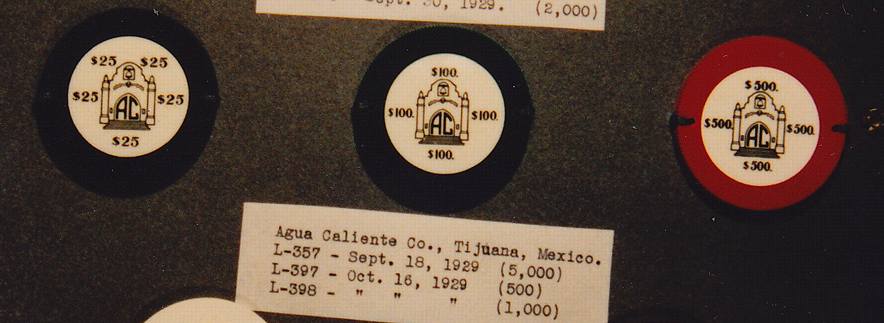
Sept 18, 1929 and Oct 16, 1929 ~ Agua Caliente
Co ~ $25, $100 and $500 chips
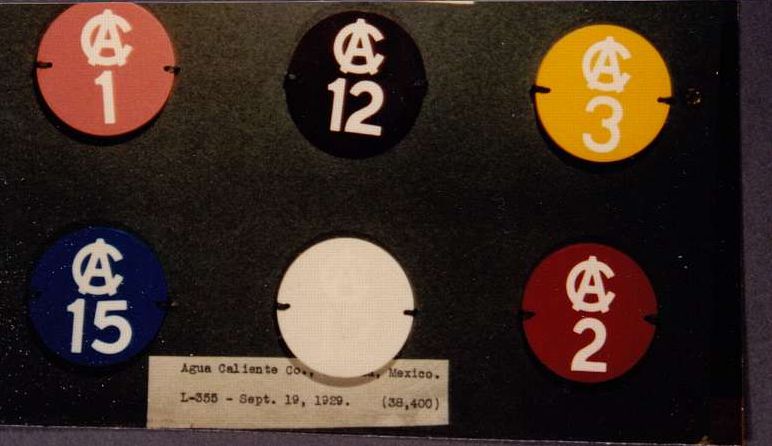
Sept 19, 1929 ~ Agua Caliente Co ~ table number
AC roulette chips
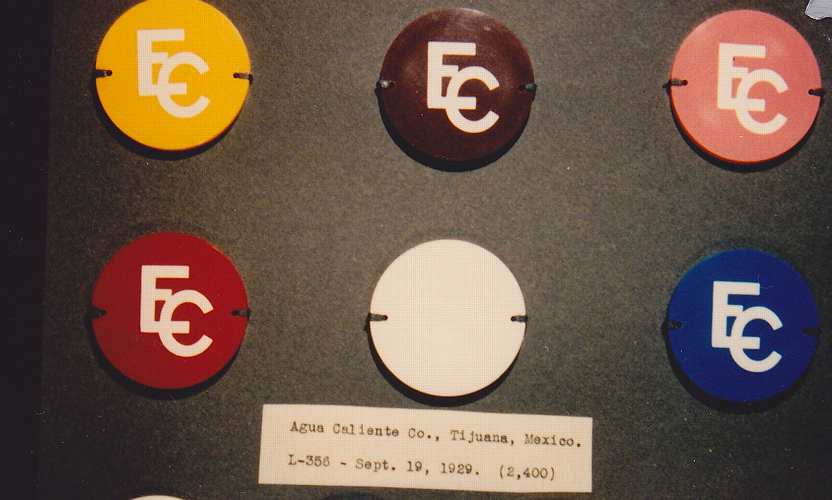
Sept 19, 1929 ~ Agua Caliente Co ~ EC chips (unidentified
B2: All
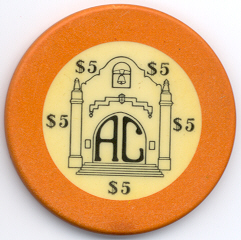
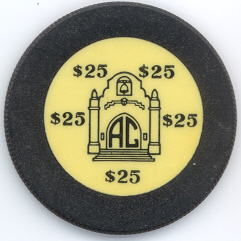
Known Agua Caliente Casino and Roulette Chips
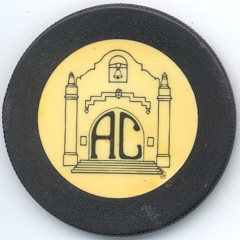
casino chips
|
|
|
|

|
|
no image
|
no image
|
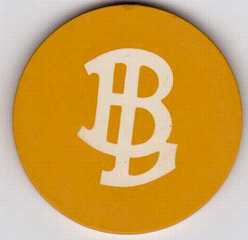
Owners' chips: Baron Long
|

James Crofton
|
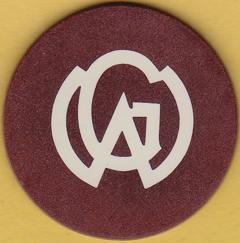
Wirt G. Bowman
|
|
roulette chips
|
|
|
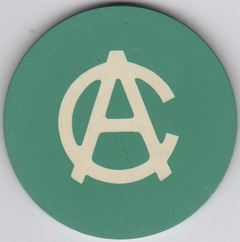
light green
|
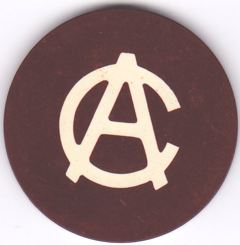
dark brown
|
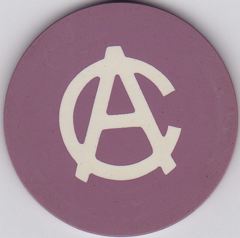
|
no image
|
no image
|
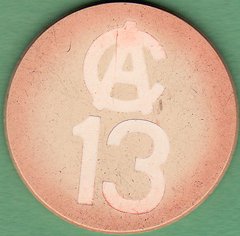
roulette chip (table 13)
|
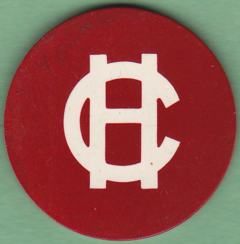
unknown identification; ordered
same date and place as Agua Caliente chips (see
below)
|
no image
|
no image
|
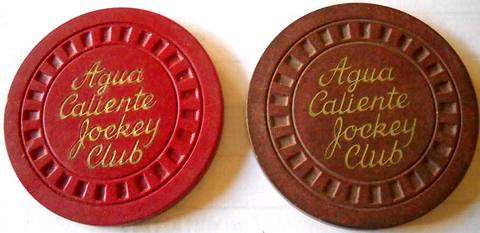
Used at the Jockey Club at the
Agua Caliente racetrack, owned by the Agua Caliente Hotel-Casino
|
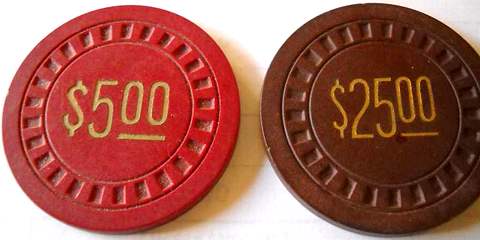
Reverse sides of the chips
|
� Thanks for the scans: Roy
Klein, $500 one; Richard
Hanover, the first five; Me, the
others!
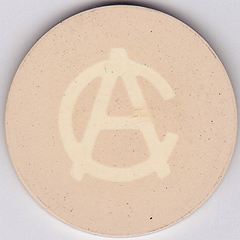
� The above AC chips (with no table number),
are a recent identification; the
USPC Co records show it was ordered by
Baja California Co, S.A. [owners of Agua Caliente],
Tijuana, Mexico in 1928. Part of USPC Co order
page is pictured near top of this page in Part B.
� The AC13 roulette chip, I show because
it is missing from picture below.
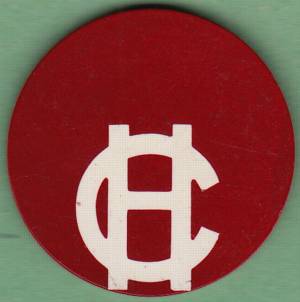
� The CH (or HC) chip is a mystery as to ID,
but is probably related to Agua Caliente as it was ordered
on the same date (May 22, 1928)
and to the same place ( Baja California
Co, S.A. , Tijuana) as the other Agua Caliente
chips. The USPC Co. order card
is pictured near the top of this page in Part B. (Click
here
to see the manufacturing error on the reverse side this particular CH chip
of mine.)
� The WG (or GW) chip is determined to be the
personal poker chip of the third "Border Baron," Wirt
G. Bowman. See the USPC Co order card near the top
of this page.
It was also ordered on the same date (May 22, 1928)
and to the same place ( Baja California
Co, S.A. , Tijuana) as the chips to the other
two"Border Barons,"
James Crofton (JC) and Baron Long (BL). Esteemed
Agua Calient collectors have confirmed this
attribution to Bowman.
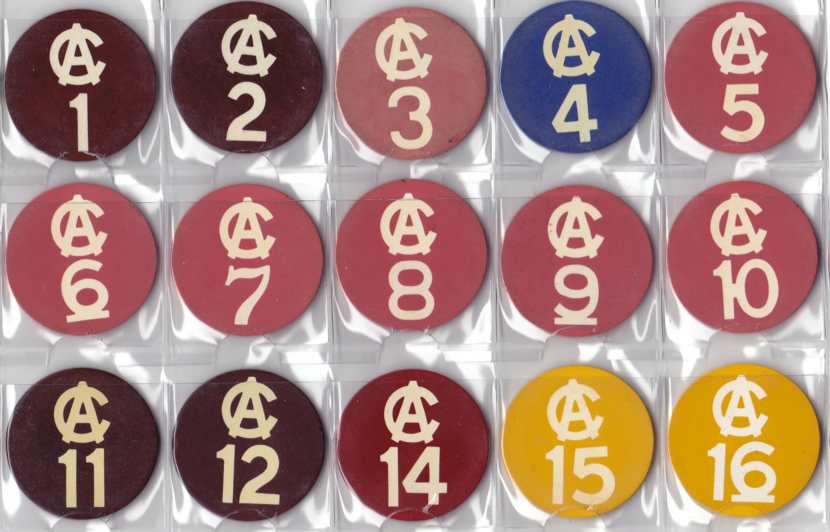
roulette chips w/ table numbers -- Roy Klein's
roulette chips.
PART C: the Agua Caliente chips I
have
for Sale, Need and have
for Trade
C1: Agua
Caliente Chips I have for Sale or Trade
Picture
120 pixel
|
Name of Chip
|
Description
|
Sales
Price
|
|
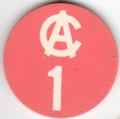
Agua Caliente, Tijuana, Baja
California, Mexico
roulette chip, table
#1
|
� pink
� fine condition
� 1929, shipped to Agua Caliente Co,
Tijuana, Mexico.
Note the USPC Co shipping-sample
record above.
� large, famous hotel-casino-race
track resort, frequented
by the elite of Hollywood. Opened 1928;
closed 1935, when gambling was outlawed
in Mexico. Prospered
largely because drinking
and gambling was outlawed
in the US during Prohibition, and
Tijuana was just a stone's throw from
the US-Mexico border, so very close
to San Diego by car and Los Angeles by air.
The Agua Caliente resort remarkably had
the world's richest golf tournament prizes
and the richest racehorse purses in the
world. It was the most lavish resort
in the Western US, and rivaled the best in the
world (gardens, health spa, Olympic swimming
pool, hot springs, etc). The resort also had
its own private radio station and airport facility
[and railroad link]. It's guests were among
the most famous and rich celebrities in the world.
No exaggeration!
|
$35
|
|
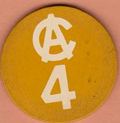
Agua Caliente, Tijuana, Baja
California, Mexico
roulette chip, table
#4
|
� yellow
� fine condition.
|
$40
|
|
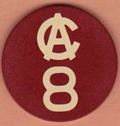
Agua Caliente, Tijuana, Baja
California, Mexico,
roulette chip, table
#8
|
� red
� fine conditon.
|
$30
|
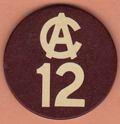
|
Agua Caliente, Tijuana, Baja
California, Mexico,
roulette chip, table
#12
|
� brown
� one
chip is fine on one side, and small burn mark on other
side.
� one chip
has a small burn mark one one side, other side is
fine except for very tiny nick on one edge spot.
|
$30
|

|
Agua Caliente, Tijuana, Baja
California, Mexico.
roulette chip, table
#14
|
� red
� fine condition
|
$40
|
|
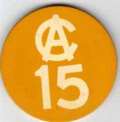
Agua Caliente, Tijuana, Baja
California, Mexico,
roulette chip, table
#15
|
� yellow roulette chip for
table #15.
� 1929, shipped to Agua Caliente Co,
Tijuana, Mexico.
Note the USPC Co shipping-sample
record above.
|
$35
|
|
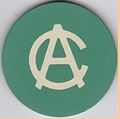
Agua Caliente roulette chip (no-table-number)
- green
SOLD
|
� green. This is my last one.
� as the USPC Co. order-sample cards above testify,
these were part of the same original May 22, 1928
order to Baja California Co., Tijuana, Mexico.
SOLD
|
$75
SOLD
|
|
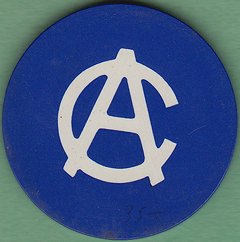
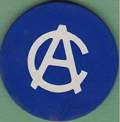
Agua Caliente roulette chip (no-table-number)-
blue
|
� blue
� as the USPC Co. order-sample cards above testify,
these were part of the same original May 22, 1928
order to Baja California Co., Tijuana, Mexico.
|
$45
|
|
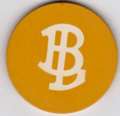
BL -- Personal chip of one of the owners
of the famous Agua Caliente
Hotel Casino, Tijuana, Baja
California, Mexico --
Baron Long
|
� yellow, only 9 chips left.
� shipped to the Baja California Co.,
Tijuana,
Mexico, May 22, 1928, the very
same date, and the adjoining
invoice number, as the JC chips.
� This BL chip, and the CJ chip below,
are two
of my most awesome discoveries!
The BL chip was the private
chip of one of the famous three "Border
Barons" who built, owned and ran
the Agua Caliente, Tijuana, Hotel-Casino
-- Baron Long. He was a prominent hotel-night
club owner in the U.S. as well, as evidenced
by this match
book cover.
(That was his birth name! Probably
why the three owners were called
"The Border Barons." The term
was applied just to the three owners of
the Agua Caliente. The third one was
Wirt G. Bowman; no personal chips
found for him.) Very lengthy biographical article on
Baron Long here.
� The US Playing Card Co. records
(pictured above) show
that both
chips (BL and JC) were shipped
on May 22, 1928 to the Baja
California Co., Tijuana, Mexico,
which was owned by the
"Border Barons." (The "Border Barons"
were the three men who built, owned and ran
Agua Caliente in Tijuana and lesser gambling
establishments along the California-Mexico
border in the 1920's-30's.
Two of them were James Crofton ("JC"
chip) and Baron Long ("BL" chip)).
Prof. Paul Vanderwood, the author
of "Satan's Playground:
Mobsters and Movie Stars
at America's Greatest Gaming
Resort [Agua Caliente]" (the book
is available at Amazon.com), has
written me and confirmed that the
JC- and BL-initial chips were
personal chips of the two Border
Barons. He says,
"The Baja California Co. would be the name under which
the Agua Caliente enterprise was legally incorporated. ... ... The
Border Barons founded and incorporated the Baja California Co. ...
... On the chips, "JC" is most definitely the baron, James Crofton,
who was in charge of the casino operation at the spa. "BL" was Baron
Long [his birth name!], also one of the entrepreneurs.... ...
Both men were vain promoters beyond belief. And they did hold big stake,
poker games for friends and
others in their homes. Or, as I said,
they organized and clandestinely
staged illegal games on the U.S. side--clandestinely,
ha. They paid law enforcement
a nice sum to look the other way."
|
$95
|
|
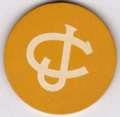
JC -- Personal
chip of James
Crofton, one of the three
"Border Barons," owners of
Agua Caliente
|
� yellow and a lavender chip.
For both only 1 chip left.
� shipped to the Baja California Co,
Tijuana, Mexico, May
22, 1928, the very same date,
and the adjoining invoice number,
as the BL chip above.
� This was the the private chip of
one of the famous three
"Border Barons" who built, owned
and ran the Agua Caliente, Tijuana,
Hotel-Casino -- James Crofton.
See what is written above
for the BL chip. Also be sure
to note, above, the picture of the
USPC Co. records for this JC chip.
� Note: I found only about a dozen
of each chip --BL's
and JC's -- in July 2010.
|
$149
|
|
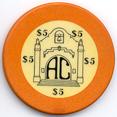
$5 Agua Caliente casino
chip
sold
|
� the $5 orange-yellow pictured
here.
� large, famous hotel-casino resort, frequented
by the elite of Hollywood.
Opened 1928; closed 1935......shipped
to Agua Caliente Co., Tijuana, Mexico,
Nov. 26, 1928 (see US Playing Card Co. shipping
record in picture above).
|
$30
sold
|
|
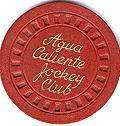
$5 Agua Caliente Jockey
Club
|
� "Agua Caliente Jockey Club,"
on one side; "$5.00" on the reverse. Red chip.
� good used condition
� the Jockey Club, a gambling venue, was owned
and run by the Agua Caliente Hotel-Casino complex.
It was attached to the Jockey Club building,
which was next to the Grandstand at the famous Agua
Caliente Racetrack.
|
$29
|
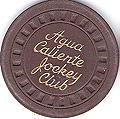
|
$25 Agua Caliente Jockey
Club |
� "Agua Caliente Jockey Club" on one side; $25.00 on the reverse. Brown chip.
� good used condition.
|
$35
|
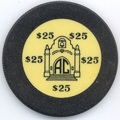
|
$25 Agua Caliente
casino chip
|
� $25 black
� fine condition.
� see US Playing Card Co. shipping record
picture above, showing 1929 date.
|
$50
|
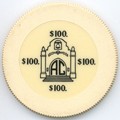
|
$100 white Agua Caliente
casino chip
|
� $100 white
� excel condition
� 1929, per USPC Co. shipping records.
|
$145
|
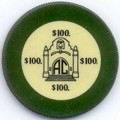
|
$100 green Caliente
casino chip
sold
|
� $100 green
� excel condition
� 1929, per USPC Co. shipping records,
sold
|
$125
sold
|
|
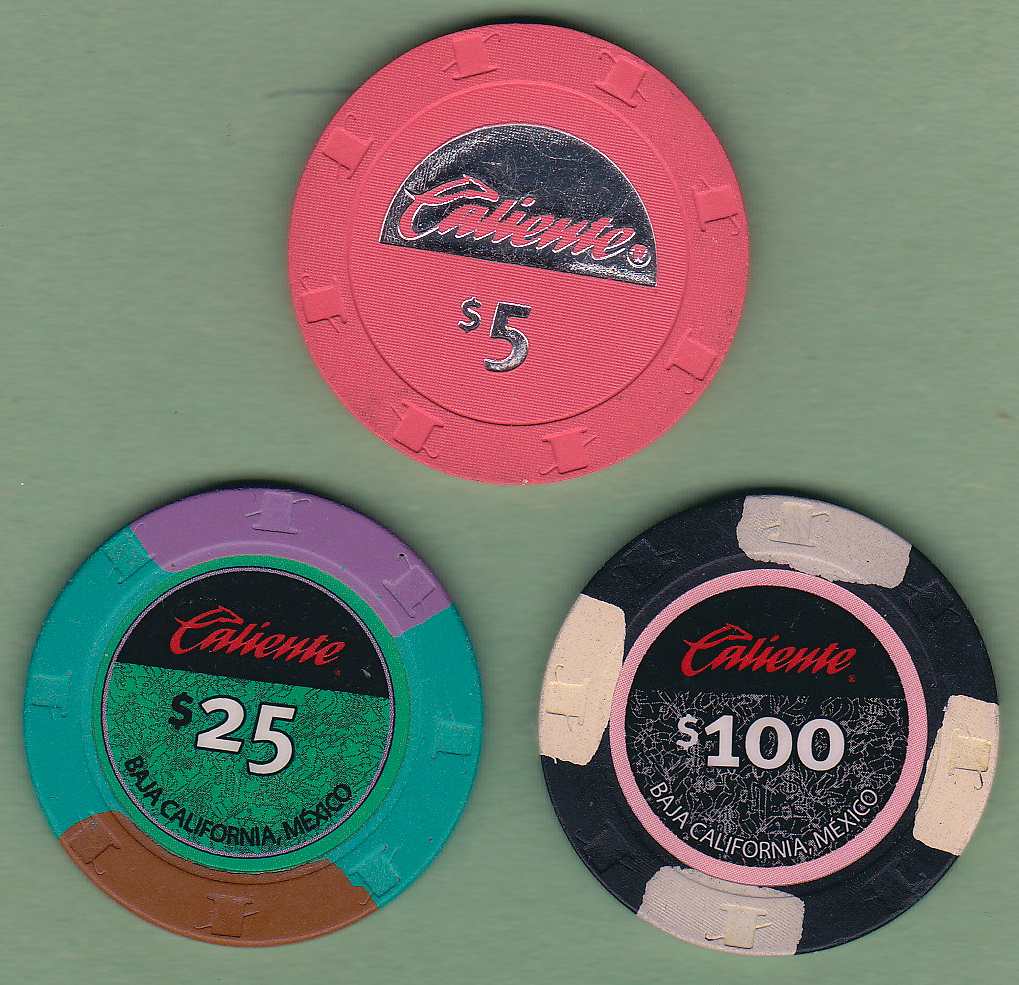
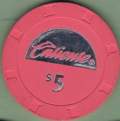
$5 (actually 5 pesos) Caliente
modern casino chip
|
� $5 casino chip issued by the Caliente
Co, which owns a chain of combined sports betting parlors-bingo halls-gaming
machine arcades throughout Mexico, the main one being at site of the old
Agua Caliente Racetrack in Tijuana, from which the company gets its name.
Live table gambling games are supposed to be outlawed, but through bribes
and what not, there is actual roulette and other such games on the premises,
which is where these chips came from -- mailed to me by a Mexican resident..
� Although the chips have a dollar sign on them, they are actually
in Mexican pesos, sold that way at the casino cage. For example, a
$100 chip will cost you 100 pesos, about $10 in US money.
� Links to the Caliente Co home page and the Caliente Chip Guide
page: here,
here,
and here.
� Link to my web page about the Agua Caliente and Tijuana racetracks
over the years (just dog races now) and gambling in Mexico over the years,
look at Section three on this
page.
|
$6
|
|
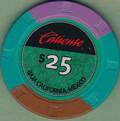
$25 (actually 25 pesos) Caliente
modern casino chip
|
� Same story as above for the $5 Caliente
chip.
� the $5 and $25 chips say "Baja California, Mexico" under the
dollar amount. Both have inlays. The $5 chip is "hot-stamped."
� large
picture of the three Caliente chips.
|
$8
|
|
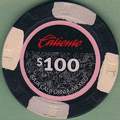
$100 (actually 100 pesos) Caliente
modern casino chip
|
� Same story as above for the $5 Caliente
chip.
� the $5 and $25 chips say "Baja California, Mexico" under the
dollar amount.
Both have inlays. The $5 chip is "hot-stamped."
|
$17
|
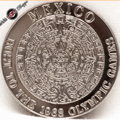
|
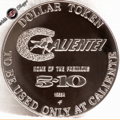
$1 Caliente Token,
1968 slot token
|
� Slot token to be used at the Agua Caliente Racetrack.
$1 PROOF-LIKE SLOT TOKEN AGUA CALIENTE CASINO 1966 FM MEXICO 1968
OLYMPICS COIN. Agua Caliente Racetrack one dollar slot token (both sides
shown), made by Franklin Mint in 1966 to commemorate the upcoming
Summer Olympics to be held in Mexico City in 1968, the first such games
held in a Spanish-speaking country. Aztec Indian design on reverse
side.
� Mint condition. Click here to see a larger picture.
|
$12
|
C2: Agua
Caliente Chips I Need
(mainly any chip from roulette
tables 5 and 9; and the $500
chip, seen just below)
I already have these chips from
Agua Caliente, so I need what you do not
see on the list:
Agua Caliente casino chips:
No Denomination,
black
$5 orange
$25 black
$100 white
$100 green
$500 red
Agua Caliente roulette chips (numbered):
table #1 -- pink
table #2 -- pink, yellow
table #3 -- pink, brown
table #4 -- yellow, pink, white
table #5
table #6 -- pink
table #7 -- yellow, blue
table #8 -- pink, red
table #9
table #10 -- brown (poor condition)
table #11 -- brown
table #12 -- brown
table #13 -- white
table #14 -- pink, red, blue
table #15 -- yellow, brown
table #16 -- blue, brown, yellow
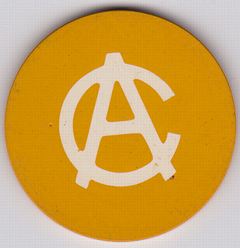
AC roulette (no number, just AC):
yellow,
blue, brown, white, green, lavender
Agua Caliente Jockey Club:
$5 red
$25 brown
Owners' initials chips:
JC in yellow and
purple
BL in yellow
WG in brown
CH in red.
|
PART D: History and Facts about
Agua Caliente
(You are in for a real
treat if you click the YouTube video links
near the bottom of the box just below.
You'll see two clips from the "In Caliente"
musical comedy movie and Phar Lap's most
famous horse race, the 1932 Agua Caliente Handicap.)
Two recent books I recommend about Agua Caliente:
� "Satan�s
Playground: Mobsters and Movie Stars
at America�s Greatest Gaming
Resort," by Paul J.
Vanderwood (available at Amazon.com): "Satan�s
Playground [Agua Caliente environs]
is the extraordinary story of clever and
unscrupulous bordello, casino, race track
and cabaret owners nicknamed Border Barons
who under the pressure of 1920s Prohibition
[and anti-gambling laws in California, even
at racetracks] reestablished themselves
in bawdy Mexican border towns like Tijuana.
There American high and low society relished
their offerings, and the Barons became celebrated,
multi- millionaires.
The gem in the Barons� crown was an elegant
gambling spa known as Agua Caliente,
heralded as the Monte
Carlo and Deauville of the Western
Hemisphere. Movie czars and
stars, sports notables, diplomats,
maharajas, ranking politicians
and famous aristocrats mingled there
in luxurious surroundings along with
more ordinary patrons anxious to see and
be seen with such luminaries. Mobsters also
dropped in on the scene. Bugsy Siegel visited
and imagined a similar plush resort
on what became the Las Vegas Strip." All
this came to an end with the repeal of Prohibition
and the relaxing of gambling at California
racetracks, the development of gambling in
Nevada, and, finally, the criminalization
of gambling in Mexico in 1935."
� "Rousing Tales From The Line City," by Jose Ramon Garcia:
book tells the story of the building of the Agua Caliente resort
through the biographies of Writ G. Bowman (banker, investor) and
Abelardo L. Rodriguez (military governor of northern Baja California,
which included Tijuana; and later President of Mexico), two
of the "Four Border Barons" who founded, developed and owned the
resort. You may buy the book at Amazon here. Or, for $24 total (includes postage to U.S.) you can buy an autographed book from the author: click here to email him.
From the Journal of San Diego History
is this lengthy historical article "The Wild Frontier
Moves South -- U.S. Entrepreneurs and the Growth of Tijuana's
Vice Industry, 1908-1935" here.
Agua Caliente Historical Society
(http://aguacalientehistoricalsociety.com/agua_caliente_1929-1935):
"The Agua Caliente racetrack (1929-1935) was built at a cost
of $2-million,
a huge amount at that time.
At the first race meet, Agua Caliente
hosted the world's richest race,
the $140,000 Agua Caliente Handicap, won
by 1928 Preakness winner, Victorian."
Wikipedia: "The Agua Caliente Casino
and Resort opened
in June 1928 in the Mexican city
of Tijuana, Baja California. It was
a lavish resort that included a casino,
[world famous health] spa, championship
golf and tennis facilities, its own airstrip,
and lots of entertainment. Stylistically,
the resort was an amalgam of Mexican colonial,
California mission, and neo-Islamic
designs that ranged from mosaic minarets,
to cozy guest bungalows, to steaming Turkish
baths. It was designed by 19-year-old architect
Wayne McAllister and built by Baron H. Long, Wirt
G. Bowman and James N. Crofton [, the famous "Border
Barons"]. Some sources note the fourth partner
was Abelardo L. Rodr�guez, Military Commander
and Governor of Baja California, and future Mexican
President. The $2.5 million Agua Caliente racetrack
opened in December 1929.
Drinking, gambling and horse racing were
illegal in the neighboring
U.S. state of California, so many
wealthy Americans and Hollywood celebrities
flocked to Agua Caliente. The actress
Rita Hayworth was discovered
there while performing in a show. The films
"In Caliente" and "The Champ"
were filmed on location there. The highlight
of the opulent casino was the Gold Room
[pictured above], where patrons could
only bet using gold chips, with a rumored $500
minimum wager. Bugsy Siegel cited Agua Caliente
as his inspiration for building the resort
on what became the Las Vegas Strip."
Lawrence D. Taylor in the Journal
of San Diego History
(https://www.sandiegohistory.org/journal/2002-3/frontier.htm):
"The Agua Caliente resort cost approximately $10,000,000,
an enormous
sum of money for that
period. The first stage of the project
comprised a 500 room hotel,
casino, health spa, and caf�, inaugurated
on June 23, 1928. The second stage
consisted of an "olympic size" swimming
pool, health clinics, 18 hole golf course,
putting course, horse racing and greyhound
race tracks, gardens and tropical aviary, bungalows,
laundry, and workshop areas completed
at the end of December 1929. The resort also had
its own private radio station and airport facility
[and railroad link]. "
Time Magazine's Sports section,
Jan. 4, 1932: "Four hours by car,
an hour and a half by plane from
Hollywood, Agua Caliente
is the most elaborate pleasure
resort in North America. .. ....
Agua Caliente's golf tournament�first prize
$15,000�is
the richest in the world.
Even more of an attraction
than these for Hollywood plutocrats
has been the racetrack, which was
constructed at a cost of $2,500,000 by
removing part of a mountain. The Annual
Agua Caliente Handicap, which
was to have been run on March 20 and for which
the great Australian horse Pharlap
was entered this year, is the richest�$150,000
�horse race in the world." [The Agua
Caliente track was the site of several industry
firsts, including starting gates, safety helmets,
and �pick six� wagering.]
aguacalientehistoricalsociety (http://aguacalientehistoricalsociety.com/agua_caliente_1929-1935):
"The rich Agua Caliente
Handicap lured the famous New
Zealander, Phar Lap for its 1932
renewal. Phar Lap made the 12,000-mile
journey from Australia to the
United States earlier that year. Phar
Lap ran into the history books as one
of racing's top horses with his dramatic
win, as he circled the entire field from
dead last with ��s of a mile to go and
held off American Derby winner, Reveille Boy.
" [Click here to see a newsreel
of that famous race at the Agua
Caliente Racetrack, courtesy of YouTube!
]
Movies filmed on location at Agua Caliente: click
here
(or here) to
see the trailer to the Pat O'Brien-Dolores
del Rio-Busby Berkeley Hollywood
movie "In Caliente" (1935), which was filmed
on location at the Agua Caliente and
shows a brief scene of the casino near the start
of the trailer. .... ... Another clip from the
movie -- great fun but not of the Agua Caliente casino,
for sure! -- Dolores del Rio's energetic "Muchacha" number,
a' la Busby Berkeley. It must be a stage show within
the movie: click here and
enjoy! (Clicking that link lands you on a page where
you choose
one of two video clips: scenes from the Dolores
del Rio "Muchacha" number in the
1935 movie "In Caliente," and Newsreel of the
racehorse Phar Lap winning the Auga Caliente
Handicap.) (Or click here
for the Dolores del Rio clip.)...
... Or click
here for 13 minutes of pure music video from the movie of
Musical Interludes from "In Caliente," 1935, with Phil Regan, The
De Marcos and Winifred Shaw (but no Dolores del Rio) featuring the
songs "To Call You My Own" and "The Lady In Red" .... Here is another
YouTube clip: good
first few minutes of still pictures (ariel
view of the resort; close-ups
of everything including the famous Gold
Bar room), piano music and Spanish words.
I urge you to vamoose at the 3:22 minute mark
to avoid the boring remainder of the clip --
the filling of the resort's Olympic swimming pool!
.. ..... There are a number of YouTube videos about the old resort,
mainly in Spanish, for example here, here, here, here, here, here, and here. I suggest
you go to the YouTube site and use their search
engine to find more videos. ... Here is a particulaly
nice one with plenty of clear photos and music, put on YouTube in 2014.
Unfortunately the pictures are not dated, not identified, and mixed
up and repeated. The same video is at this informative web site. Mucho info here.
Tijuana Tourist site (packed full of
information, maps, pictures
and history) explains it
this way: "By the time prohibition
took effect in 1920, enterprising gringos
had been coming "down" to Tijuana to
get together with other enterprising Mexicans
in order to make money off of other gringos
who more and more were coming to Tijuana not
as "excursionists" looking for Mexican
culture, but as extraterritorial
sinners who wanted to buy, legally, what
was illegal "on the other side" - a process which
had begun with bullfights and gambling,
then advanced into horse-racing and prostitution.
... ... This period coincided almost perfectly with
the "Roaring Twenties," but dragged on into the middle
thirties. Although alcoholic beverages
became legal once again in the United States in 1933,
Tijuana was somewhat insulated against the great
depression by the continuing gambling and horse-racing
activities. At least until 1938 [?], when
casinos were banned by Presidential decree. Between
these two bookend years, the beginning of the
dry law in the States in 1920, and the ending of "legal"
gambling in Tijuana in 1938, this little border
city experienced its "golden age."
|
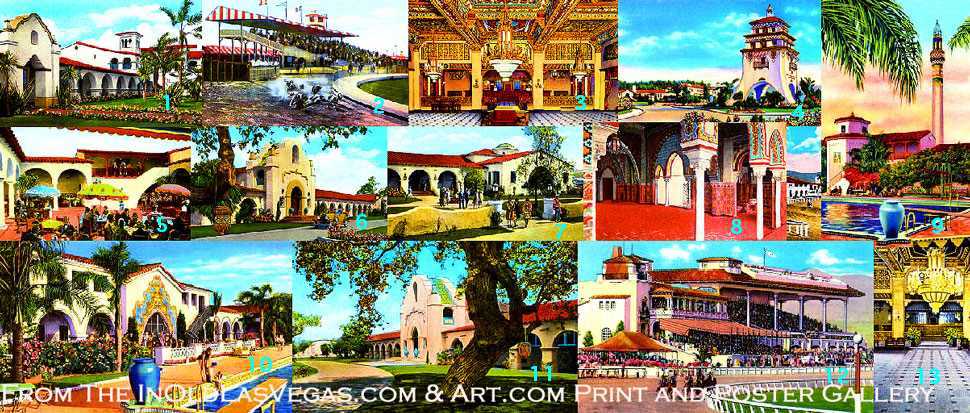
Above collage
is from this great site: inoldlasvegas.com/strip.
All these pictures are from postcards showing Agua Caliente
views. I've numbered them from 1 to 13: (1) "A Corner of the Patio
and Corridor" of the hotel; (2) "Dog Races"; (3) casino "Gold Bar"; (4) "Campanile,
Chimes Tower and Golf Club"; (5) Patio Dining area of the casino where
La Fuento del Estrella (Fountain of the Little Star) is; (6) hotel
entrance; (7) casino entrance; (8) "Swimming Pool;" (9) "Swimming Pool
and Bath House" and Minaret; (10) Bath House and Pool; (11) hotel
entrance, again; (12) racetrack; and (13) "Interior of Casino and
Famous Gold Bar".
Among the interesting things mentioned at
the inoldlasvegas site
are:
� "In 1927, wealthy nightclub owner
Baron Long
and owner of the famous U.S.Grant Hotel
in San Diego, formed a 4 man partnership
to build a giant casino-hotel complex,
named Agua Caliente," less than 20 miles
from San Diego CA.
� "The architect hired to design Agua
Caliente was an astoundingly
young nineteen year old named
Wayne McAllister. After designing Agua
Caliente, McAllister gained fame for
designing nightclubs and restaurants
in Southern California. MacAllister
was the creator of the circular drive-in
restaurants in So Cal such as the 'Pig 'n'
Whistle', Simon's, Herberts, and Van
De Kamps. He also designed Lawry's Restaurant,
the Cinegrill, and the Biltmore Bowl auditorium
(an early location used for the Academy
Award ceremonies). McAllister also designed the
1949 Bob's Big Boy Restaurant and the drive-ins
in its chain. .. .... Most importantly,
Wayne McAllister would later go on to play
an important role in Las Vegas development thru his
knowledge of roadside architecture and casino design.
McAllister would design the first Strip casino-motel
ever built (the El Rancho) in 1940. That same
year he designed Downtown Las vegas' El Cortez
Hotel. In 1949 he created plans for the most modern
casino in Las Vegas (The Desert Inn) and two years later
designed the Sands. In 1955, he was again hired to create
the Downtown Vegas' first high-rise hotel, the Fremont
Hotel and Casino. ... .... Just as Las Vegas took
its name from a watering spring [Meadows], so did Auga
Caliente [hot water (springs)]. ... .... [Agua Caliente]
was a rarity in architectural design for public entertainment.
... [It] opened as the one of the most lavish public
entertainment facilities of its time. Auga Caliente included
a casino, luxurious guest bungalows, a spa, Turkish
baths and two ballrooms, all designed in a combination
of Mexican Colonial, California Mission stylings.
The resort [had] an airstrip, championship golf and tennis
facilities. ... .... Two years after the casino opened,
McAllister designed the $2.5 million dollar Agua Caliente
Racetrack. The racetrack hosted the world's richest
race with its $140,000 grand prize and was known throughout
the world for being the home for some of the most famous
horse races in history with Phar Lap and Sea Biscuit. The
racetrack opened four years before Southern California's Santa
Anita Racetrack and was considered the most important track
in the west. ... ... Auga Calient was a tremendous success
and hugely popular with wealthy Americans and celebrities.
Quite unexpectedly, Mexico's President, L�zaro
C�rdenas, outlawed gambling in 1935.
The resort was closed and became the property of
the Mexican government."
|
PART E: Photos, Single Postcards, Ariel Views,
Souvenir Post Card Folders, and Maps of the Resort
(and links to pictures
on my Second
Agua Caliente Page)
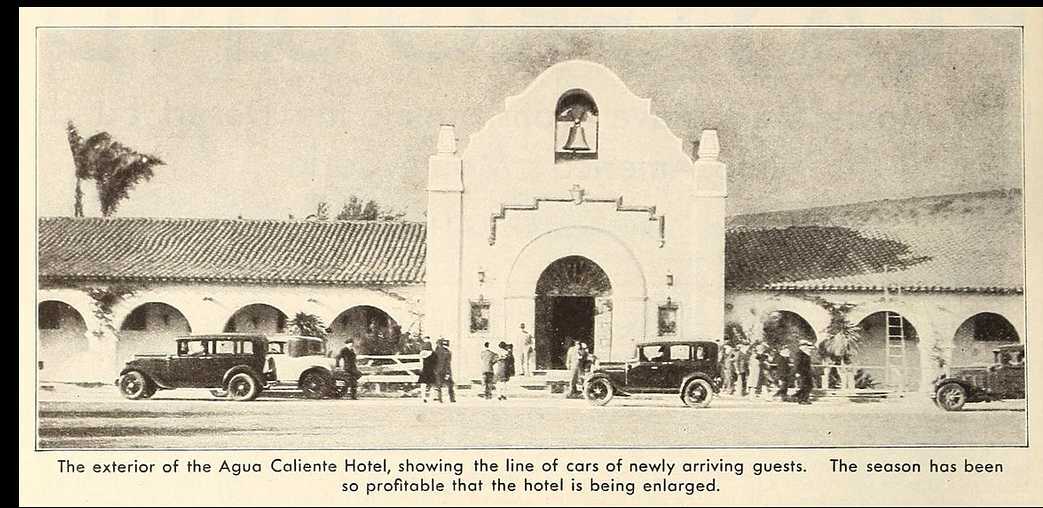
HOTEL: Early Photo of the Agua Caliente
Hotel entrance, 1928 or 1929. More pictures
of the Hotel building at my Seconday Agua Caliente page here.
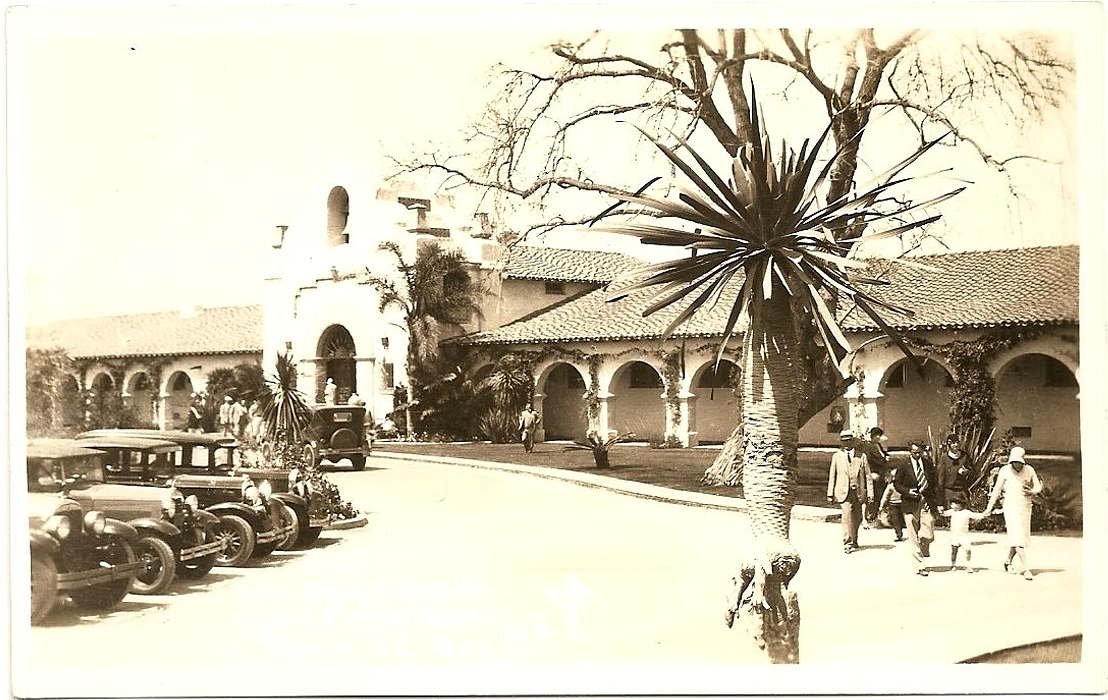
Real Photo
Postcard of the Agua Caliente Hotel
Entrance, c. 1930's.
For another real photo postcard view of the entrance,
but more close-up, click
here.
For pictures
of the Hotel courtyard, click
here.
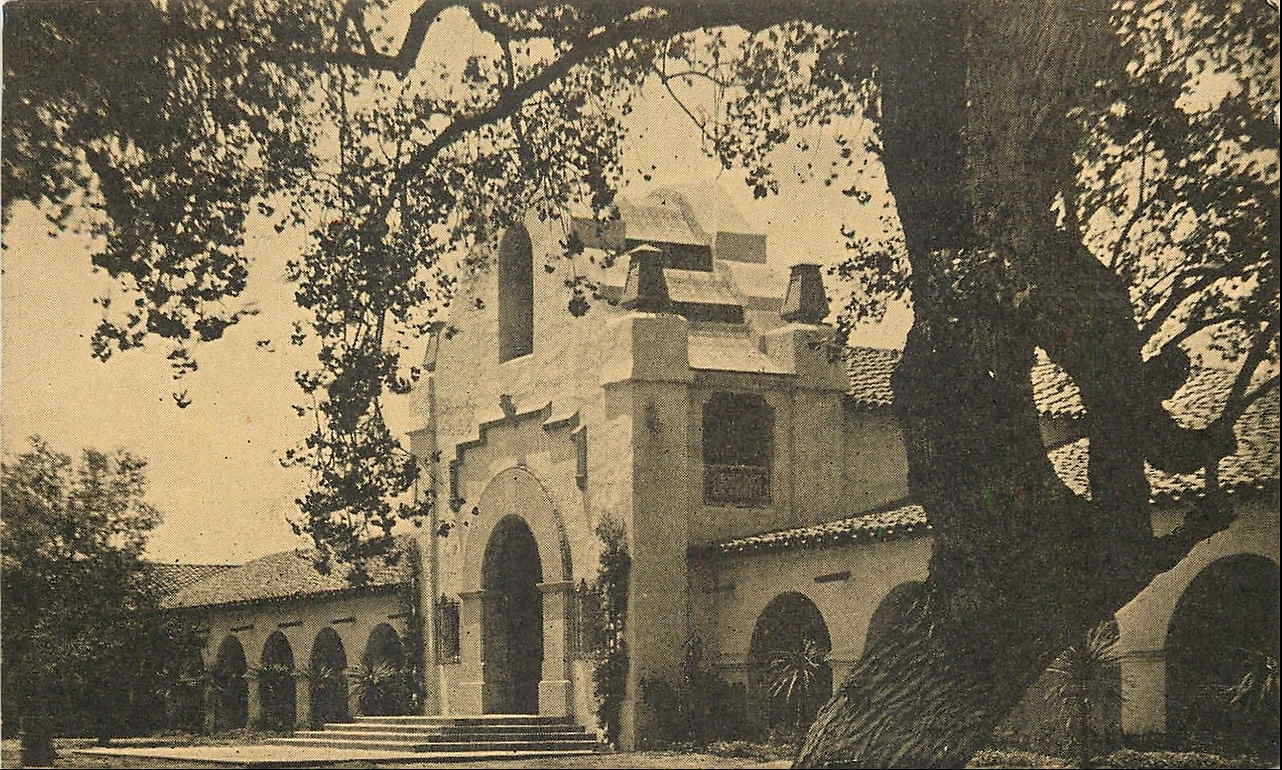 Hotel entrance, from a postcard: back says, "Hotel Agua Caliente, Tijuana Hot Springs, Old Mexico."
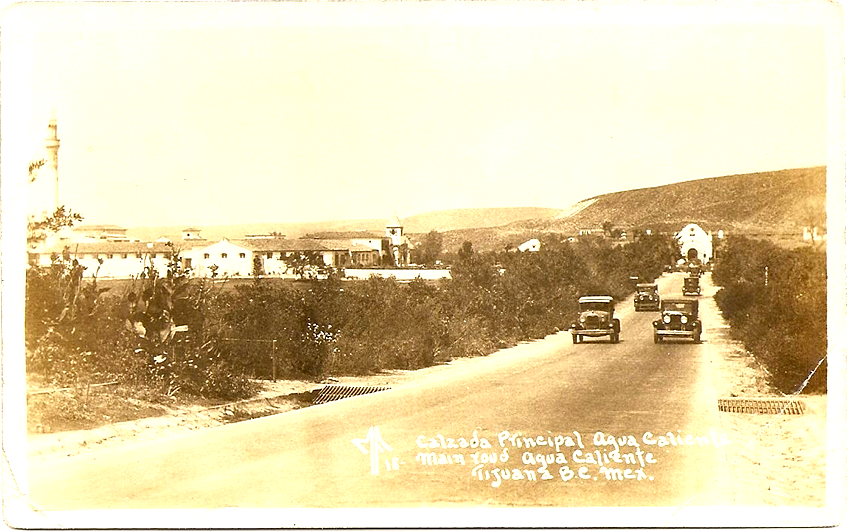
Terrific, rare, early Real Photo Post Card of main road to the Hotel.
View from the Bell Tower. Note the minaret faintly at the far left.
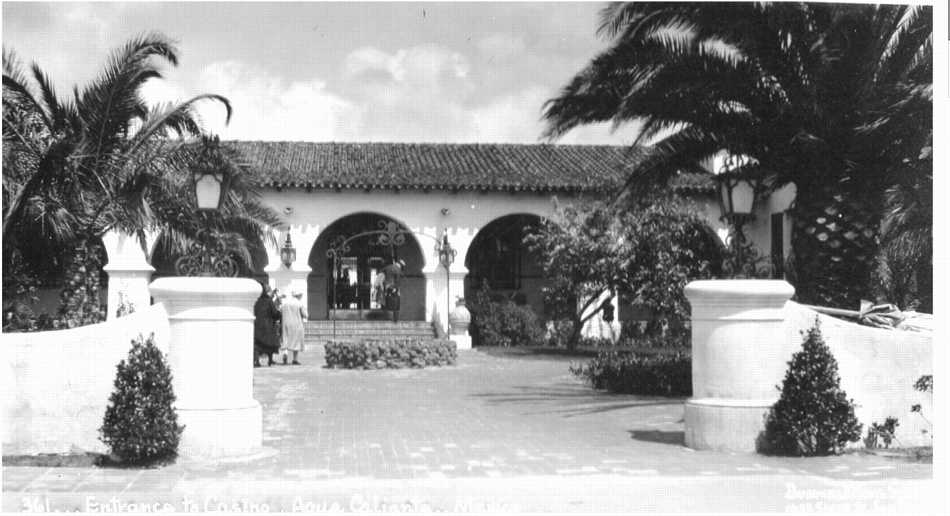
CASINO: Real Photo Postcard of
Agua Caliente Casino entrance, wishing well in front. Another
RPPC here.
More
pictures of the Casino here.
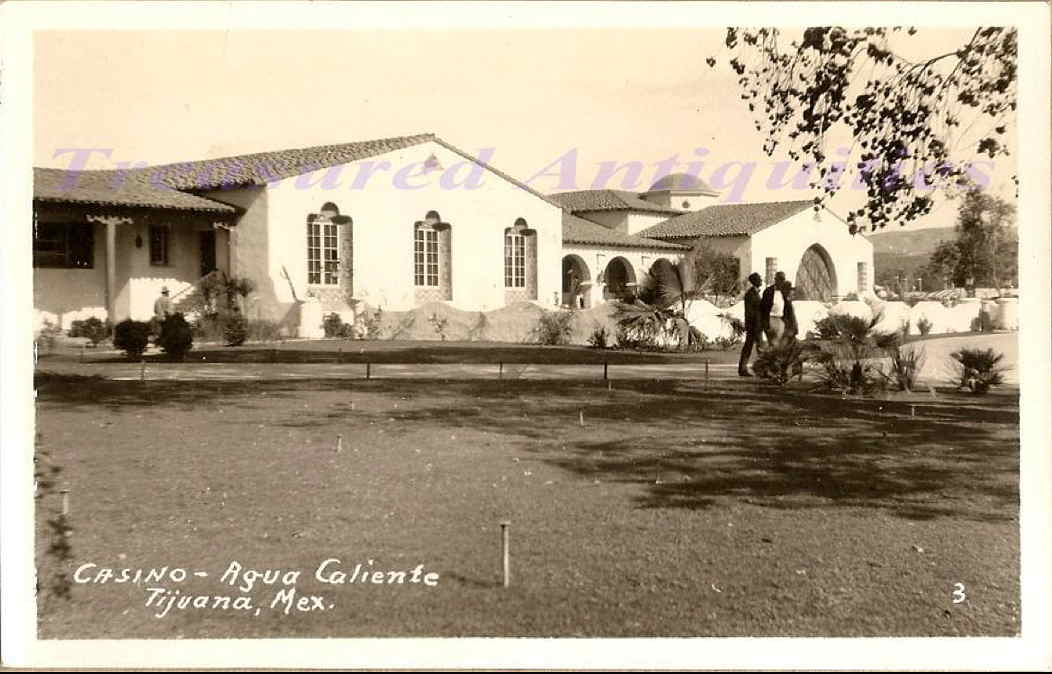
Casino building -- another Real Photo Postcard. Rare postcard.
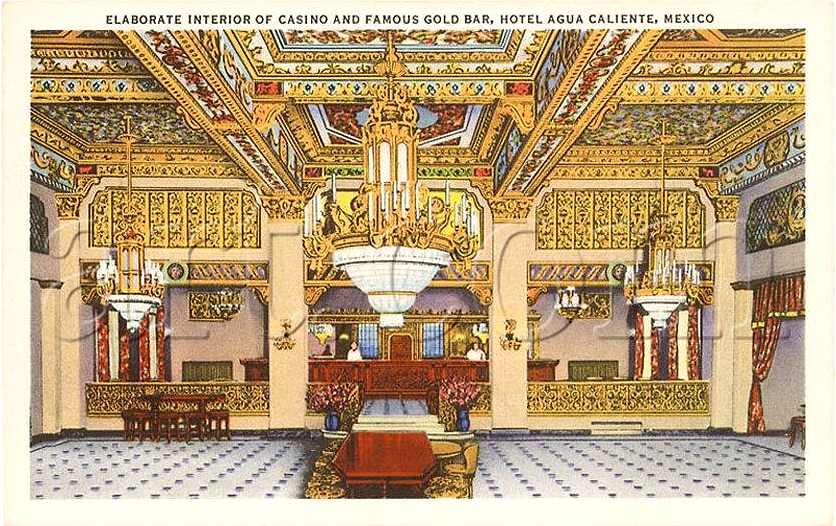
Interior of casino
(in the foreground) and the famous Gold Bar
room in the rear (beyond the
low yellow "fence")
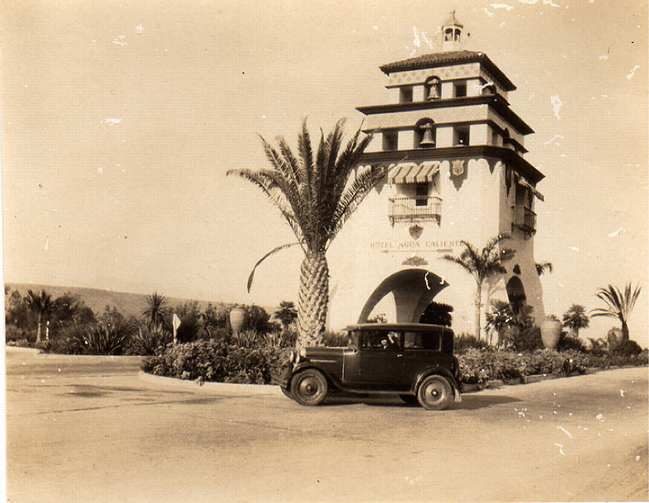
CHIMES TOWER: 1933 photo of famous
landmark Agua Caliente Campanile, Chimes Tower.
Note the sign with arrow that says "Hotel Agua Caliente."
The 85-foot Campanile ("bell tower" in Italian) served at least four
purposes:
bell tower, beacon for the air strip, entrance sign from the road, and
icon of the resort.
The Tower is "item 8" on the map near the top of this page.
The original tower has been destroyed; only a replica exists today at
a different location: click
here.
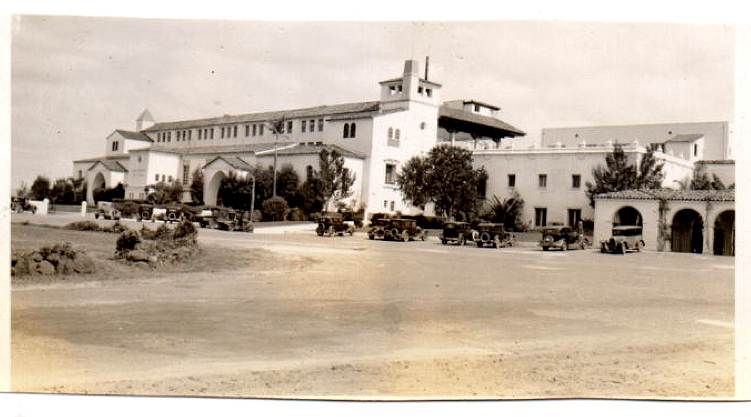
RACE TRACK: Early photo
of entrance side to Agua Caliente
Jockey Club.
(Club House and
Grandstand bleachers, and racetrack
were on opposite side, seen just below
this picture).
More pictures of the
Racetrack, Jockey Club and Grandstands at my Seconday
Agua Caliente page here.
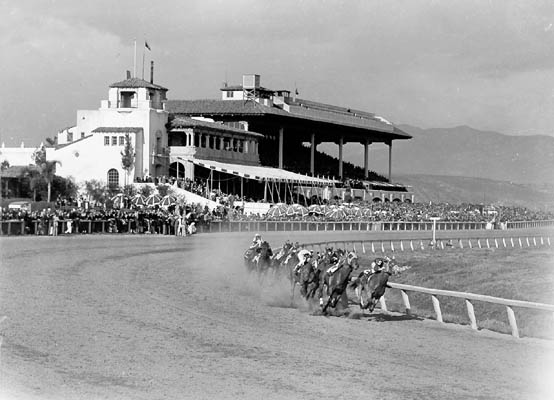
Action side to Agua Caliente Jockey Club:
Club House and Grandstand (two separate buildings).
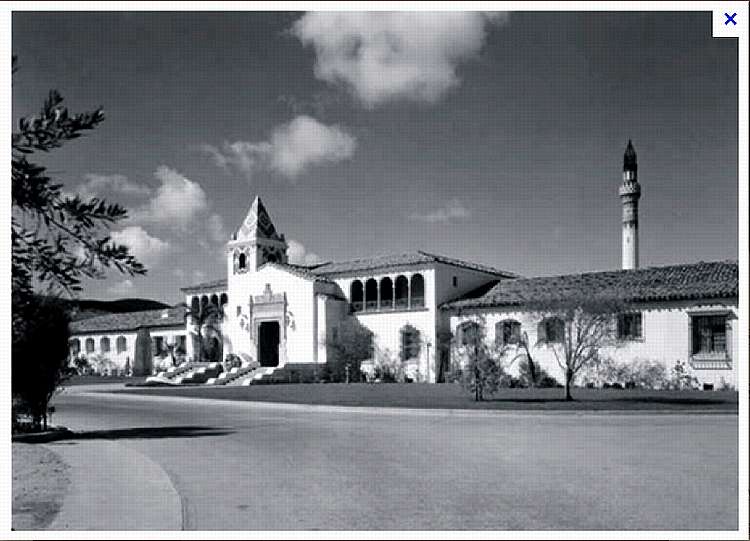
SPA, POOL AND BATH HOUSE:
More pictures of
the Spa, Pool and Bathhouse building at my Seconday Agua Caliente
page here.
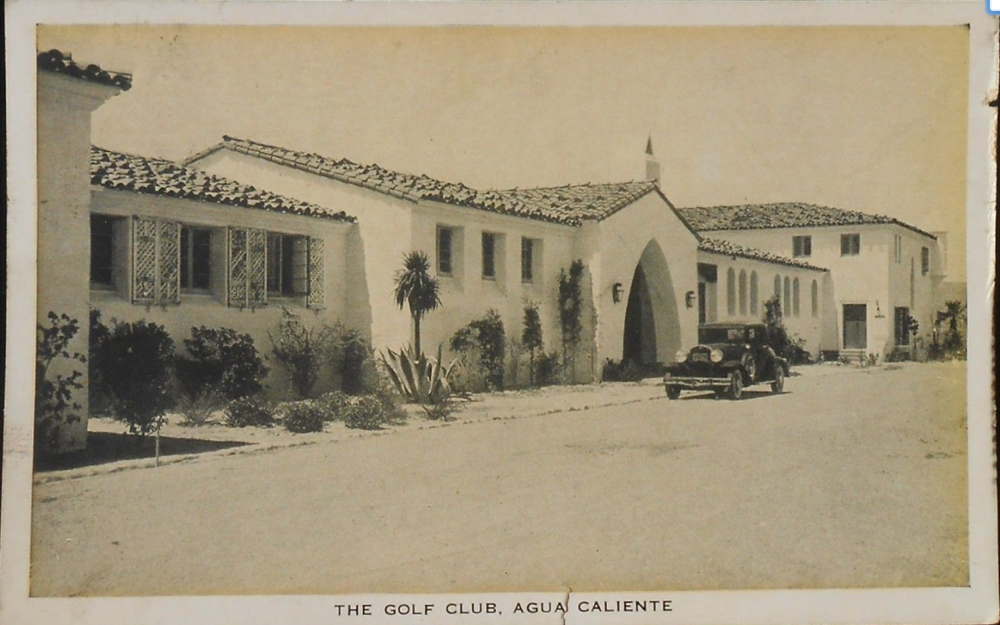
Golf Clubhouse at Agua Caliente. Real Photo Postcard.
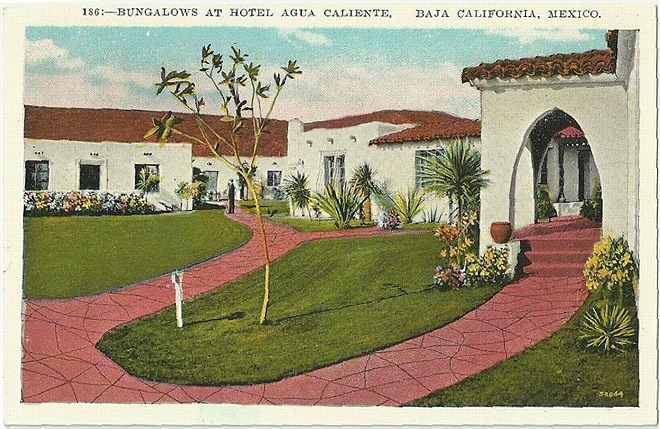
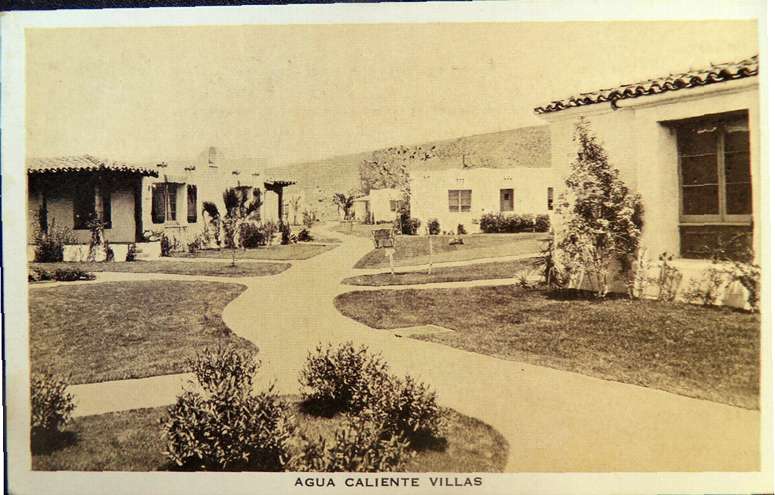
GUEST BUNGALOWS: ("private villas")
of Agua Caliente resort complex (shown
on maps below).
Click
here to see a real photo postcard of
the bungalows.
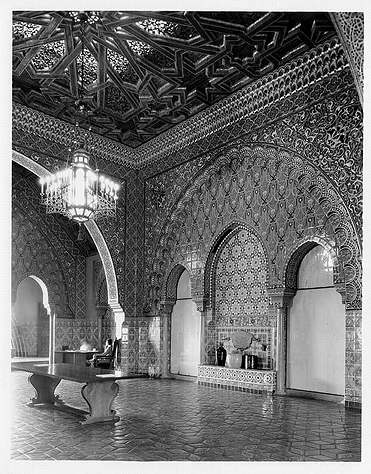
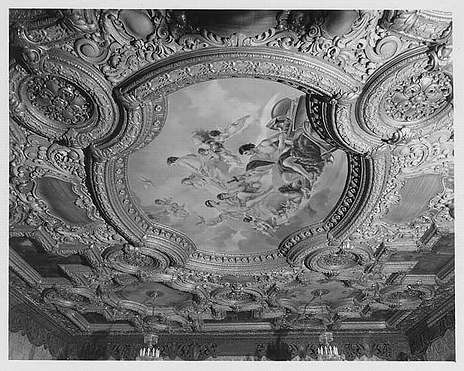
LINKS
TO PHOTOS AND OTHER AGUA CALIENTE RESOURCES:
Above are 2 of the some
100 wonderful 1928 black and white photos
of the Agua Caliente complex found at this
web site: click
here
and here.
The photo on the left is of the "pool building lobby," and the
one on the
right is called simply "interiors"ceiling. My
postcard pictures of the spa are here.
Other photos in this
collection include such varied subjects
as the Agua Caliente gym, golf club shop,
golf club locker room, fountains, entrances,
arches, stairways, casino bathroom tile
and marble detail, ceilings, barber shop,
bungalows, etc. The photos provide a real
feel for the splendor of the resort. ... ..... Other photos
here
at web site of San Diego History Center. Other SDHC pictures here
and here
. Links to other Agua Caliente resources here
. From the Journal of San Diego History is this lengthy historical
article "The Wild Frontier Moves South -- U.S. Entrepreneurs
and the Growth of Tijuana's Vice Industry, 1908-1935" here.
|
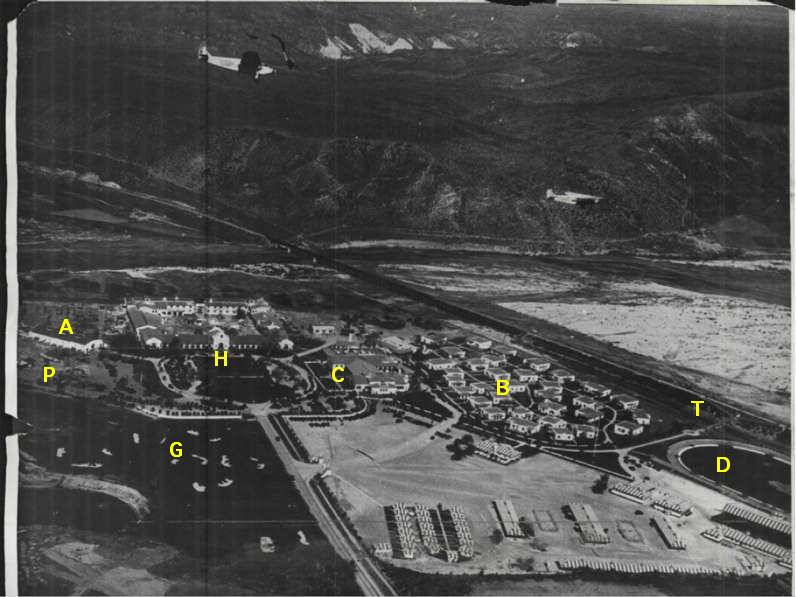
1929 aeriel view of the Agua Caliente resort. "A" is
the Auto guarage; "B" is Bungalows for guests; "C" is Casino
entrance; "D" is Dog
Track
(the famous horse racing track wasn't built
at this time, and will be a
short distance below the Dog Track (off this photo);
"G" is Golf course; "H" is the Hotel entrance; "P"
is where the luxurious Pool and Spa
will be, and to the left (off this photo)
is the Aviation field; and "T" is one
of two San Diego & Arizona Rail Road Train
depots at the resort.
This photo is"from February
1929 featuring Agua Caliente,
Tia Juana [spelling then], Mexico,
showing the Casino and Hotel
with two Maddux Planes in the air. This
photo originates from the archives of
Chicago Sun-Times and Chicago Daily
News. It measures 8� by 10� and is in excellent
condition," went for $300 in July 2010
eBay auction. ... ... The dog track is at the
lower-right (the $2.5 million dollar Auga Caliente
Racetrack is near-by farther to the east). At
the left, below the "Baths," is one of the resort's
golf courses
|
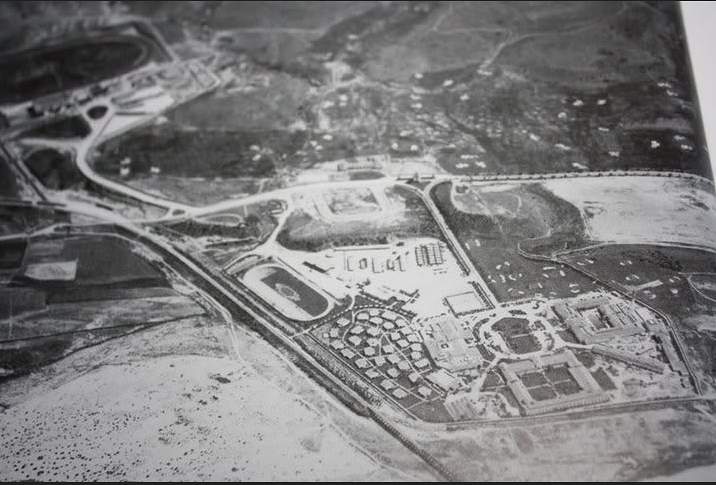
This aerial view has its advantages: it shows a particularly
wide area, takes in the horse track at the very upper-left, and has
a clear view of the pool-spa area at the lower-right. The main sights
here are: the dog track oval a little left of center, then about
35 bungalows below and to the right, then the blurry casino complex
to the right, then the traffic circle and hotel quadrangle with
the crossed walkway in the center of the quadrangle, and finally
the spa-pool complex on the far right (notice the rectangular
pool). (Source.)
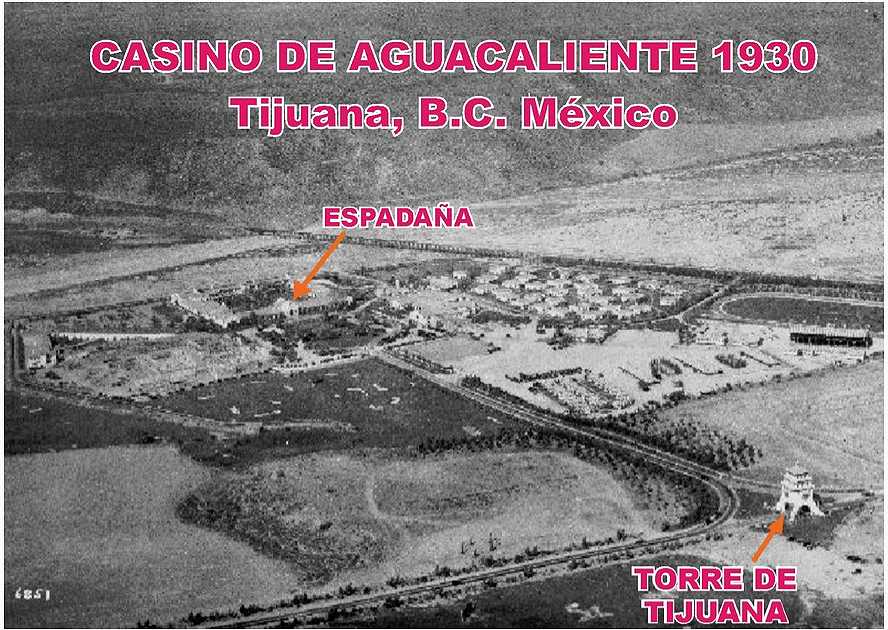
"Espada�a" is Spanish for "steeple;"
arrow is pointing at the iconic entrance to the hotel.
"Torre de Tijuana" is the equally famous
and iconic Bell Tower, entrance to the resort from the main road.
Source.
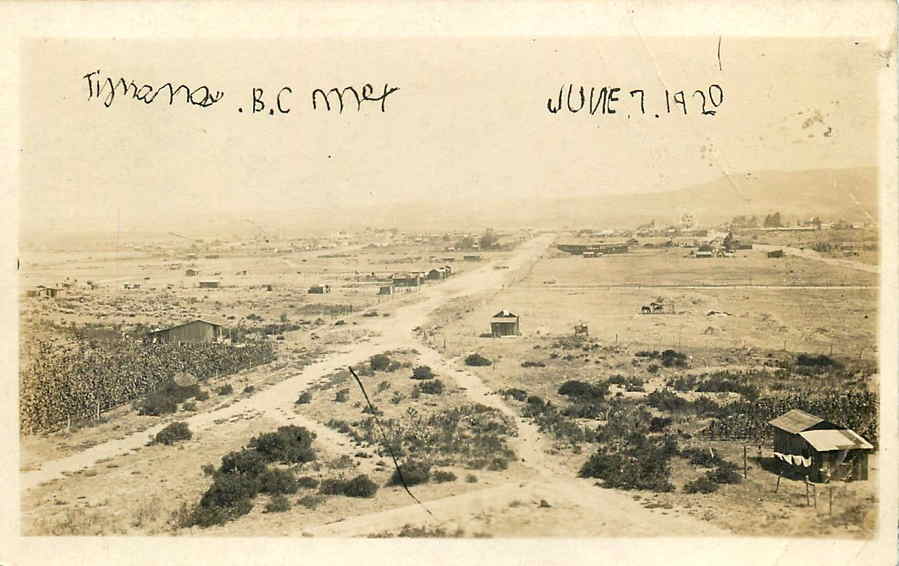
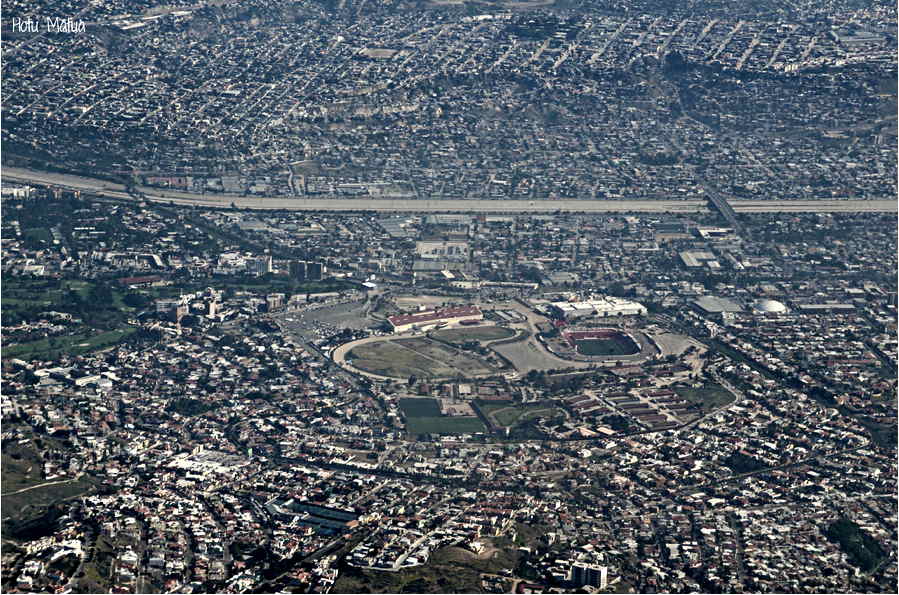
| Tijuana -- then and now.
Top picture is of a Real Photo Post Card, cancelled l923. Lower
picture, taken a few years ago, shows the new stadium-dog
track-grandstand-casino building in the center, location of old resort. |
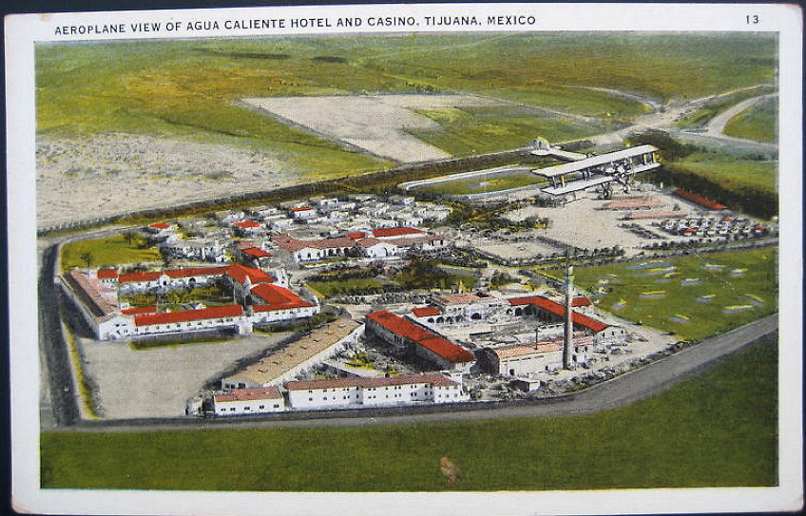
"Aeroplane View"
postcard, taken from an actual black and white
real photo postcard) presents a different
angle.
The buildings on the bottom
(note the Minaret) are the Spa, Bath
House, Swimming Pool complex).
The large building on the
left is the Hotel. Uppermost is the
Casino building and the guest Bungalows.
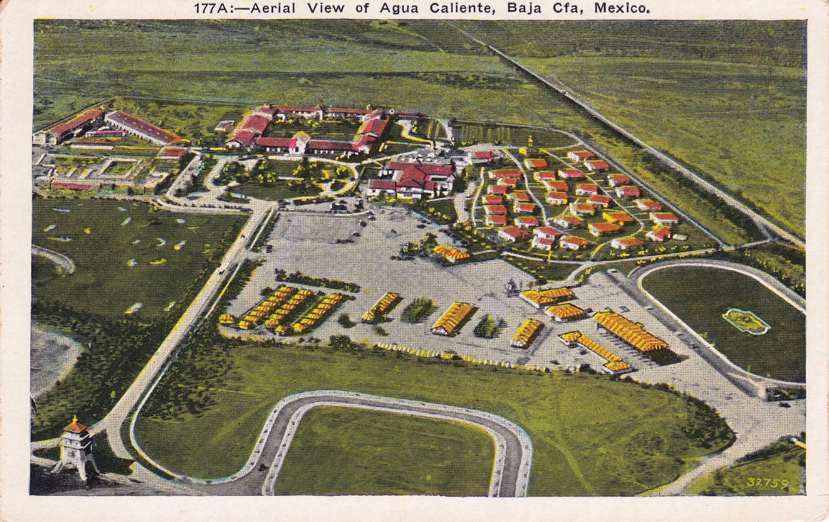
Rare postcard -- aerial view of the resort.
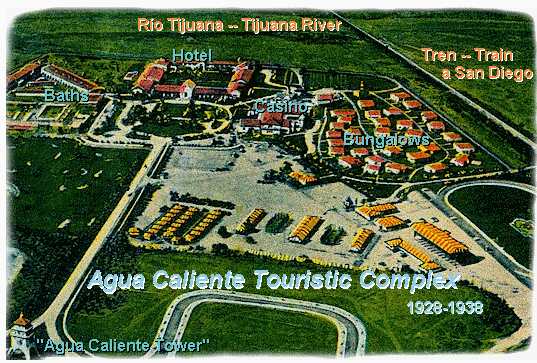
Colored stetch -- from this
fine web site -- all
about past and modern Tijuana.
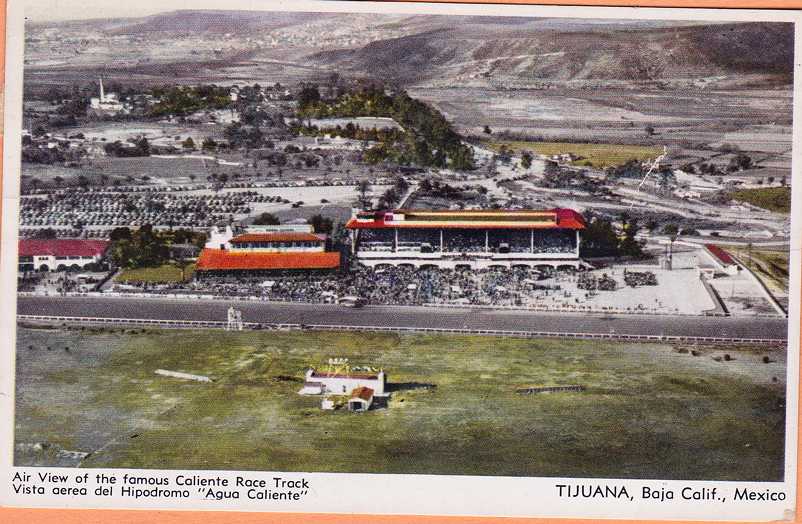
Air view of the famous race
track -- the Agua Caliente hotel-casino complex is
in the background.
Is that the Minaret in the distance
(upper-left), next to the Spa and swimming pool
area? I bought the postcard to scan it; it
is for sale.
More
maps of the resort at top
of this page.
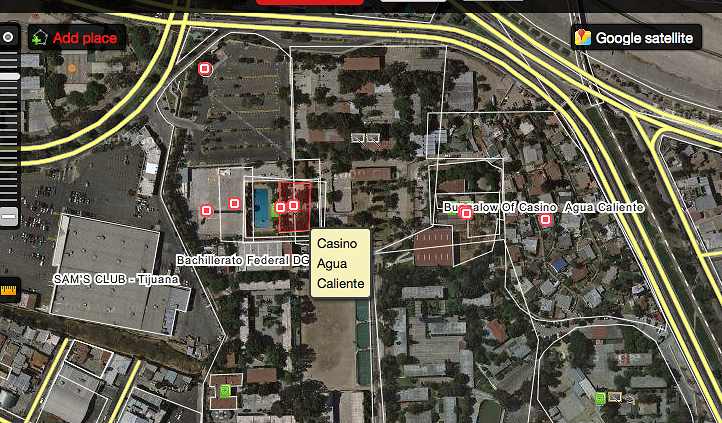
|
I present
this odd-looking map here to draw your attention to this
wonderful web
page. Click that link, and you will be introduced
to this Wicki map where a modern Tijuana aeriel
map is overlaid over the old Agua Caliente resort complex
layout. Have fun dragging your cursor over the map and
clicking those little red boxes to download wonderful pictures
and information. You can also drag the map in different directions,
and enlarge and reduce the scale of the map.
|
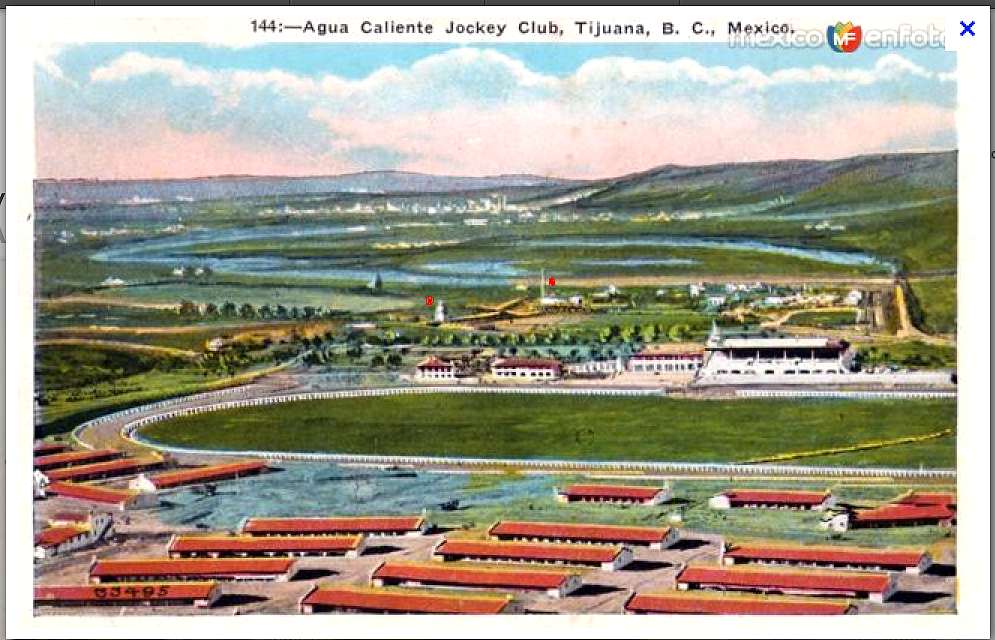
Stables in the foreground, then the green race
track oval, then the Jockey Club and Grandstand.
In the center I placed
two small red dots. The one on the
left is at the famous "Old Tower of Agua Caliente"
(chimes tower landmark),
and the red dot
on the right is at the famous Minaret at
the Bathhouse and Pool.
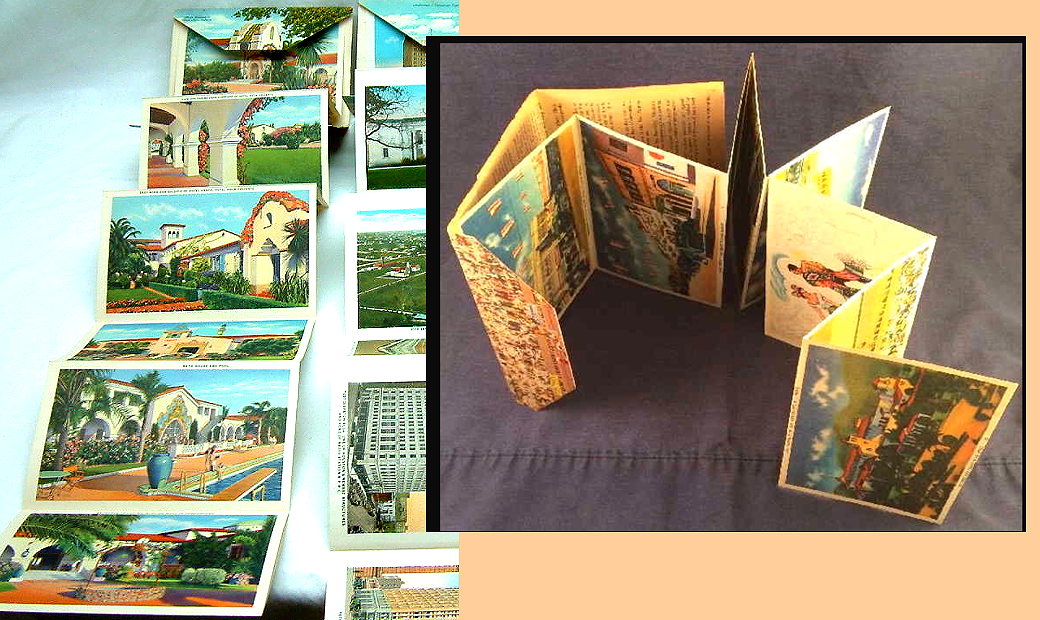
Post Card Souvenir Folders. Each one unfolds like this. The accordion-like, attached postcards are referred to as "views."
The cover usually consists of historical/explanatory text and some
pictures/artwork. When I say below that there are so many "views,"
I am not counting the cover, which might have additional views on the
inside or outside of the cover folder.
I own all of these folders except where I state I do now own it.
500 pixels
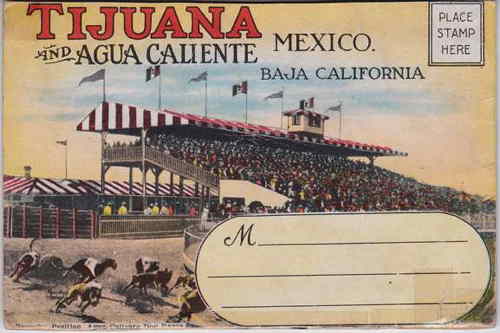
PCSF1. 20 views here, about half relate to Agua Caliente
(especially the dog and horse tracks) and the other half are of other
Tijuana sites. Good quality pictures. (More dog race pictures and discussion beginning
here.) There is a brief discussion of the resort and Tijuana inside the cover.
|
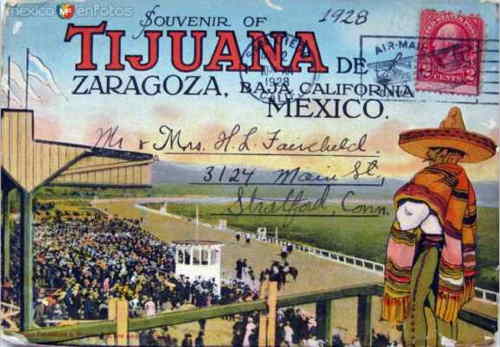
PCSF2. New to me. Pictured above, on the cover, is the old Tijuana Race Track, not the
1929 Agua Caliente Track. Note the 1928 cancellation date.
("In
1925, the city attempted to shed its negative image of hedonism and
lawlessness created by American mob impresarios by renaming itself
Zaragoza, but its name soon reverted to Tijuana,"per eBay ID cbenhob .) I do not own this one.
|
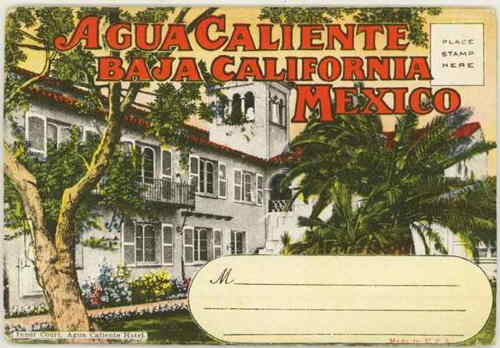
PCSF3. 20 views, all of Agua Caliente, good quality pictures. Description of Agua Caliente inside the cover.
|
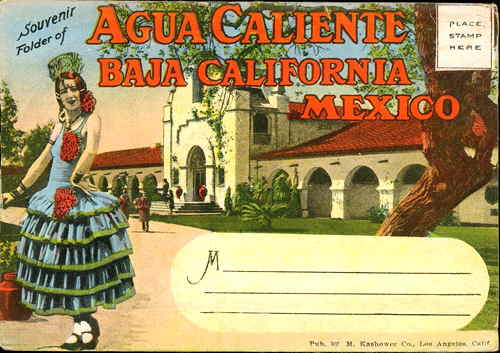
PCSF4. 20 Agua Caliente views, which has view of Jockey Club and description of the resort on cover.
Some of the views are different than PCSF3.
|
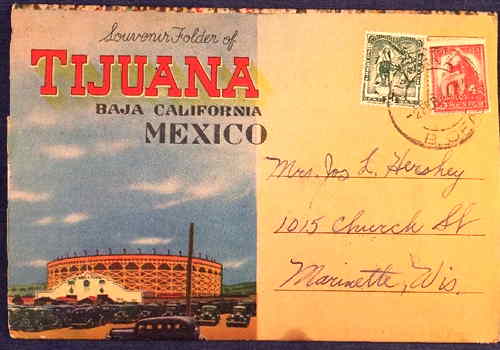
PCSF5. 18 views, mostly related to bull-fighting (Tijuana bull-fight arena pictured on cover, above here), Agua Caliente horse-racing, automobile scenes (especially at border, customs) and Tijuana locales. Generally poor quality of pictures and selection.
Nice descriptive text, inside the cover, of Tijuana (w/ history) and info about no need
for passports, and customs duty-free to U.S. (up to $100 every 30 days).
|
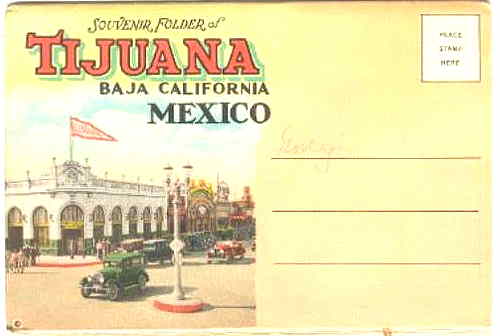
PCSF6. 18 views.
Good quality. Only several are Agua Caliente scenes. Inside
the cover is a brief history of Tijuana. Pictured above, on the
cover, is "The Big Curio Store."
|
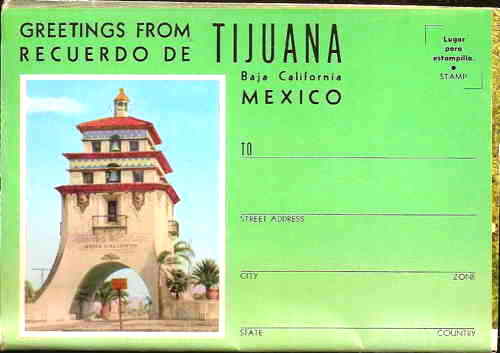
PCSF7. Vintage Tijuana Mexico Folder Postcard, 14 views,
plus two cover views. Probably made long after the resort
closed. Includes the Bell Tower, the racetrack and Tijuana scenes.
|
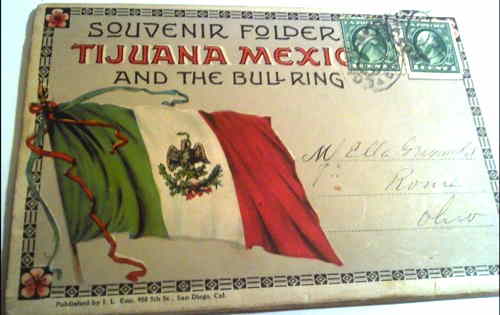
PCSF8. Copyright 1902, mailed 1915,
so no Agua Caliente info. 22 quality views, half of bull-fighting
(with nice explanations on each view) and half of Tijuana street
scenes. No descriptive text message inside the cover.
|
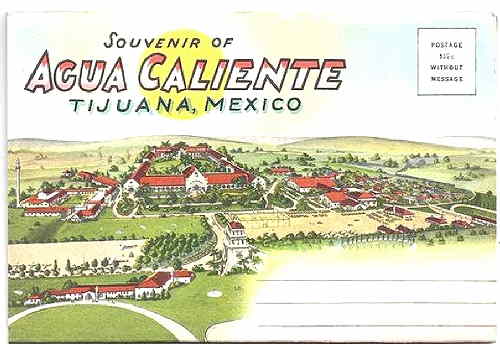
PCSF9. 18 views, all of Agua Caliente, and excellent quality pictures. The map below is based on this cover. The text gives a brief history of the resort.
|
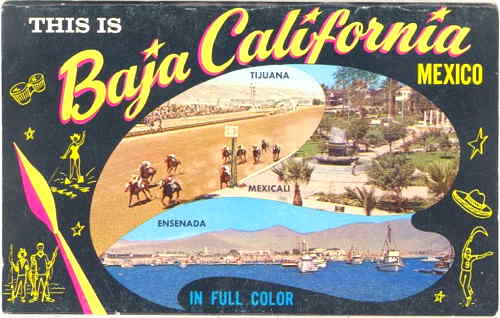
PCSF10. Published after the resort closed. Only Agua Caliente Racetrack pictures of the old resort.
I do not own this one.
|
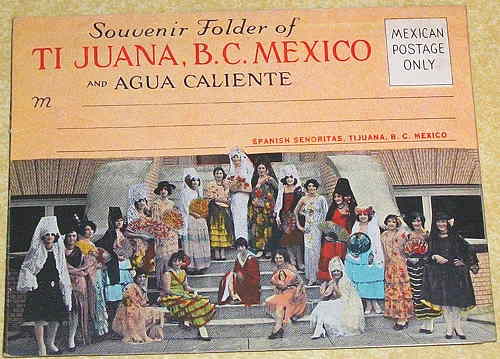
PCSF11. Quality pictures, 18 views, more than half of Agua Caliente.
Unusually small for a souvenir folder: 4.75" x 3.5." Under the
cover is a brief history of Tijuana and Agua Caliente.
|
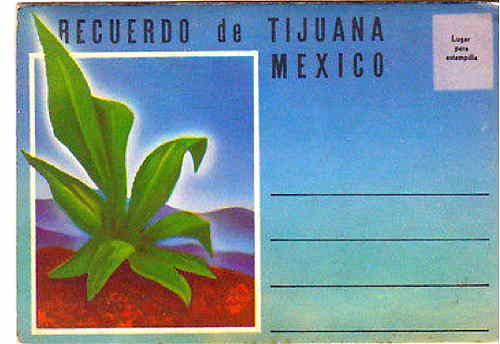
PCSF12. only 12 views (mostly of Tijuana environs)
and nothing inside the cover. Probably from post-resort period;
only 2 views of Agua Caliente: the Tower (with sign to the school) and
the racetrack.(Recuerdo is Spanish for "souvenir.")
|
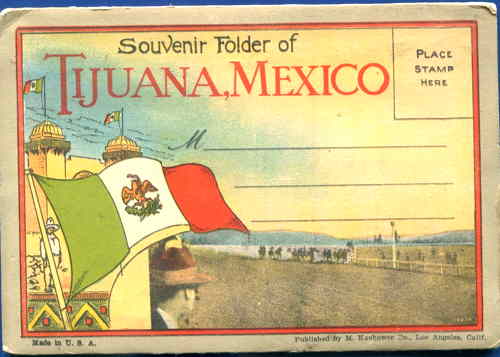
PCSF13. 20 views, very professional, good quality.
A lot on these subjects: bull fighting, horse-track racing,
liquor/bars, Tijuana scenes. No other Agua Caliente scenes. No
descriptive text message inside the cover.
|
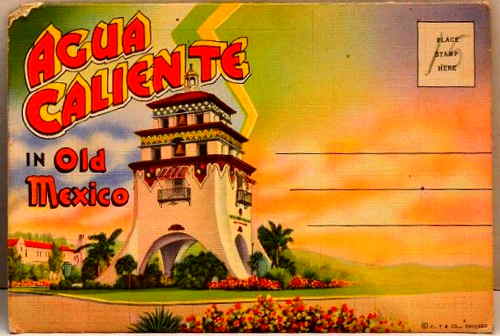
PCSF14. 18 views plus cover. The inside cover promotes the resort. Nice job. About half the views are of the hotel.
|
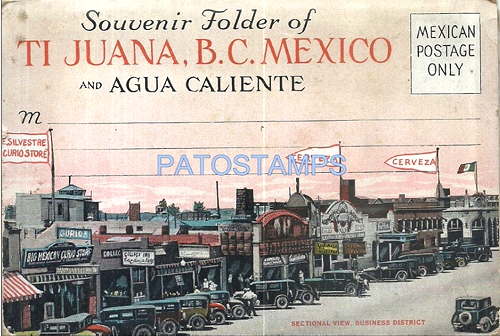
PCSF15. 16 or more views. Half are of Agua Caliente sites. I don't own this one.
|
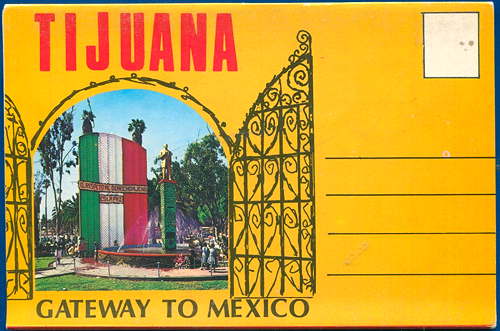
PCFS16. 10 views, plus two more on the inside and outside of the folder.
Nice strong glossy paper, but nothing on Agua Caliente. Modern
zip code printed on folder indicates made 1963 or later. Tijuana
scene pictures including lots of bull-fighting pictures.
|
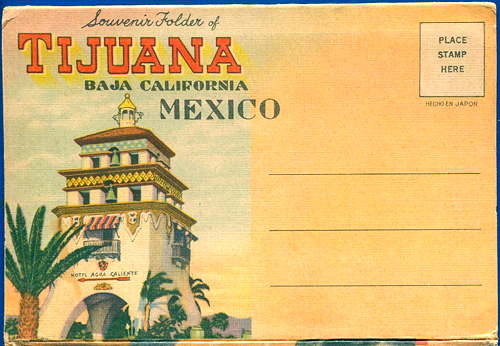
PCFS17. 18 views plus the cover,
which also has a brief history of Tijuana attractions post-resort
closing. No Agua Caliente pics. Not so much views as colorful soft
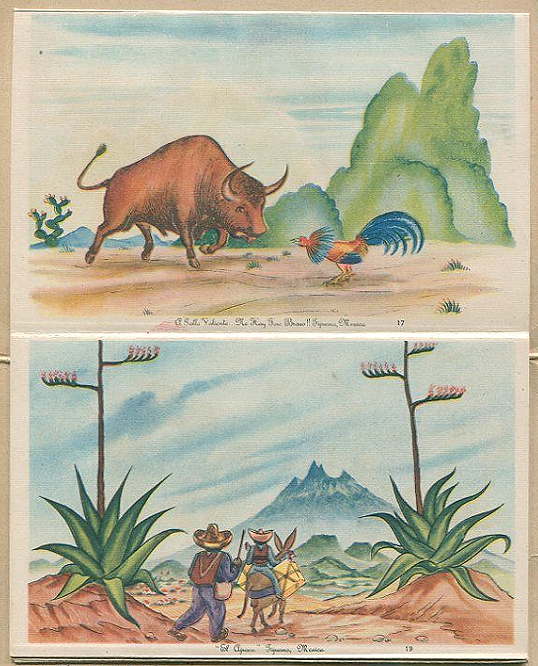
pastel sketches of Mexican people at work and play (like these); many bull-fighting sketches.
|
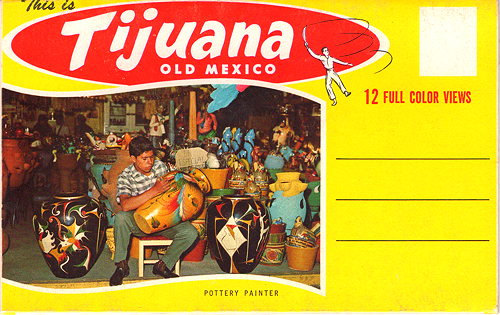
PCFS18. 12 views (including 2 in the cover). Short description of Tijuana. Only 2 pictures of the dog/horse racetrack.
|
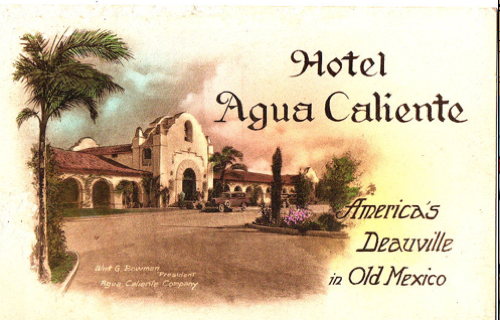
PCFS19. 12 postcards/views including the cover. This is
best postcard souvenir folder. Each postcard/view has a back like this for mailing purposes. On the postcard backs it says, "Published
by Agua Caliente Co. [the owner of the resort], Wirt G. Bowman,
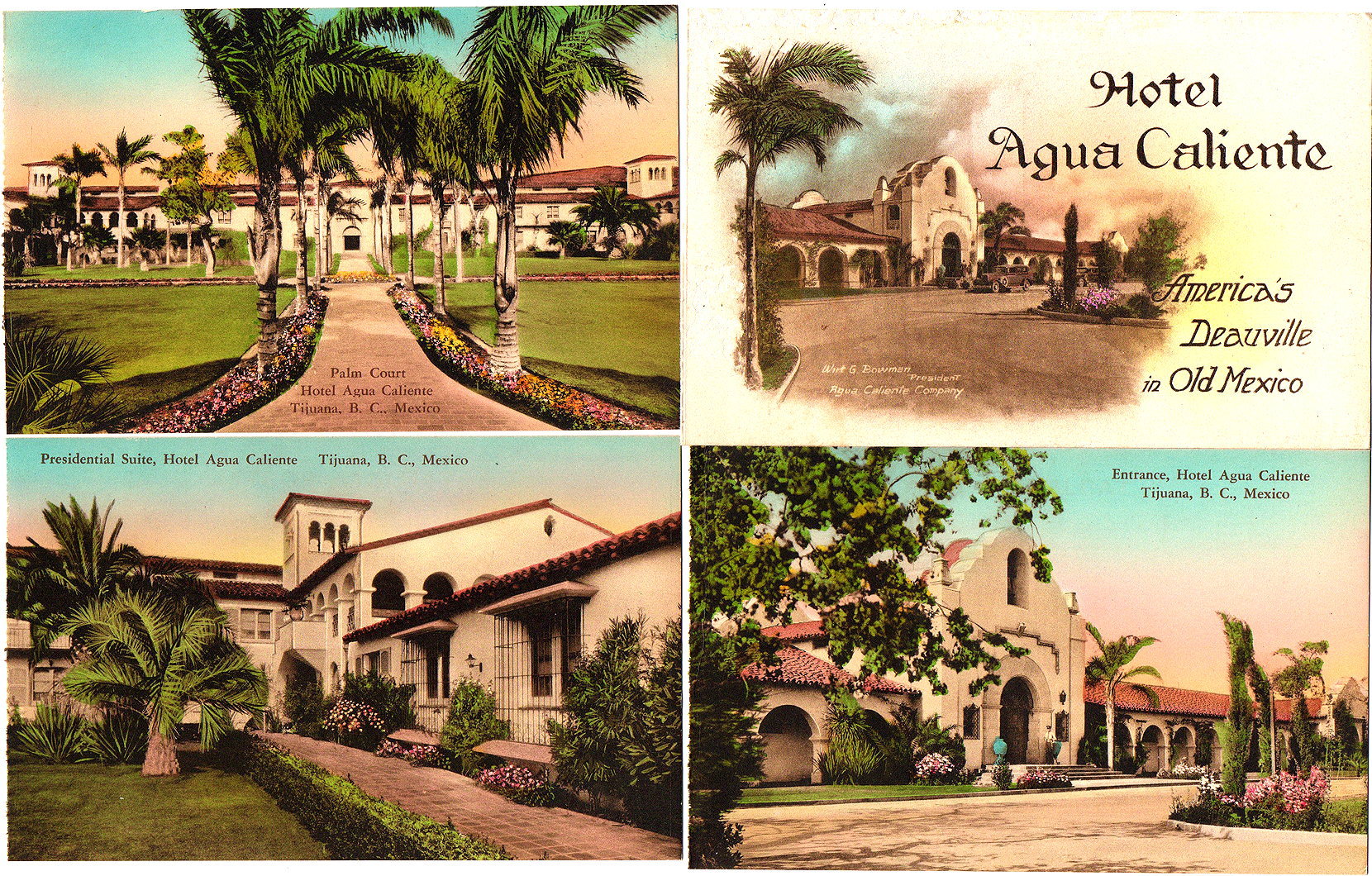
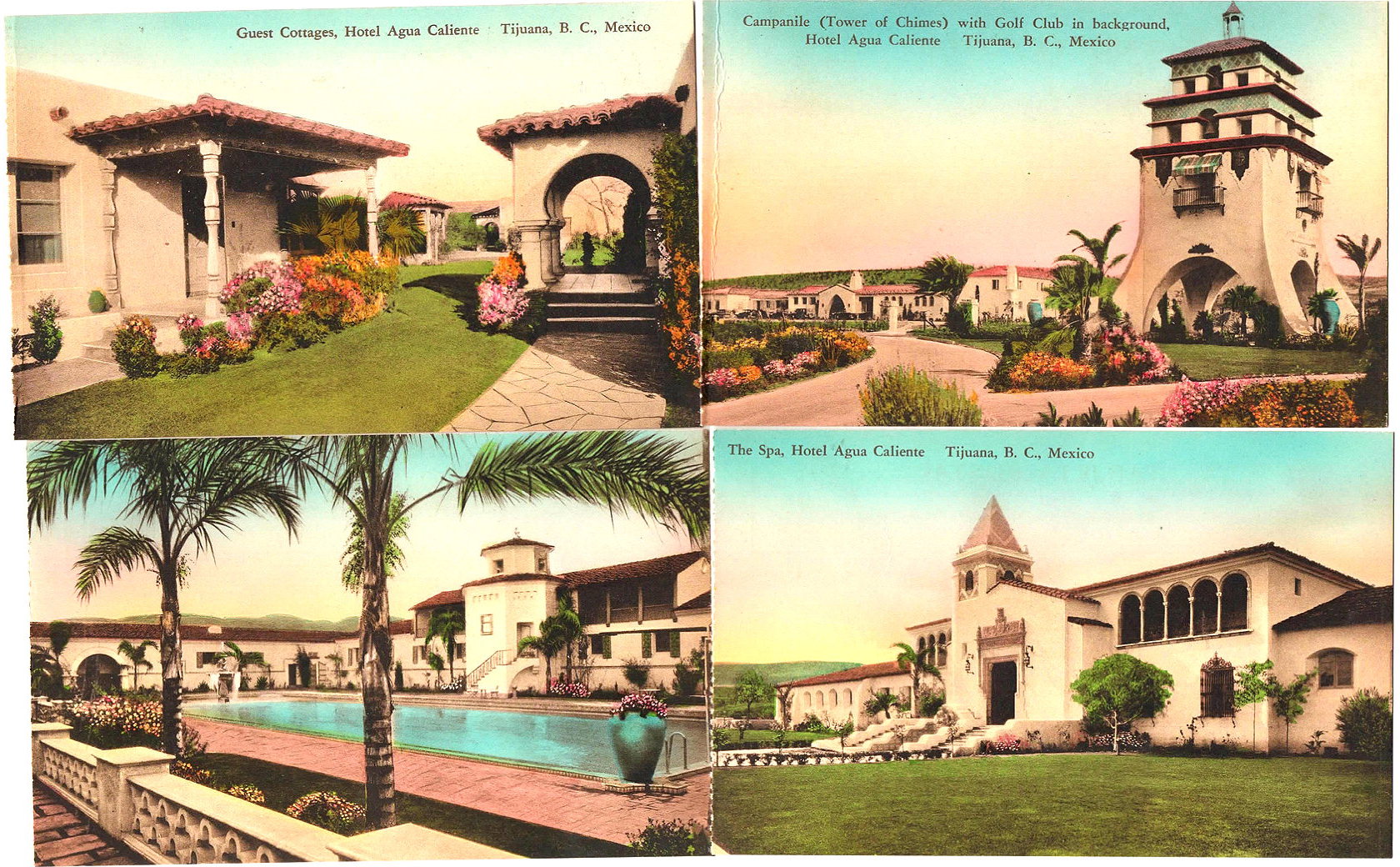
President." Click here (Hotel bldg), here (various resort bldgs.) and here (Casino bldg and Racetrack) to see all 12 postcards!
|
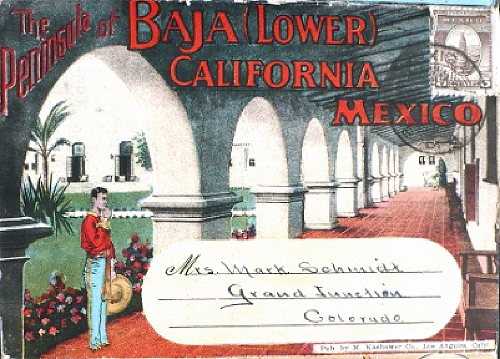
PCFS20. 20 "great views"
according to the seller. Scenes from cities throughout Baja
California, including Tijuana's Agua Caliente, which is seen on the
cover (pictured above).
|
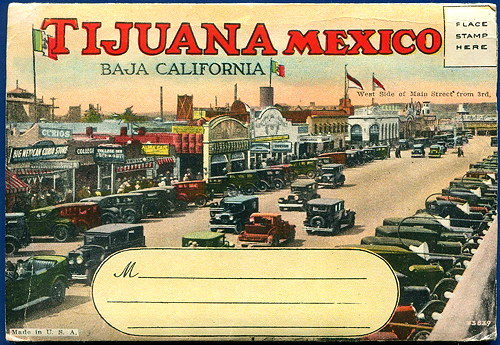
PCFS21. 20 views plus
short description of Tijuana. One view of Agua Caliente (the pool)
and two of the
racetrack.
|
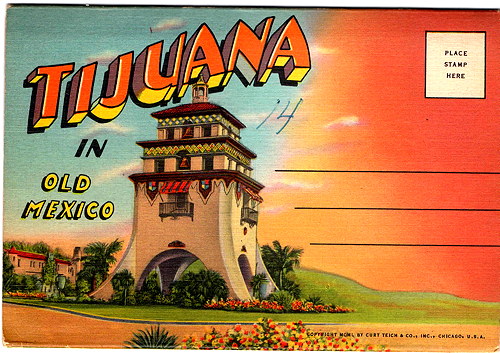
PCFS22. 16 views plus cover, plus lengthy description of the modern attractions, arenas and buildings.
|
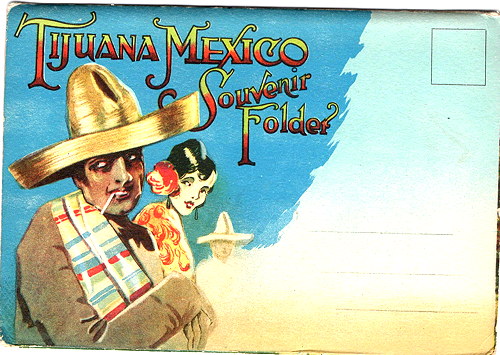
PCFS23. 18 views plus cover. Lots of buildings, racetracks and advertisements.
|
|
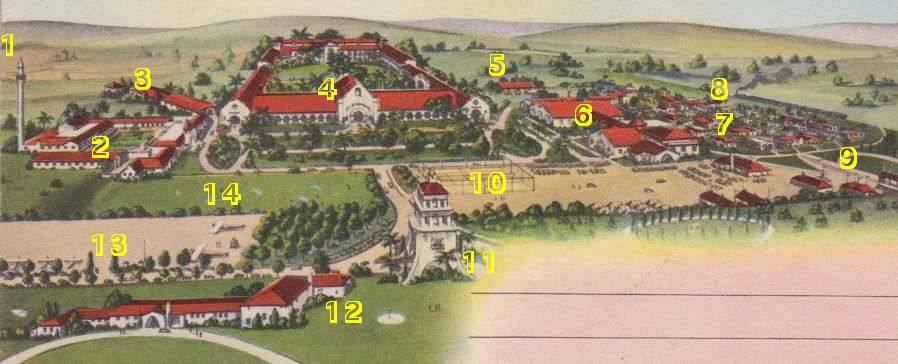
Numbers from
sketch layout map just above, for large map below.
(You will have to scroll page right and left to see all the items):
1. Minaret
2. Spa, Baths and Pool
3. Auto garage
4. Hotel quadrangle and courtyard
5. Power plant
6. Casino buildings complex,
with dining and entertainment rooms
7. Guest bungalows
8. San Diego & Arizona
railway line
9. Dog track.
10. Championship tennis courts
11. Famous bell tower
12. Golf Club House and championship
golf course
13. Airfield
14. Pitch and Putt golf course
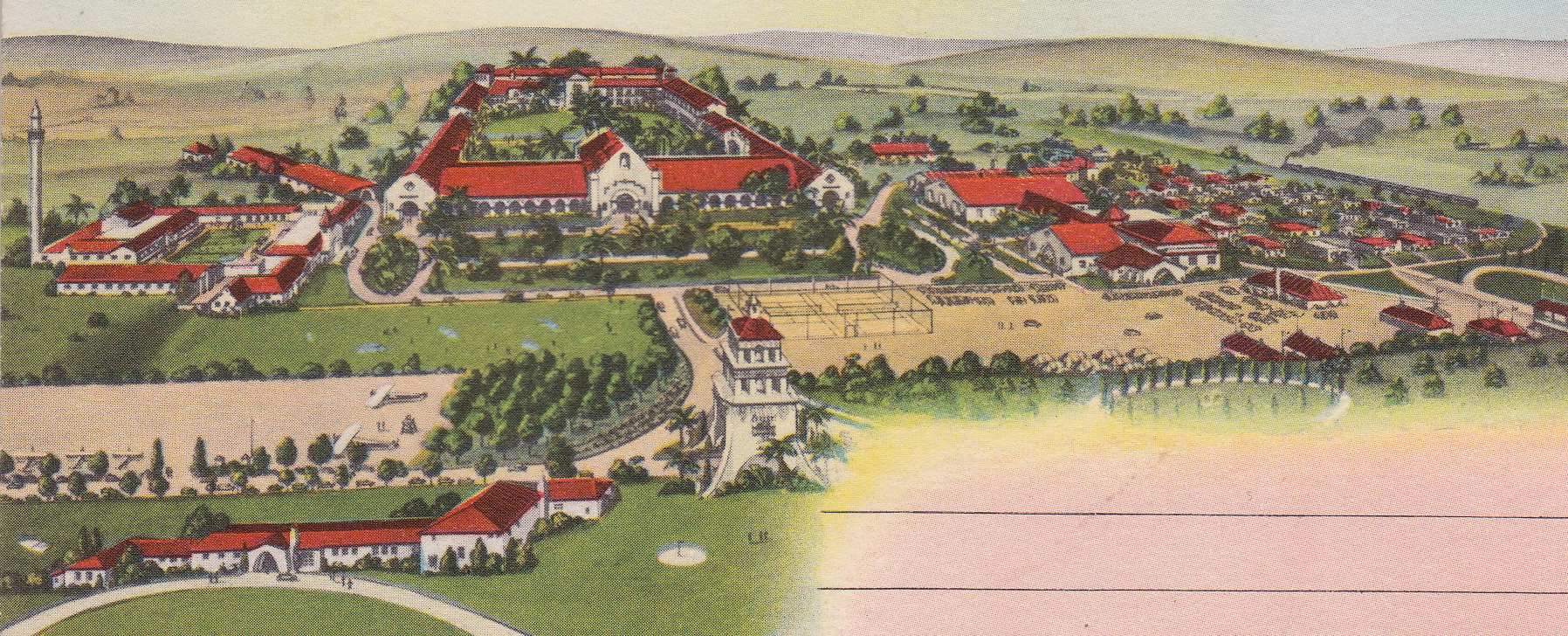
Layout of the resort. Blown-up
picture of the above Souvenir Folder cover. (The
picture is probably wider than your monitor, so scroll right
and left to see it all.)
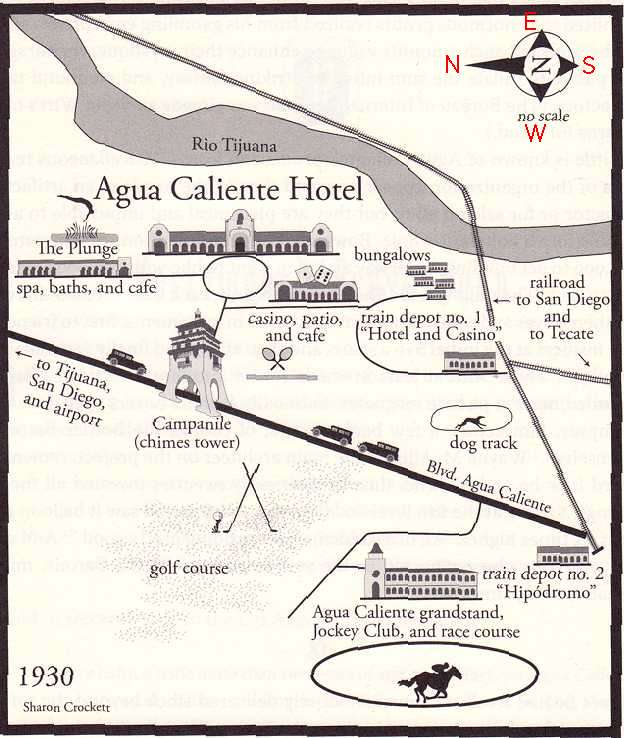
From p. 224
of Paul J. Vanderwood's "Satan's Playground."
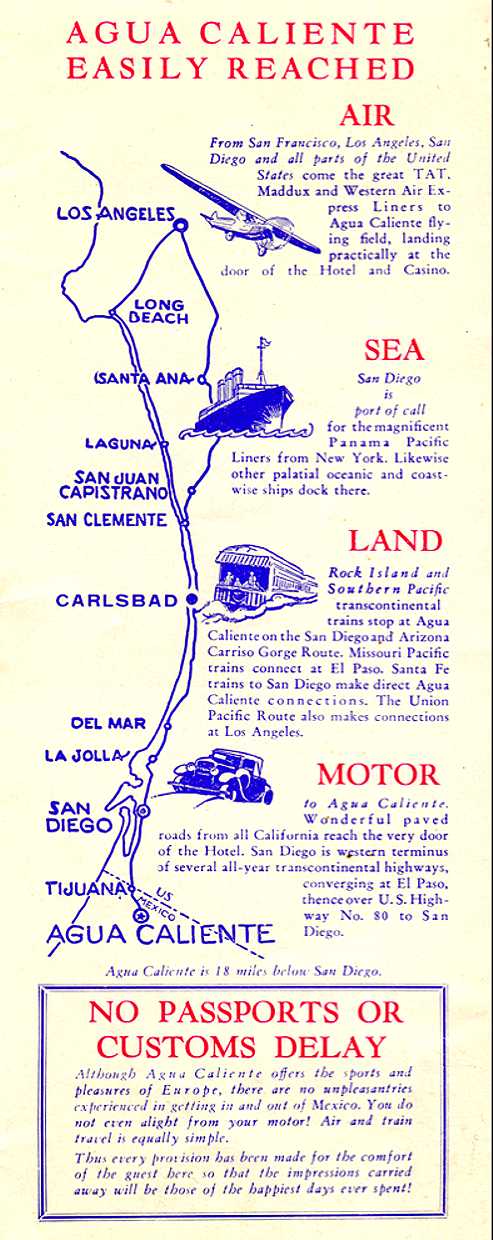
Agua
Caliente in Tijuana, Mexico: lies only six miles
South of the Border, 18 miles from San Diego,
accessible
by train, 139 driving miles from Los Angeles, and
a one hour plane ride from Los Angeles.
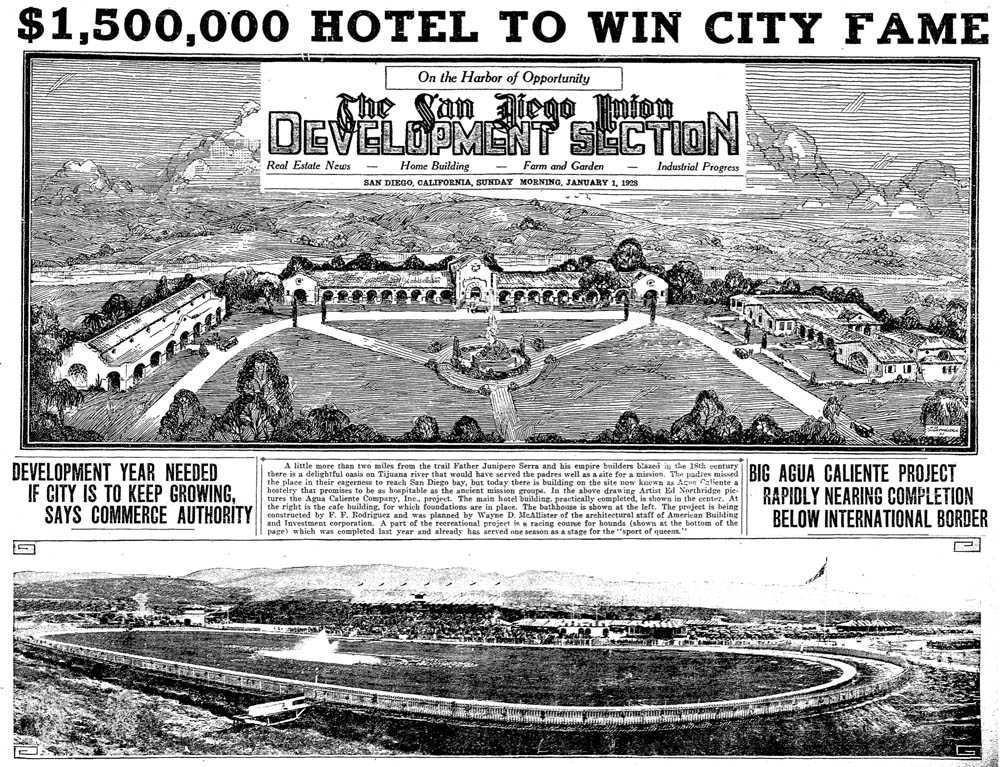
The construction of the Agua Caliente Hotel
and Resort was featured in this newspaper Jan. 1, 1928.
The Spa-Pool building is on the left, Casino
on the right, and Hotel in the center. (source)
The Hotel started out without the wings and
quadrangle in the rear, which were completed the following
year.
PART F: Souveniers and Other Artifacts of the Resort: Brochures,
Stock Certificate, Key Fobs, Spoons,
Bottle Opener, etc.
330 pixels
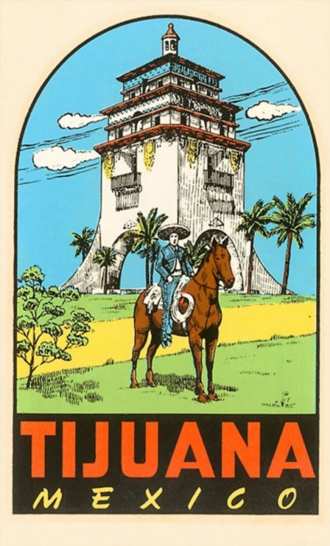
Advertising tourist poster
-- shows the famous landmark Bell Tower, at road entrance
to Agua Caliente resort.
--345 pixels--
|
558 pixels
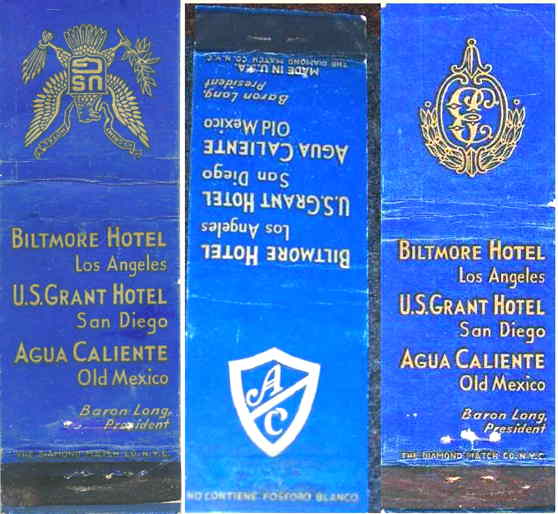
Matchbook covers showing Baron Long's ownership in
three prominent hotels including Agua Caliente.
Each cover lists the three hotels, but has the logo for just one of them: (left to right) US Grant, Agua Caliente and Biltmore.
--558 pixels--
|
405 pixels
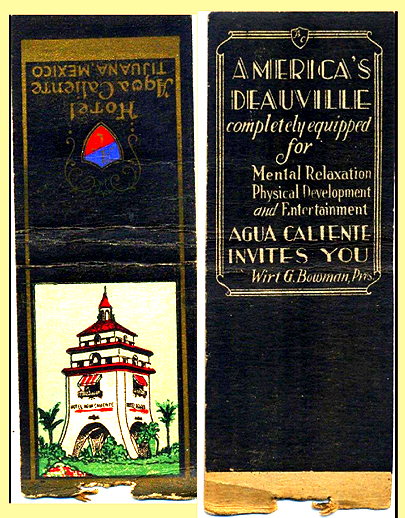
Another matchbook. Bowman was a partner in the resort. Went for $41 on eBay, Jan 2018.
|
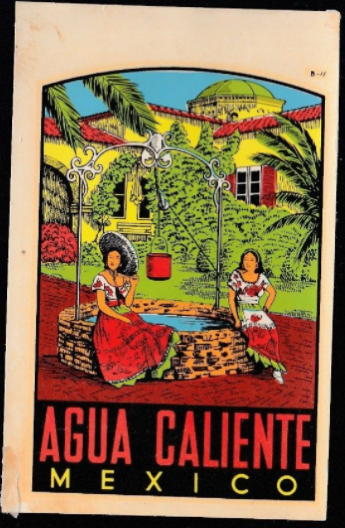
Luggage decal showing the Wishing Well in front of the Casino.
|
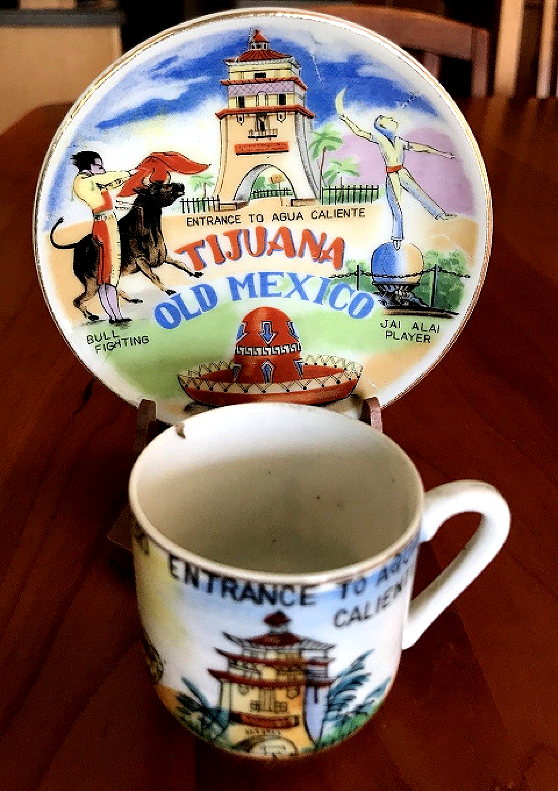
Antique mini cup and 4" saucer souvenir from �Old Mexico�
|
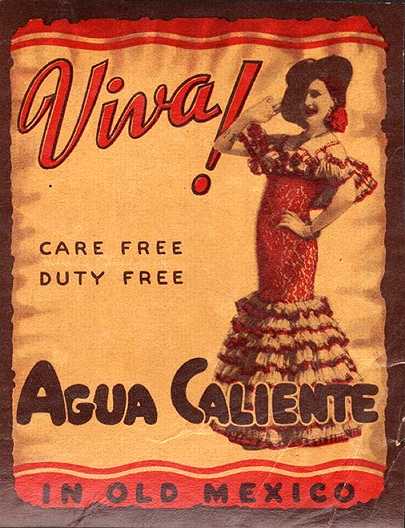
Another luggage label, 4 � x 3 � inches.
"DUTY FREE," above, refers to the fact that Tijuana then was declared
by Mexico as a "free zone," the only such zone in the Western Hemisphere.
It meant that products could be imported to Tijuana "duty free." Thus,
champange cost less than in Paris, and cigars cost as much as in Havana! Gasoline
sold at a bargain price.
|
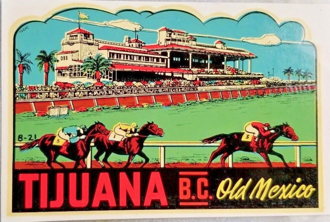
Decal of Race Track.
|
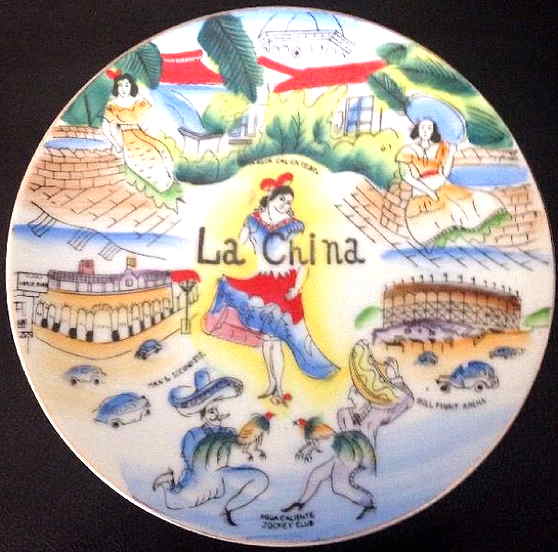
8 inch souvenir plate. "Agua Caliente" scene and name in upper section.
|
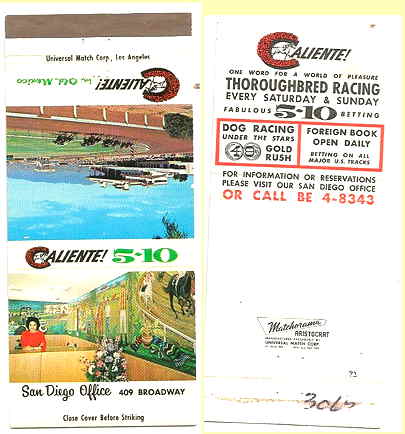
Matchbook cover (both sides)
for the Caliente Track. Note
the dog and horse racing, int'l. sports book,
famous 5-10 bet (Big 6), and
weekend racing. While the Big 6 is an attractive bet for small
punters (BIG rewards for LITTLE outlay), it is very difficult to
win. The better must select the winner in 6 races, here the 5th
thru 10th race.
|
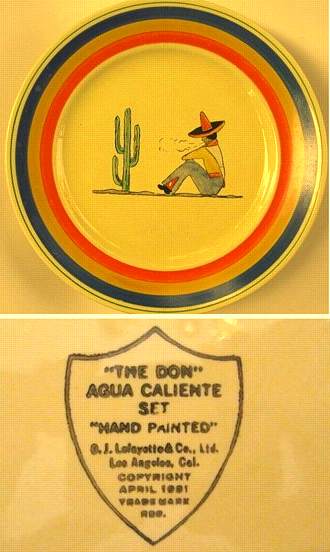
Vintage dinner plate, 9-1/8" across.
Named on the back.
|
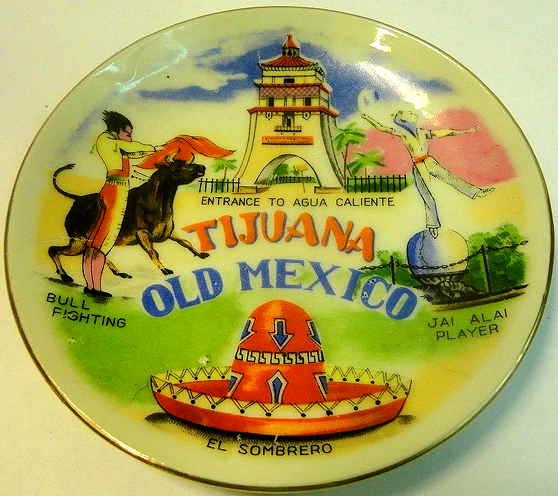
Another 4" souvenir plate.
|
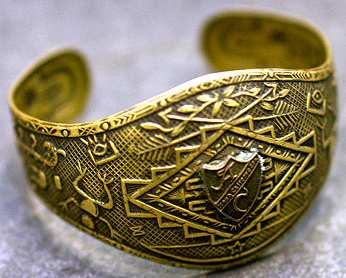
Ladies bracelet features the Agua Caliente crest
in the center of the picture.
It's estimated to be from between 1928 and 1935.
(Source.)
|
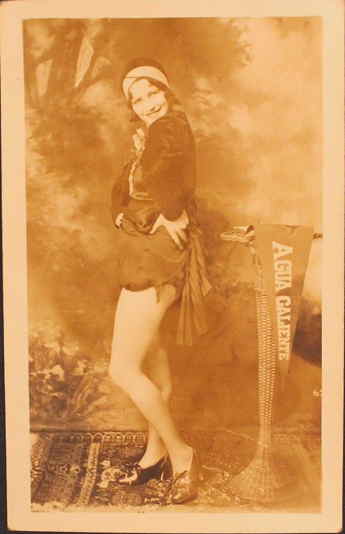
1920s post card showing flapper with "Agua Caliente"pennant.
|
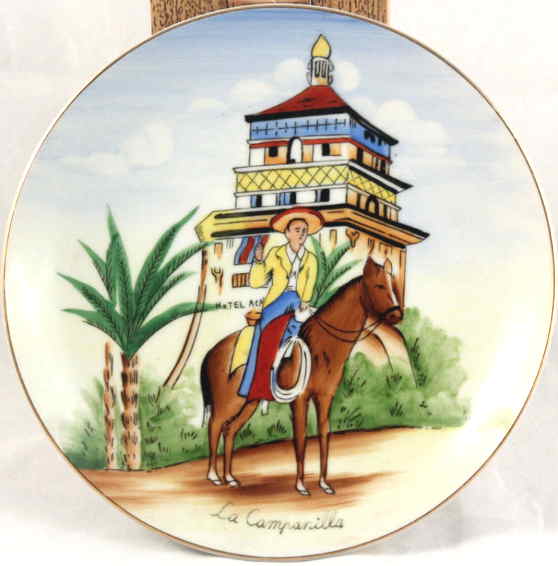
Ceramic Hanging Plate from Mexico, famous landmrk Bell Tower of Agua Caliente resort. La Campanilla means small bells or chimes.
This plate is from the "La Campanilla" meaning "Chimes bell tower" at
the hotel Agua Caliente. The plate is 8" in diameter. This
vintage plate has been hand painted.
| 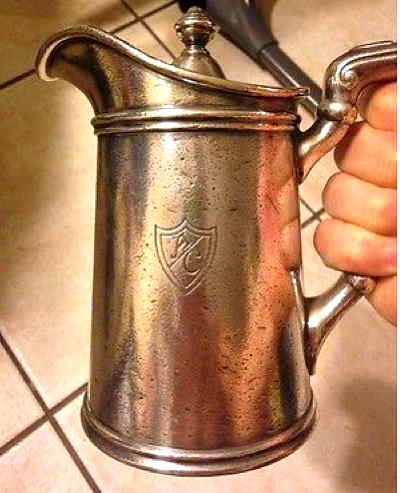
Metal coffee pot from the resort. 10 oz. size.
"Agua Caliente Co" named on bottom.
Note the A/C shield logo. 6-1/2" tall.
Went for $358 at eBay auction June 2015.
|
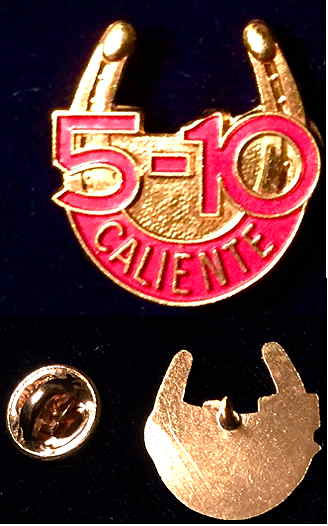
Horseracing
lapel pin from the historic Agua Caliente Racetrack. This pin is a
horseshoe with "5-10" on it. 5-10 was the betting system
predating the pick 6 system, another "Caliente first."
|
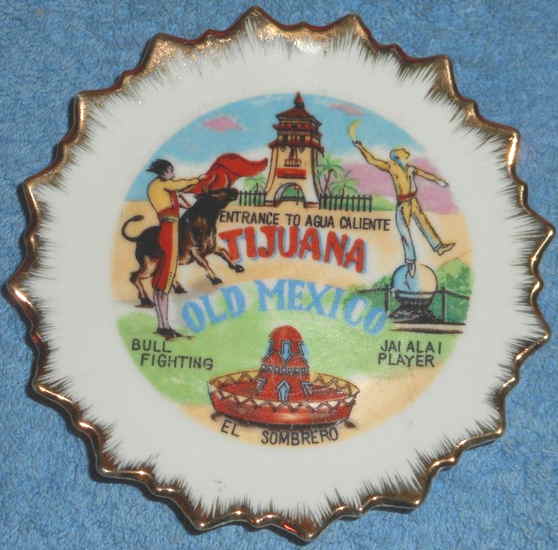
PORCELAIN SOUVENIR COLLECTOR PLATE FROM "TIJUANA OLD MEXICO". MEASURES 5" ACROSS.
|
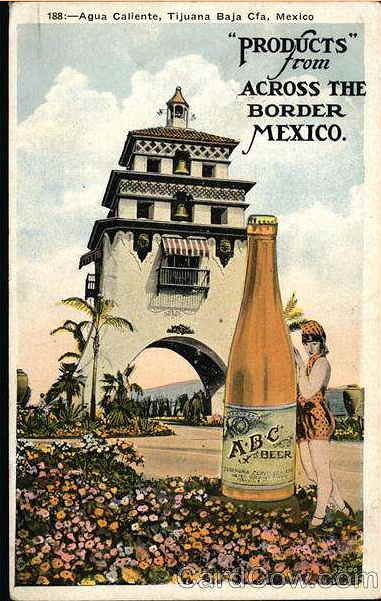
The Aztec Brewing Company was founded in Mexicali (near
Tijuana), Mexico in 1921; it closed in 1953. Postcard.
|
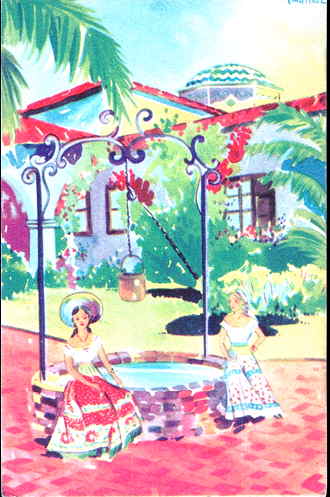
Antique Linen Postcard of Wishing Well, Agua Caliente Casino, Tijuana, Mexico. Artist-signed by Rafael Martinez and entitled "By the Wishing Well."
|
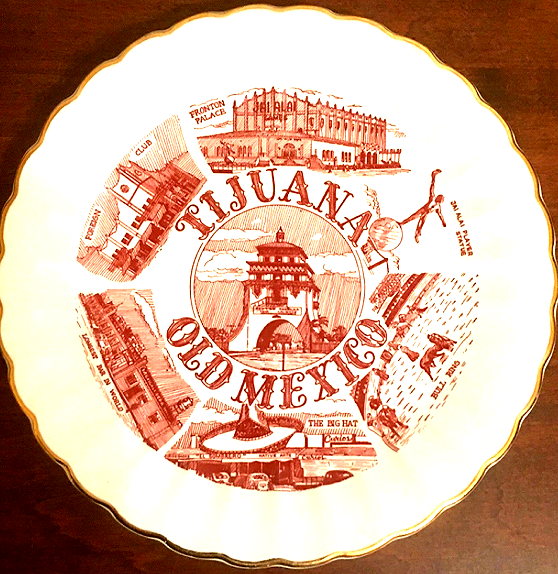
Souvenir plate. Iconic Bell Tower in center.
|
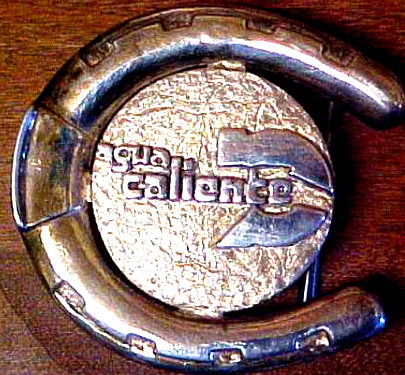
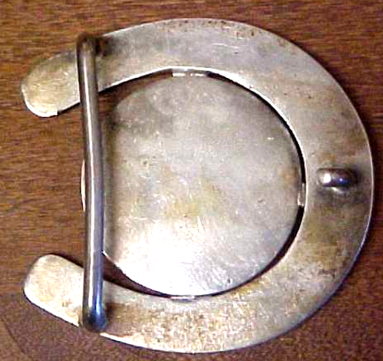
Racetrack belt buckle. Horse racing silver
presentation. THIS MEASURES 1-1/2 INCHES X 1-1/4 INCHES AND FITS A UP UP A 1-1/4 INCH WIDE BELT. Click here to see the reverse side.
|
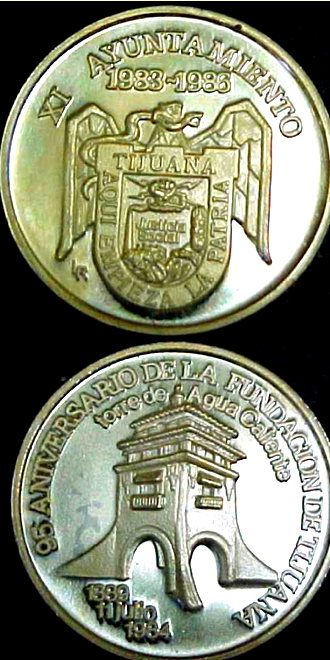
Silver medal depicting the iconic Bell Tower at Agua Caliente. Issued on anniversary of the construction of the Tijuana Town Hall.
|
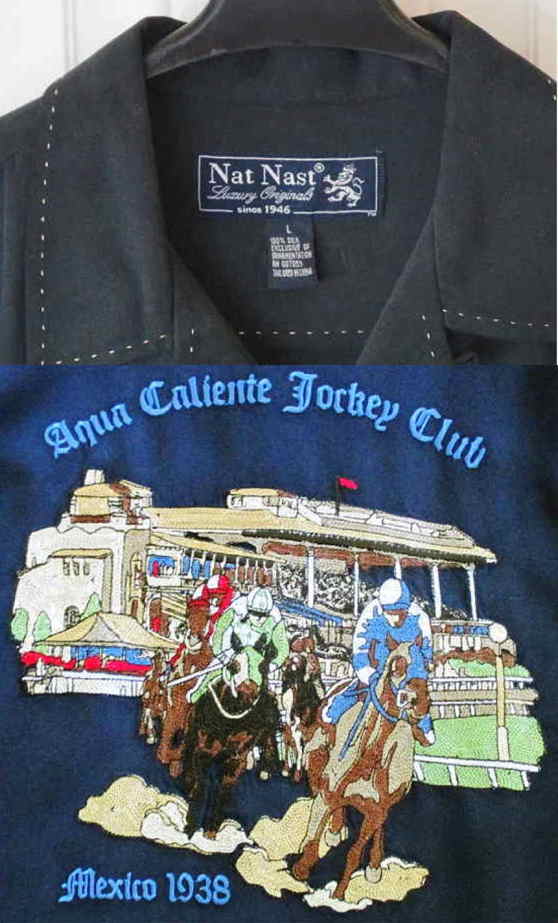
NAT NAST ORIGINAL LTD ED #192 " AGUA CALIENTE JOCKEY CLUB, MEXICO-1938 " 100% silk shirt. Color black.
embroidered back, orig retail $195. I don't know why the label
says "since 1946" and the back has a 1938 date, but that is the way
it is.
|
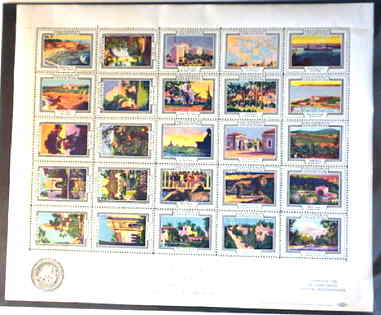
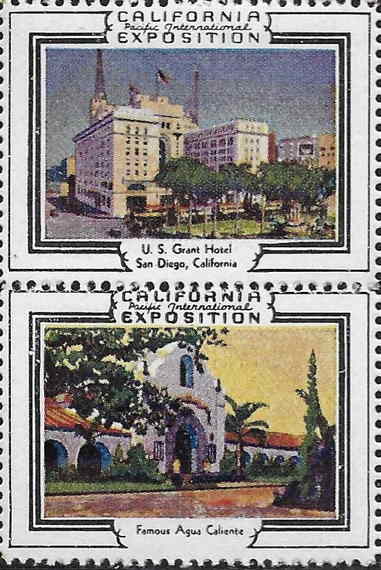 Sheet of the official stamps of the 1935 Pacific International Exposition in Balboa Park, San Diego, CA.
The stamps show pictures of 25 attractions in the area, including two
hotels owned in part by Baron Long, U.S. Grant and Agua Caliente.
|
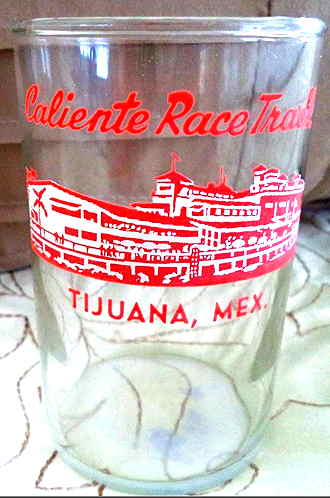
Drinking glass Caliente Race Track.
3-1/2 inches.
|
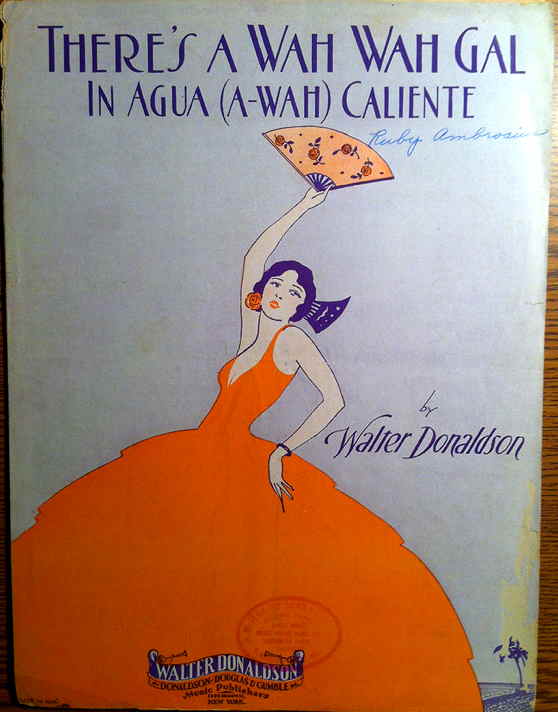
Sheet Music: "There's A Wah Wah Gal In Agua (A-Wah) Caliente," by Walter Donaldson, copyright 1930. Here are three
YouTube 1930 jazz recordings (words and music) of the piece,
accompanied with pictures from the period (girls, Agua Caliente scenes,
etc.): Johnny Johnson and his Port Lodge Orchestra , Isham Jones And His Orchestra and Boswell Sisters .
|
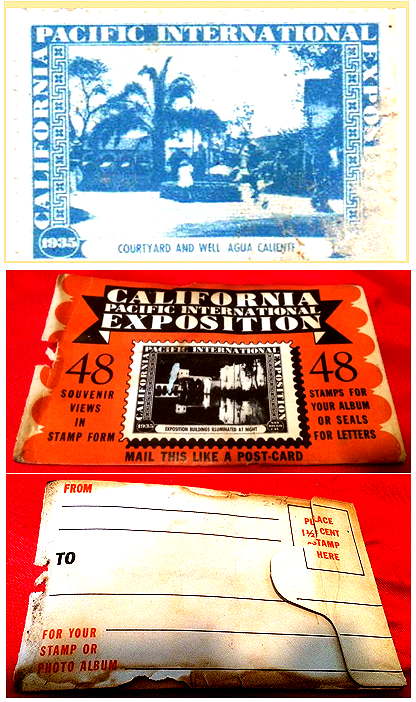
Wishing Well and Entrance to the Casino.
Commercial (not US Post Office) stamp
issued for the 1935 California International Expo.
"1935" at the lower-left; "San Diego Cal." (obscured) at the lower-right.
It came in the Souvenir Mailer Folder of
48 stamps. See below for three more "stamps.". Published by
Stamp Guild, 23 W 47 St, NYC.
|
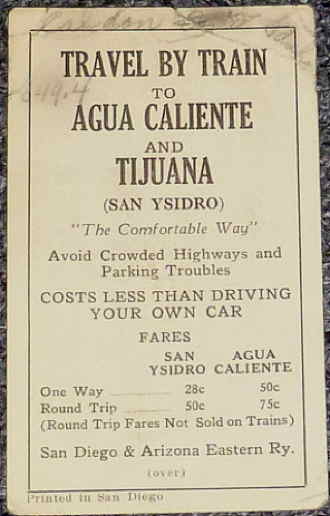
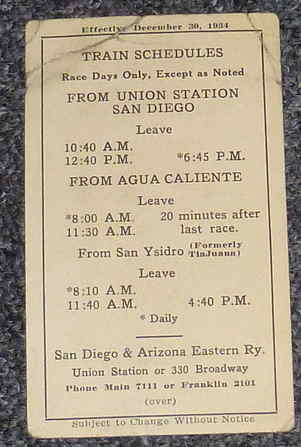
1934 Railroad time table between San Diego and the resort. Each trip was less than $1. Click here to see the reverse side. (San Ysidro, on the US-Mexico border, became a part of San Diego in 1957.)
|
Soda bottles. Left: Paper
label reads �Agua Caliente Pale Dry Ginger Ale, Cloverleaf Products Co.,
Los Angeles, Net Contents 12 FL OZ., A Most Refreshing Beverage�.
The shoulder label reads �Agua Caliente Pale Dry Ginger Ale.�
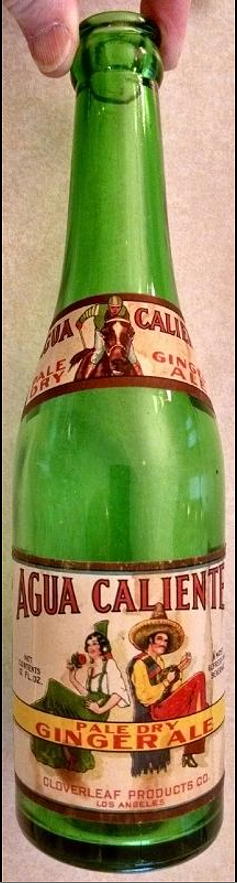
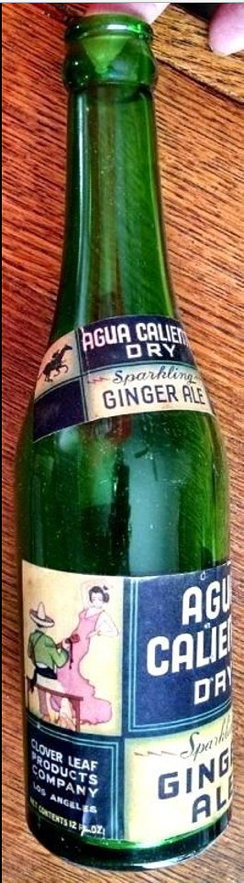
Approximately 9 � inches tall. ... Right: "Sparkling Ginger Ale," made by the same company. Also 12 FL OZ. and 9-3/4 inches.
|
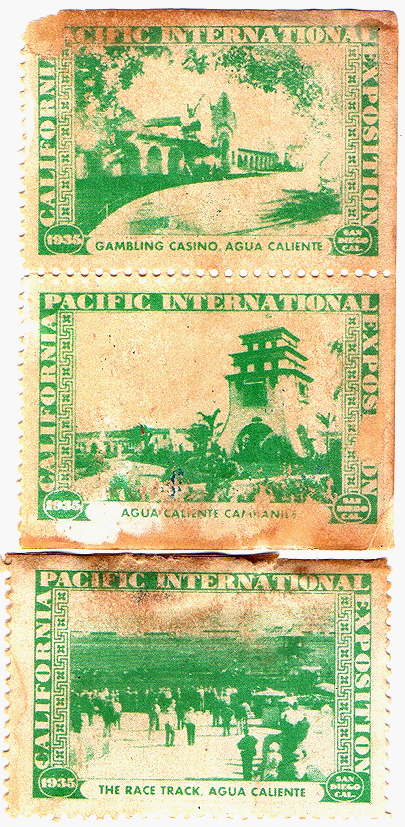
Three more Expo "stamps." See row above.
From top to bottom, you have the resort's hotel building (not the "casino" building), bell tower and race track.
|
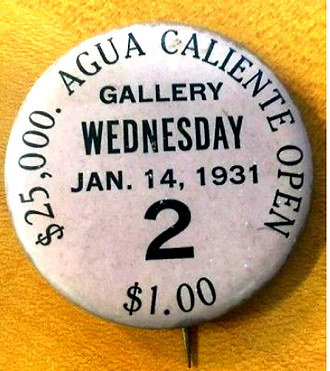
Celluloid pinback from the 1931 Agua-Caliente Golf Tournament.
Per seller: "from ...tournament held in Tijuana, Mexico. This is a rare
gallery pin ( marked # 2) from the tournament, which was first held a
year before in 1930 (won by legend Gene Sarazen). The 1931 Open was won
by Johnny Golde."
|
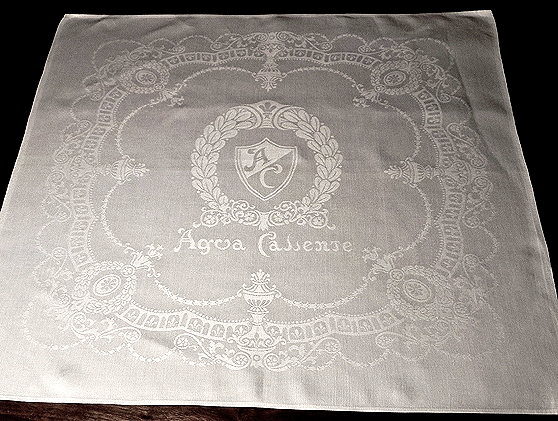
Large Linen Damask Dinner Napkin from Aqua Caliente Resort
Casino Tijuana Mexico. Napkin has the hotel's logo centered on a
field framed Urns, Floral flourishes and Ogee forms. Below the logo it says "Agua Caliente." Size:23 x 24 inches
(approx.).
|
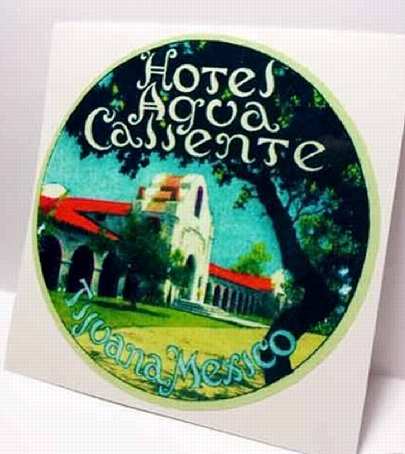
Luggage label decal -- shows Hotel
entrance.
|
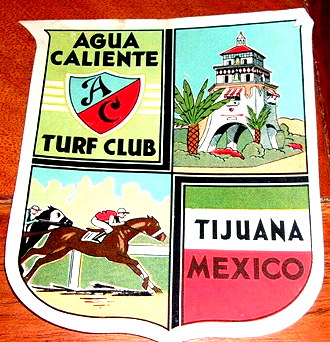
Decal for Agua Caliente's Racetrack Turf Club. About 3-1/4 x 4 inches.
|
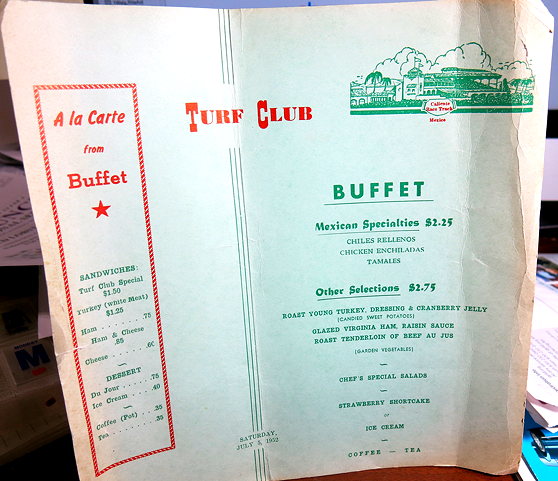
Agua Caliente Race Track "Buffet Menu." 1952 date is at bottom left. Upper right, under picture, is "Calinte Race Track."
|
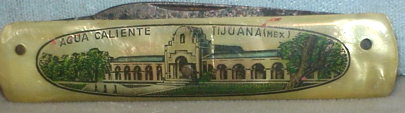
Souvenir knife. By A. Feist, Solingen, Germany.
Blade is 2-7/8 x 1-1/2 inch. Says "Agua Caliente,
Tijuana (Mex)." Picture of hotel entrance.
|
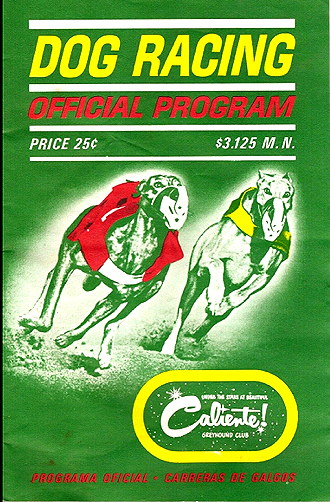
1967 Dog Track program.
|
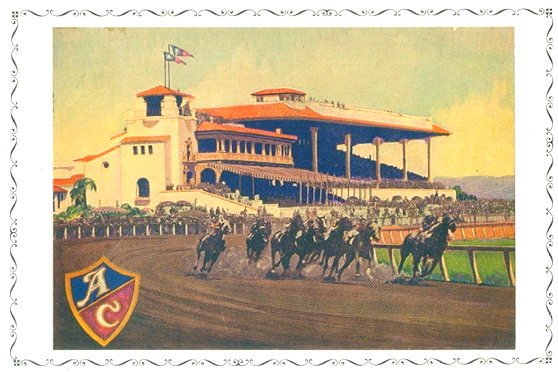
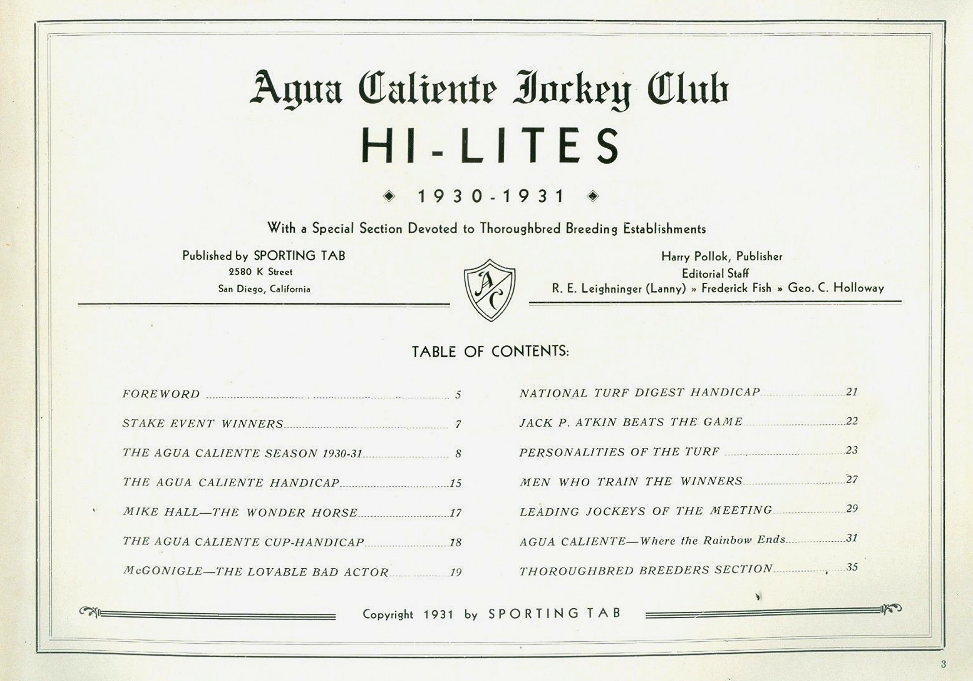
Front cover of 46-page booklet, 9 x 12 inch pages, of "Hi Lights of the 1930-31" Racing Season of the Agua Caliente track, by the Agua Caliente Jockey Club. Chock-full of information as seen from the table of contents.
|
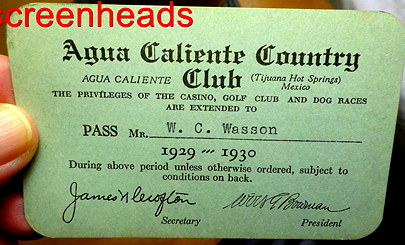
Agua Caliente Country Club Card granting privileges to Casino, Golf Club and Dog Races.
|
|
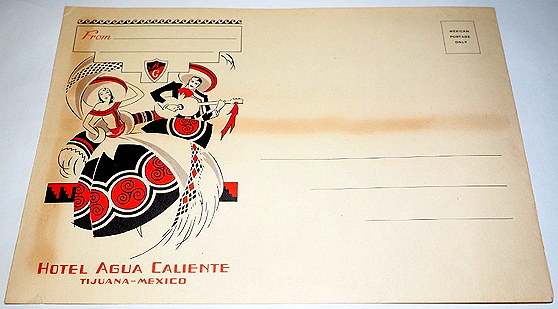
Envelope, 7.5 x 10.5 inches.
|
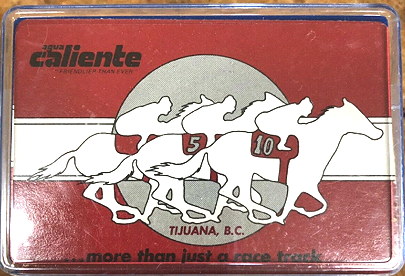
Playing Card Deck. Back of
the cards reads: "Caliente . .. Tijuana, B.C. .... more than just a
race track." The "5" and "10" on the saddles refer to the famous
innovative 5-10 (Big 6) long-shot bet inaugurated at that track.
While the Big 6 is an attractive bet for small punters (BIG rewards for
LITTLE outlay), it is very difficult to win. The better must
select the winner in 6 races, here the 5th thru 10th race.
|
286 pixels 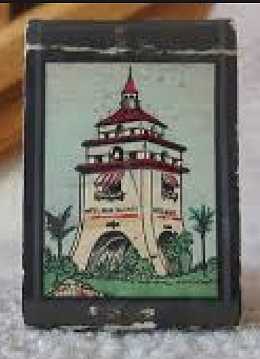
Matchbook with the iconic Bell
Tower on it.
|
558 pixels
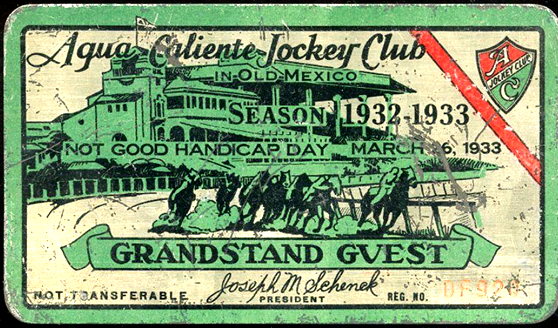
Agua-Caliente Jockey Club Grandstand Guest Pass -- 1932-1933
Season .
Made of metal, 2 x 3-1/2 inches.
|
372 pixels
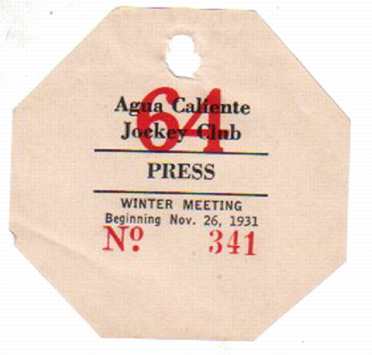
1931 Press Pass to Jockey Club.
|
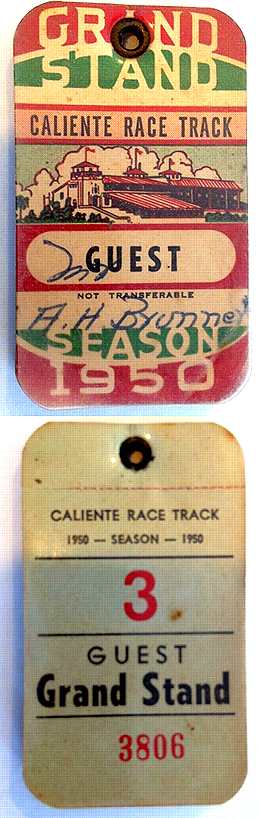
1950 Grandstand Pass
ticket booklet
|
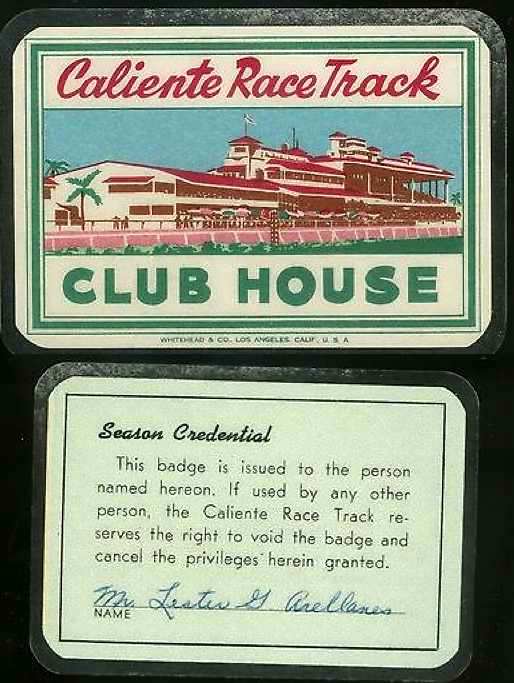
Club House Pass, undated.
|
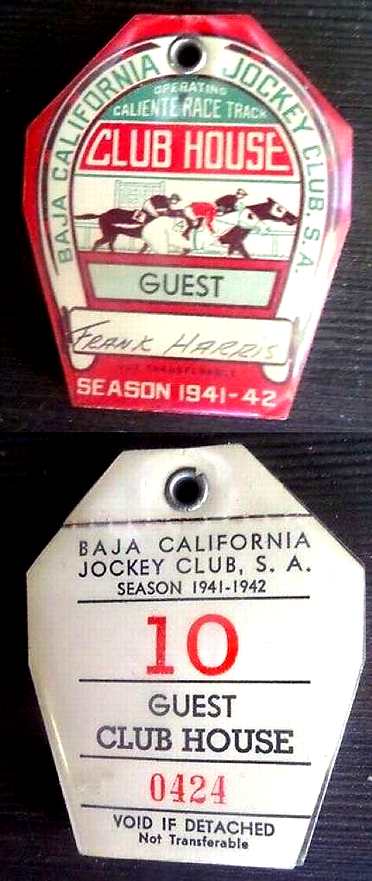
1941-42 Club House Guest Pass.
|
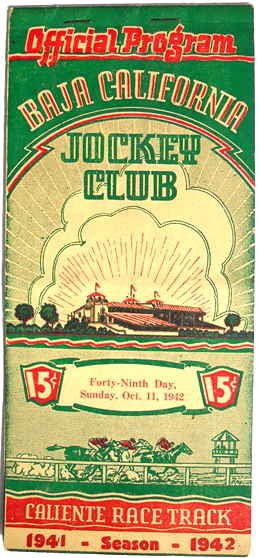
1942 Official Program
|
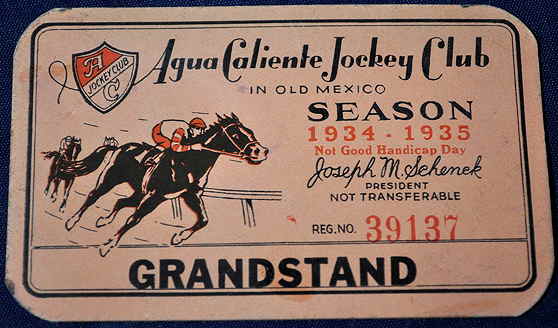
Jockey Club pass, 1934-1935
|
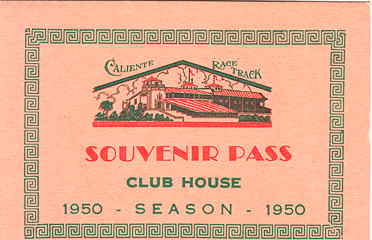
Souvenier Pass, Club House, 1950
Jockey Club pass, 1930-31
|
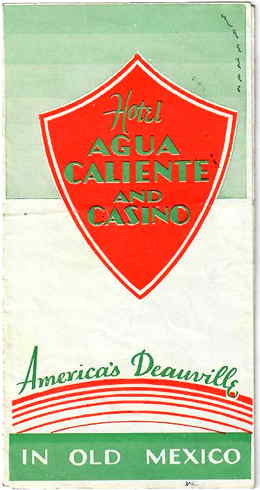
brochure, 3-1/4" x 6-3/8."
|
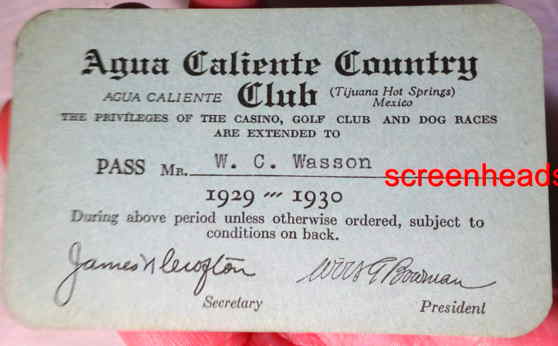
Country Club pass, 1929-1930
|
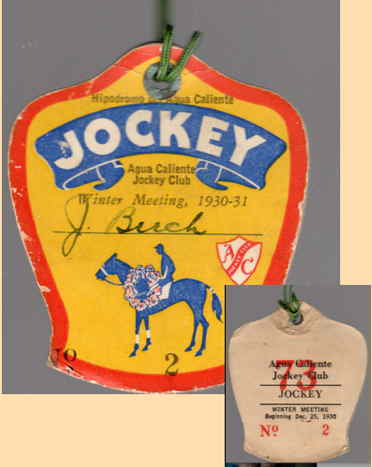
Jockey Club pass, 1930-31
|
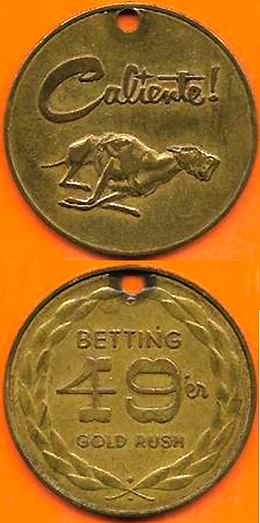
Key chain souvenir issued
in 1949, 32mm, for dog track
|
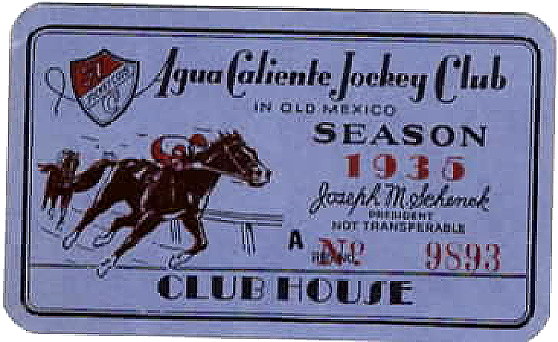
Club House pass, 1935 season.
|
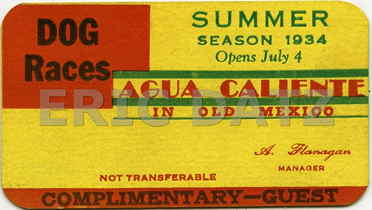
1934 season pass to dog races
|
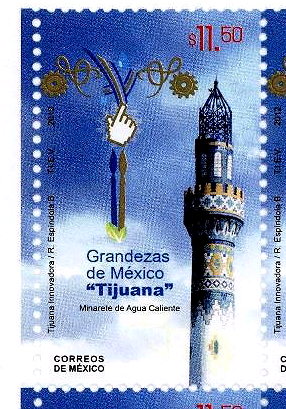
2012 Mexican postage stamp showing the minarette. Translation top to bottom: Greatness of Mexico, Tijuana; Minarette of Agua Caliente; and Mails of Mexico.
Thanks to Miguel Angel Alvarez Gonzalez for the picture.
|
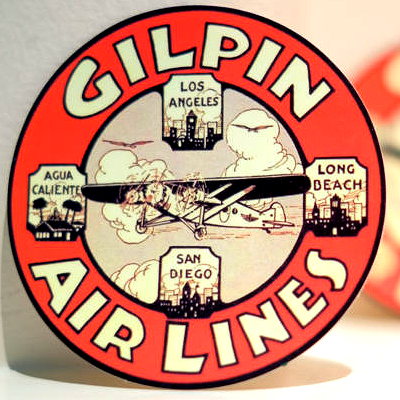
Retro luggage decal of the airline that took the Hollywood elite, and
others, to Agua Caliente. The Gilpin Airline brochure and timetable
is seen some pictures below. The label is 3" diameter.
|
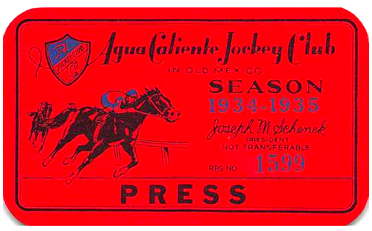
Press Pass to 1934-1935 season
|
|
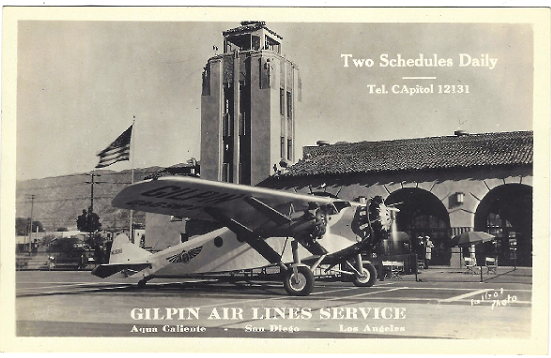
Real Photo PostCard for Gilpin Air Lines. Note the destinations at the bottom: "Agua Caliente . San Diego . Los Angeles."
|
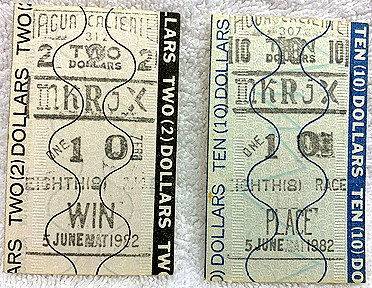
Tote tickets issued during the last season (992) the track was open for live horses betting.
|
|
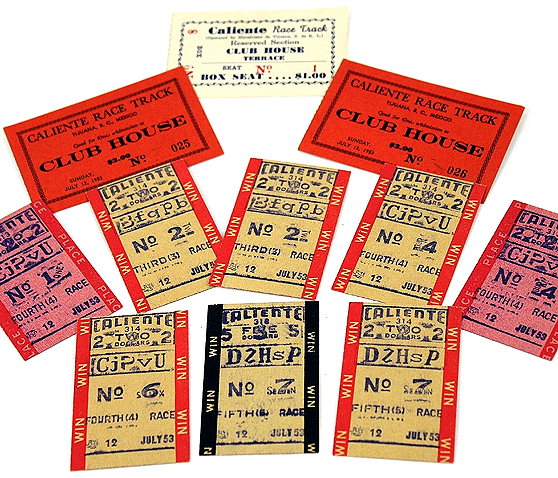
11 Caliente Race Track tickets, July1953. 8 race track tickets, 2 Club House admission tickets, and 1 Club House box seat ticket.
|
|
|
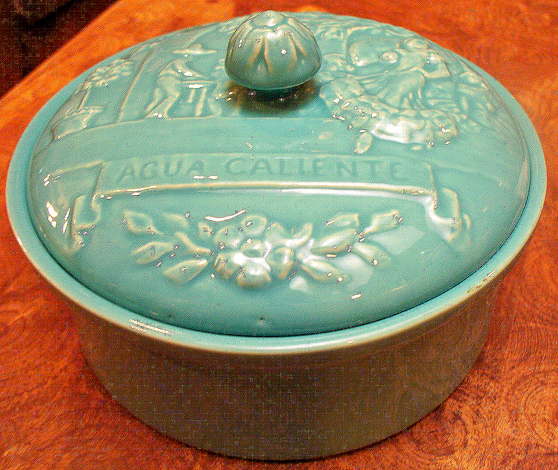
1930's Gladding McBean Agua Caliente NASCO California Pottery Casserole Dish with lid.
Note "Agua Caliente" embossed near center of lid. This was Made for the National Silver Company for the 1935 Pacific
Exposition. Measures approximately 8" round and the casserole dish
itself is 3" tall without the lid-- with the lid it is 5" tall.
|
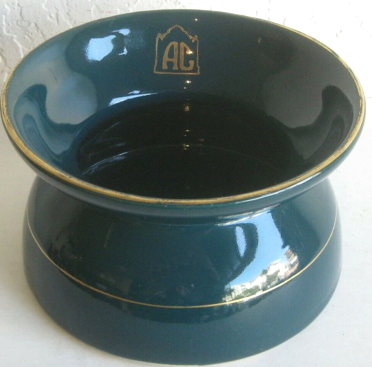
Spittoon from the Agua Caliente Hotel-Casino
and Race Track� � Made by Hall's China . Has the advertising logo
on the inside surface as seen in the photo. . Measures approx. 7 1/4"
wide by 4 3/8" tall. Weight is 3 pounds 2 ounces unpacked.
|
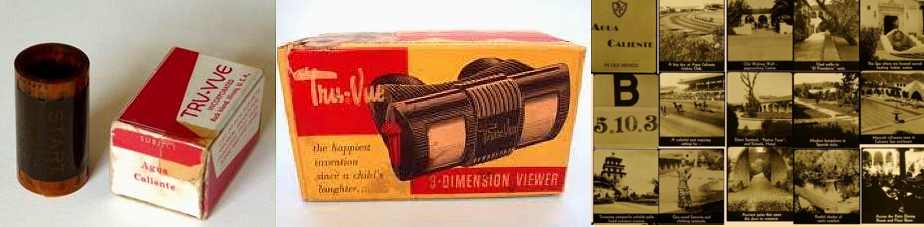
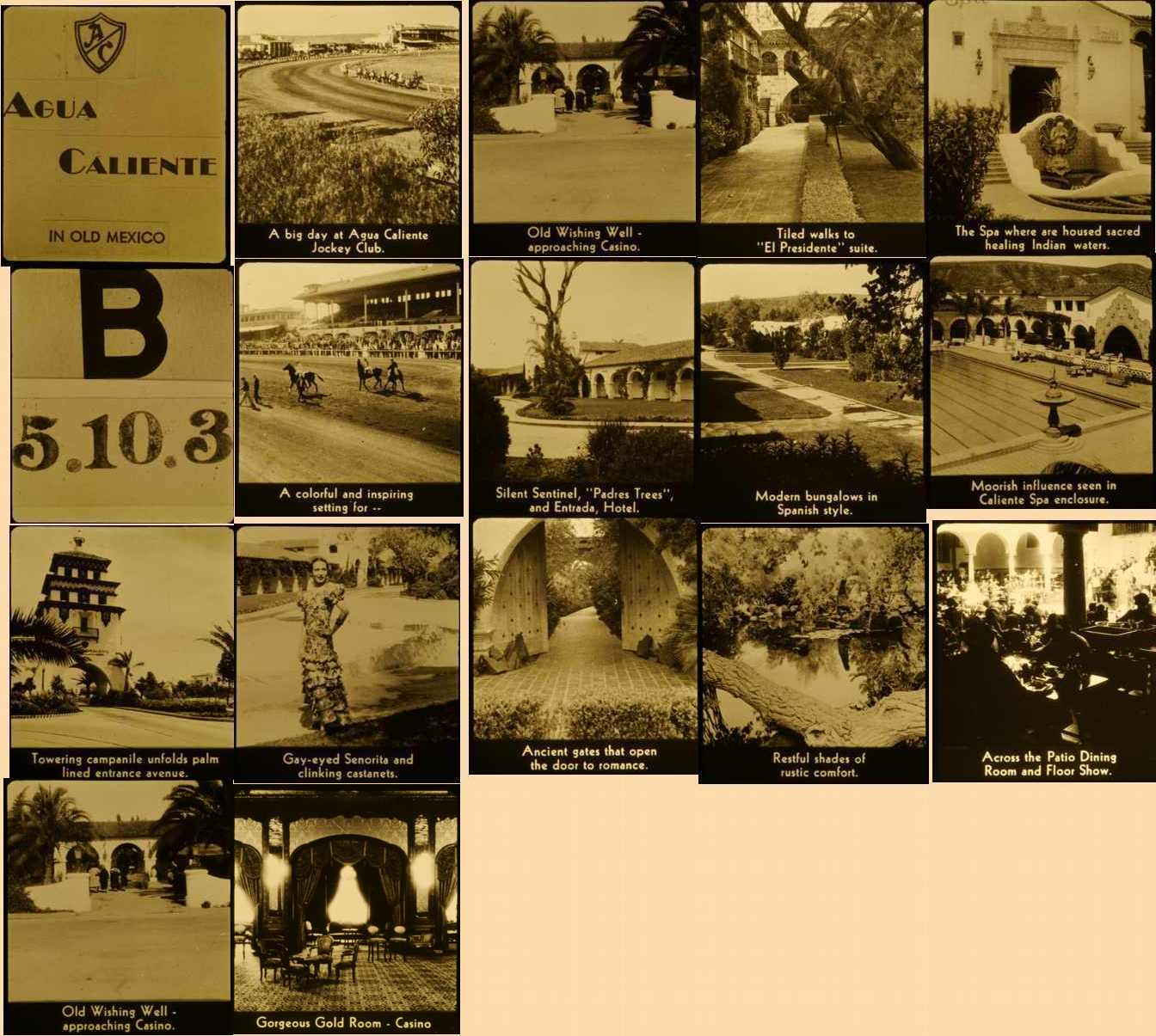
One of the first Tru-Vue filmstrips featured the then-current (1930s)
Agua Caliente resort. Click here
to see the views on the filmstrip.
(Tru-Vue was a company that existed in Rock Island, IL from 1931-1951 that
manufactured stereoscopic filmstrips.
They were fed through a slide viewer, similar to a View-Master, which was
art deco or streamlined in style.
The viewers were made of bakelite and available in multiple colors. When
held up to light the images appeared in 3D.)
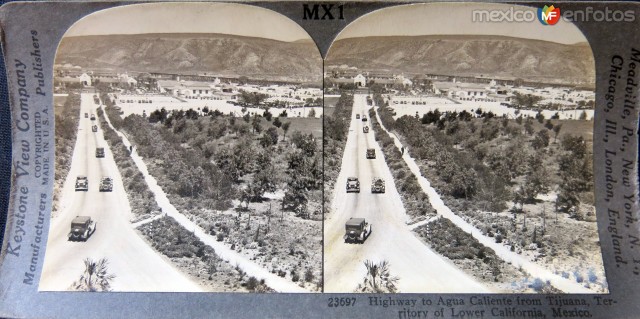
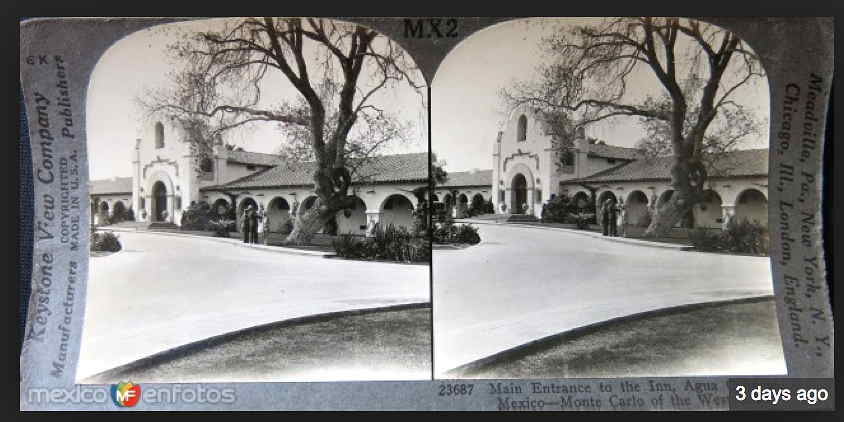
Stereoscopic photo from Keystone View Company. Shows road past the bell Tower,
leading to the front entrance of the Hotel. Casino and Bungalows, at upper right.
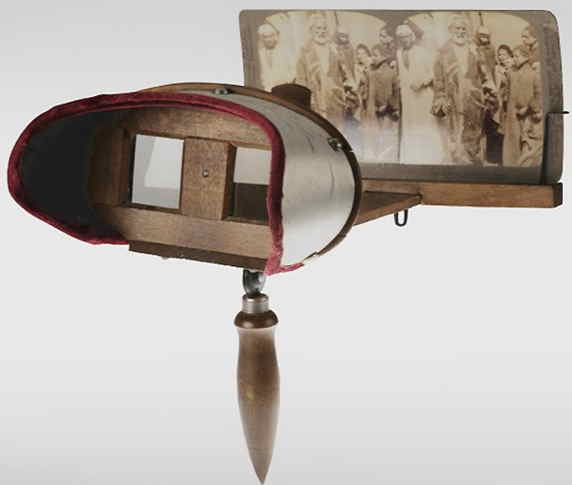
Here is a stereoscopic picture of the Hotel. Stereoscopic photos are viewed in holders like this one.
.
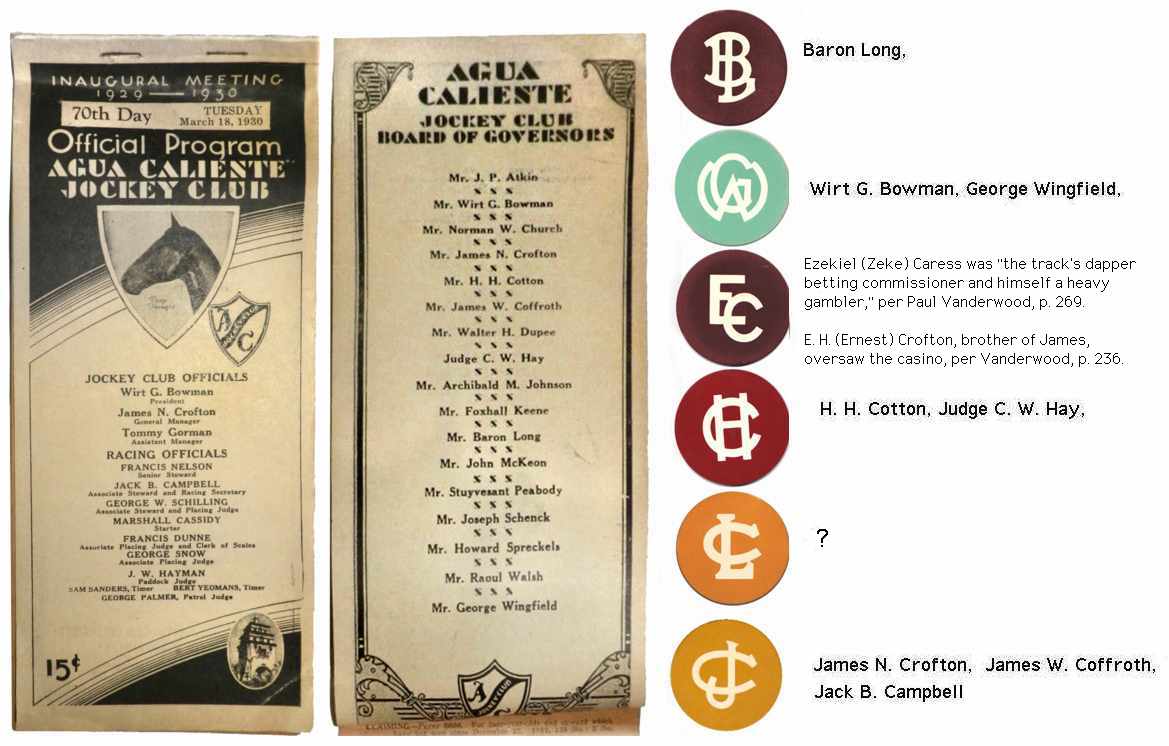
Program
and chip pictures from Roy Klein. Chip
identification possibilities, clues.
The
above green chip is undoubtedly Bowman's as those
who knew him referred to him as "WG."
The
CJ chip is probably Crofton's, one of the "Border
Barons," the opinion of author Prof. Paul
Vanderwood, too.
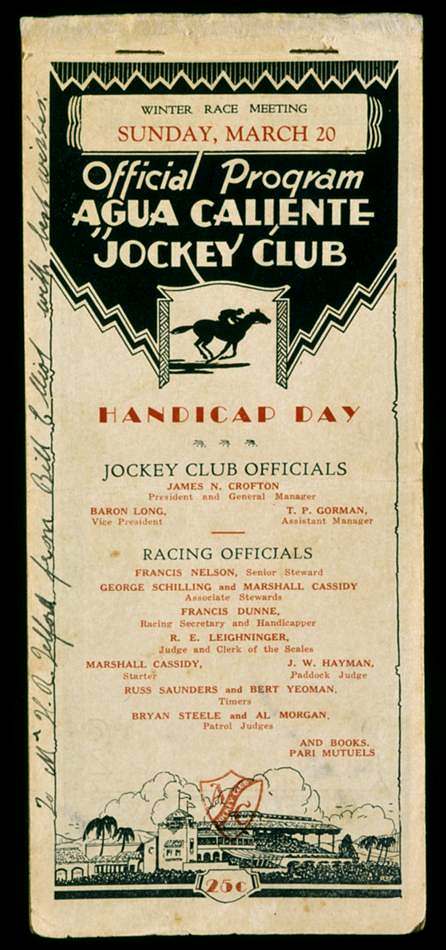
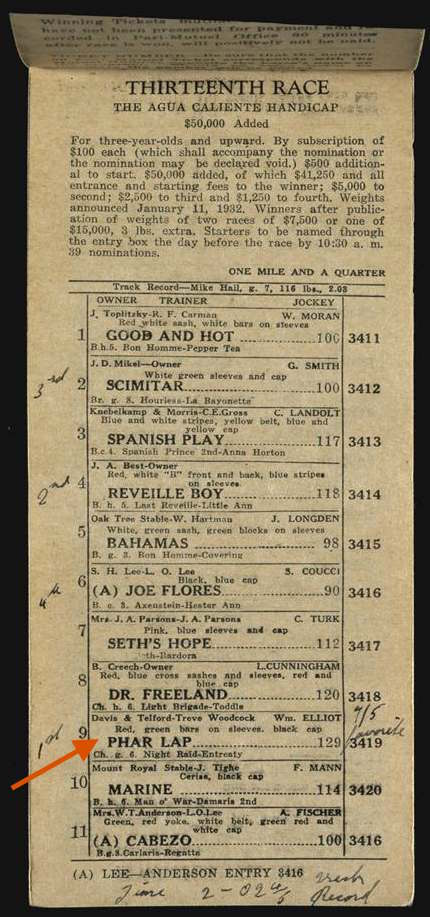
Programme of the day PHAR LAP won the Agua
Caliente Handicap, March 20th, 1932!!!!
This race was significant
as the only race ever run by Phar Lap outside
of Australia.
This copy is handsigned by jockey Bill Elliot
to his trainer Harry Telford, who had remained in Australia.
(Source.)
One of the most famous horse races ever run
anywhere! Read about it and see the video of the race here.
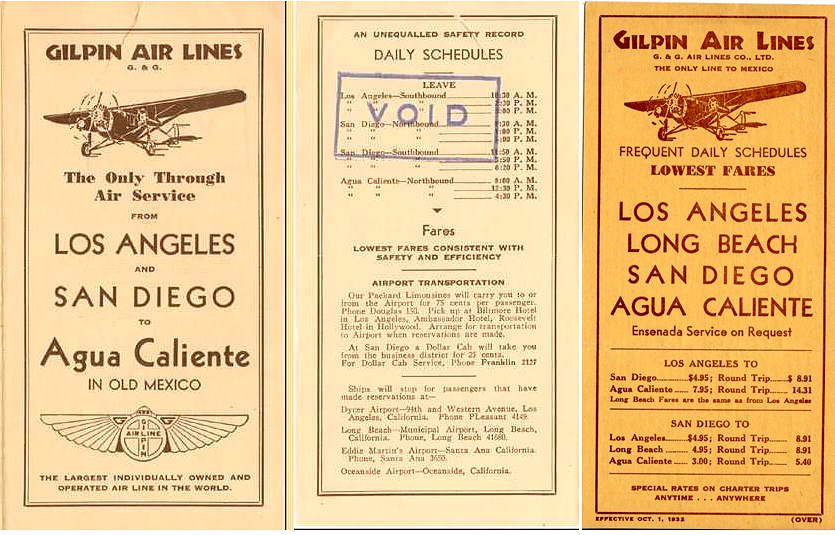
Gilpin Air Lines serviced the resort from California.
Above are their brochures including the Daily Schedule.
Elsewhere in the brochure they touted their safety ("Over
a million miles without an accident of any kind")
and speed ("cruising speeds of 125 miles per hour"). A plane ride from Los Angeles to Agua Caliente
cost $14.31 per passenger round-trip per the brochure on the right, October 1932 rates.
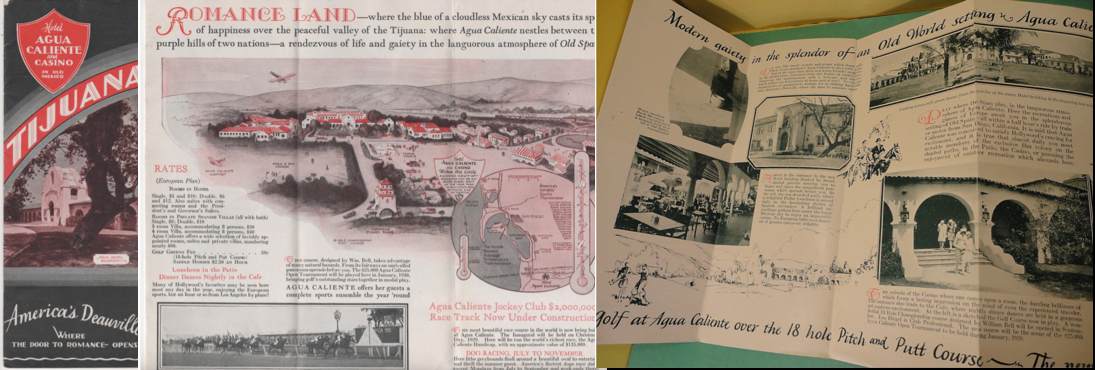
Brochure: "America's Deauville -- Where
the Door to Romance Opens." Goes for about $50.
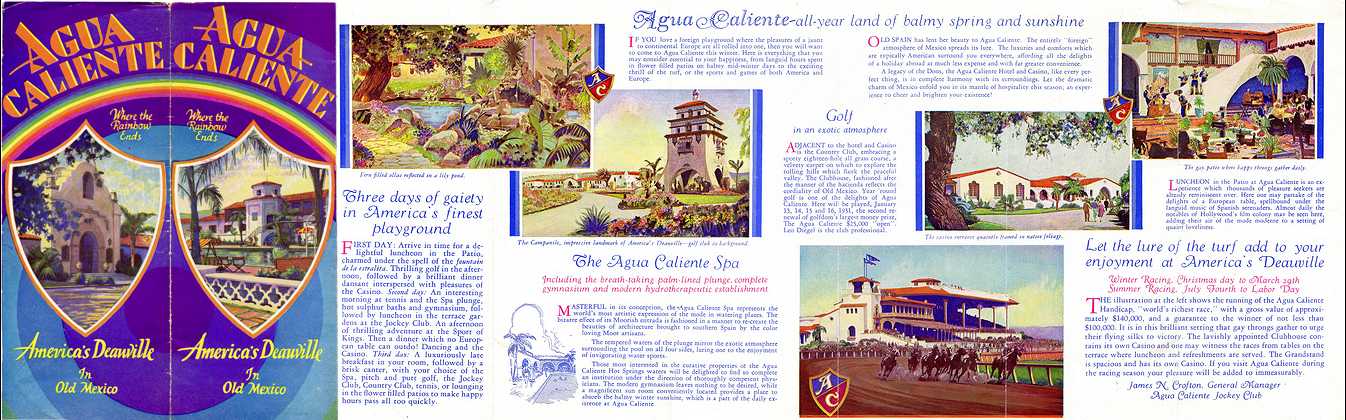
Another brochure -- it also includes
the blue and yellow map near the top of this web page.
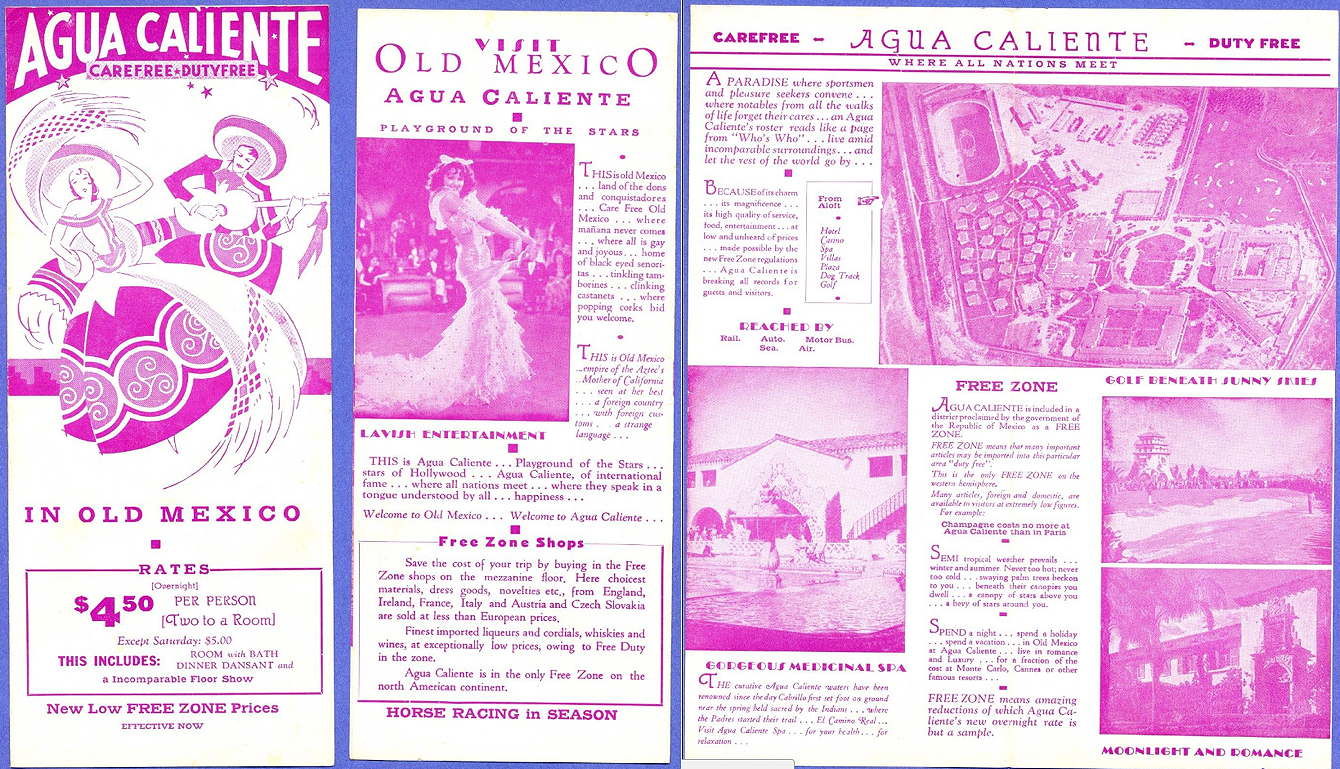 Another brochure.
 Note the duty free zone and the $4.50 rate per day for two, which includes room, dinner and floor show!
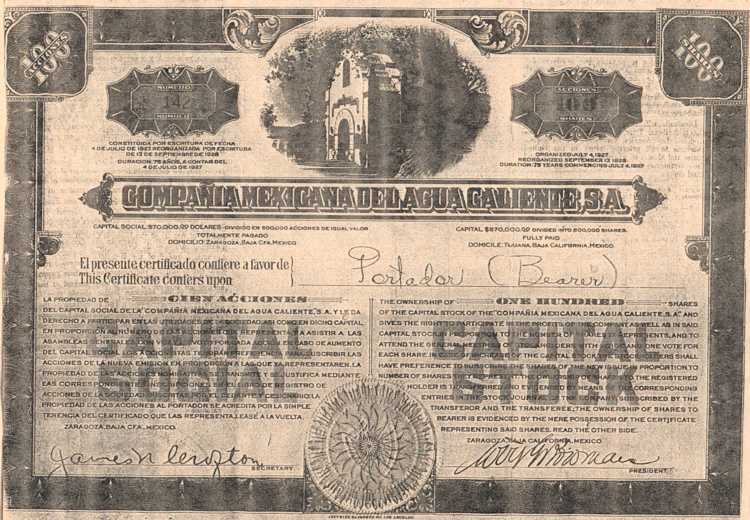
100 shares of stock in the Agua Caliente Company.
Note that the left side is in Spanish and the right in English.
The hotel entrance is pictured.
It says that the company was organized on July 4,
1927
and reorganized in 1928, the year
the resort opened.
Note the signatures: James Crofton,
Secretary, lower-left; and Wirt Bowman, President, lower-right.
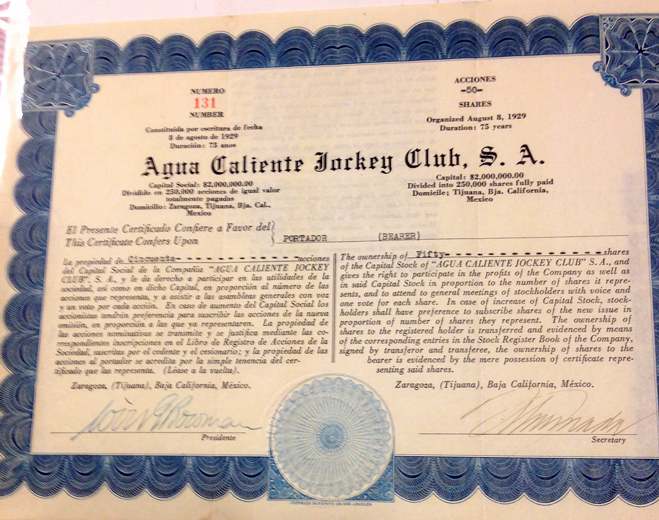
Agua Caliene Jockey Club, S.A., 50 shares of capital stock, orgnizedAugust
8, 1929,
made out to "Bearer," signed Wirt Bowman, President.
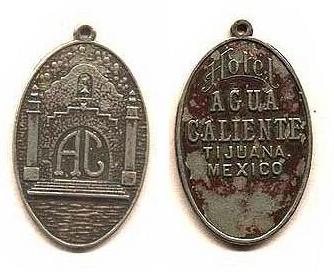
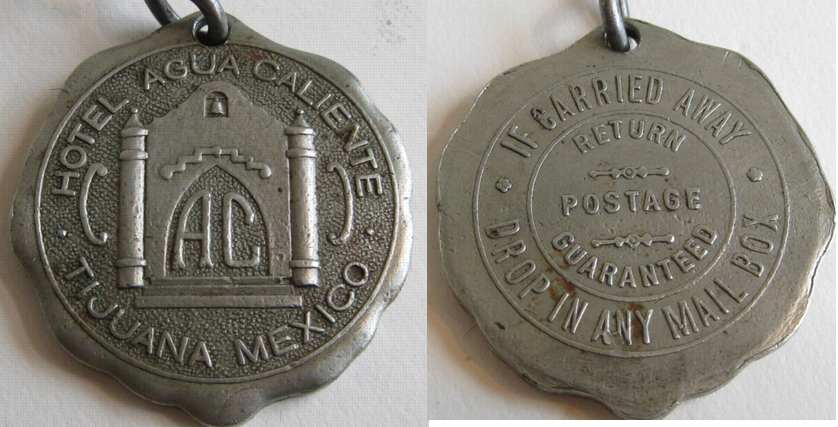
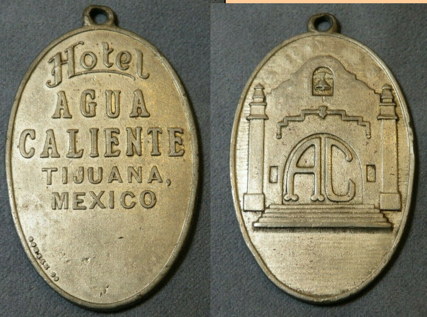
Key fobs from Hotel Agua Caliente; both sides
of each are shown.
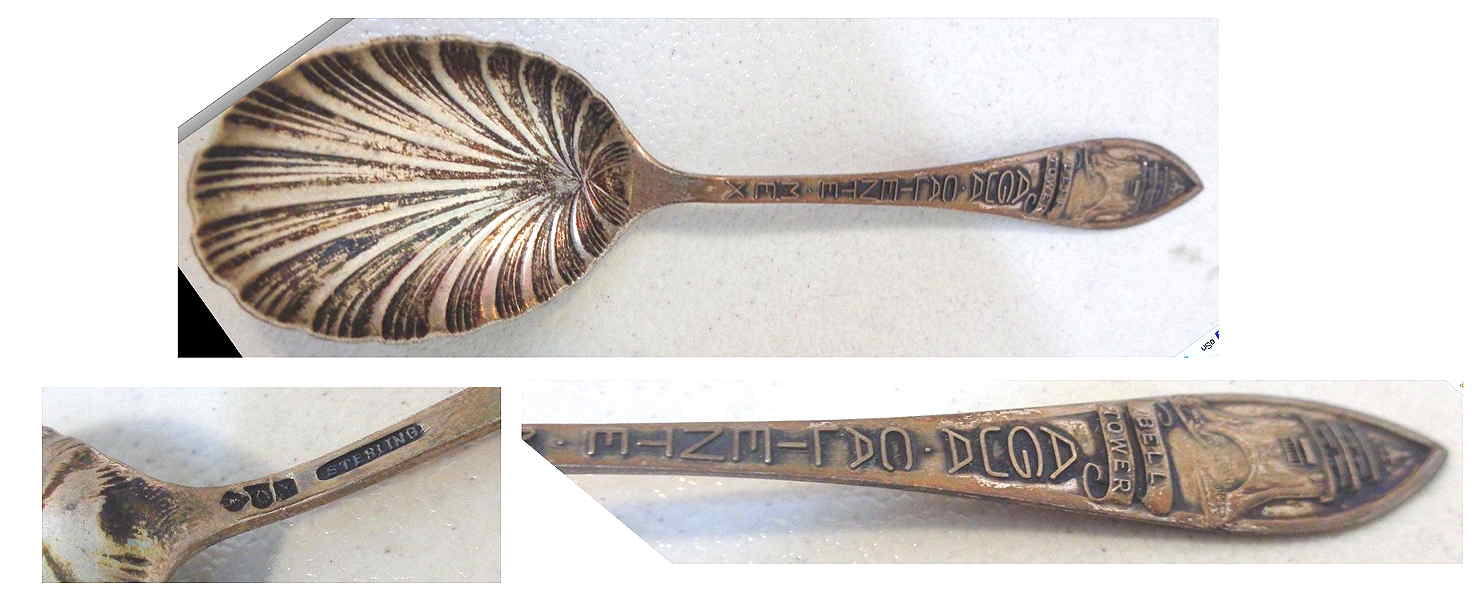
Sterling vintage souvenir spoon of Agua Caliente, with patina. Note the "Bell Tower" at the end of the spoon. 5-1/8 inches, 15.1 grams.
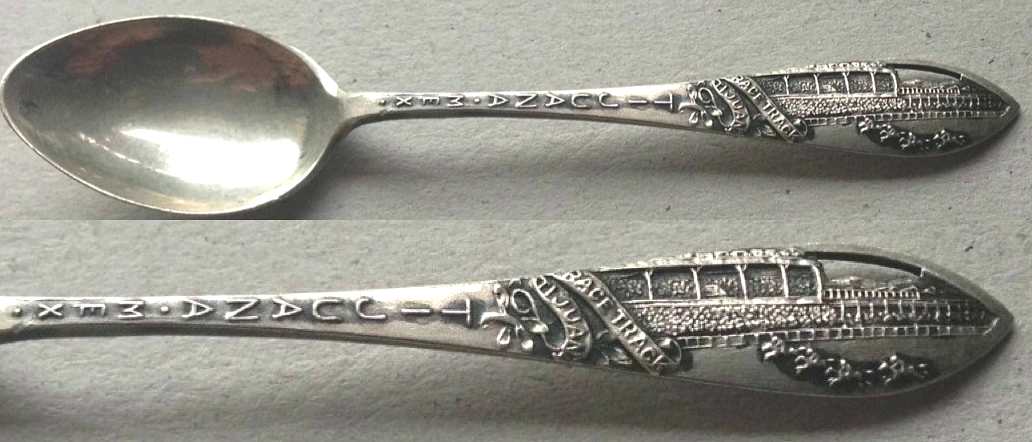
Sterling Silver mini spoon measuring 3.25 inches
in length. The handle features an embossed
image commemorating the Agua Caliente race track.
The stem has "Tijuana Mex." running down towards
the bowl. The back of the stem is hallmarked
with "Sterling" and a maker's mark.
This spoon weighs about 4.4 grams.
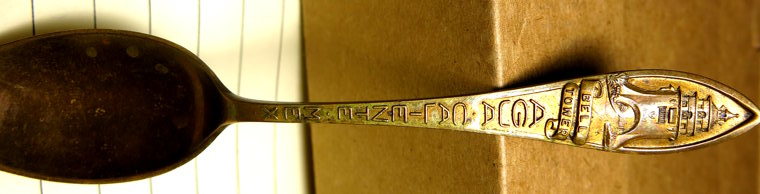
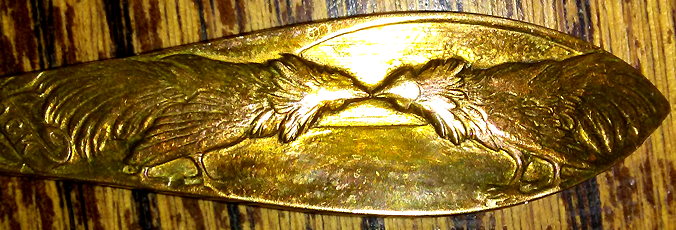
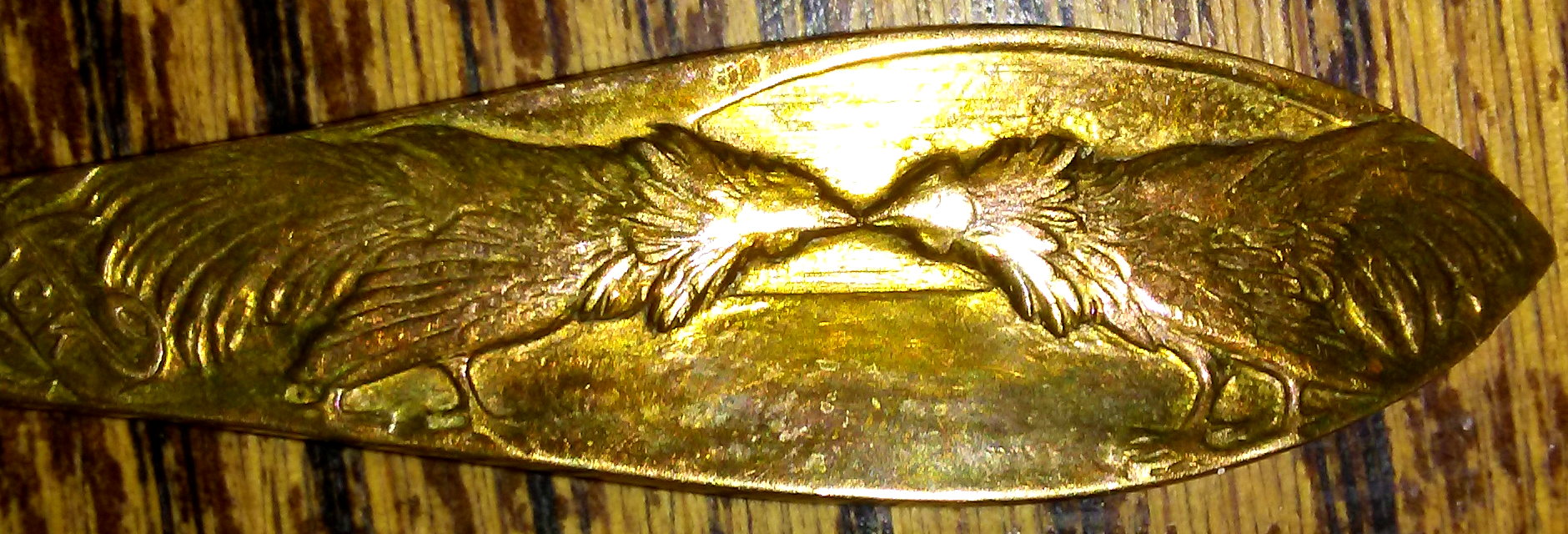
Souvenir spoon: "Bell Tower" on the front with title "Agua Caliente"(pictured above); and two fighting cocks (birds),
shown above, on the reverse, with the notation "Cock Fight," also it says "Tijuana Mex."
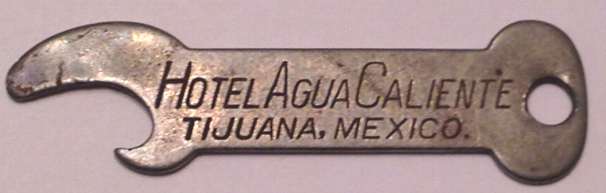
Bottle opener. Approx. 3"
long. I picked this up March 2014 for $30.
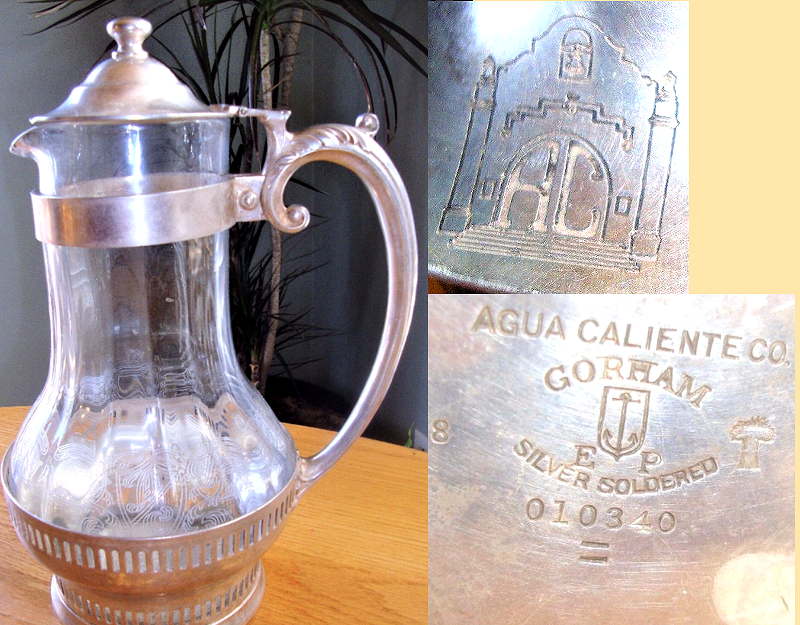
Silver Soldered and Glass Water Pitcher with Hallmark "Agua Caliente Co" and "Gorham EP Silver Soldered" and "8" with "010340.�
Tree Hallmark indicates made in 1928. Measurements: 11" inches
tall, 9" wide includes the handle, base of glass pitcher is 7" in
diameter.
Note the "Agua Caliente" engraving
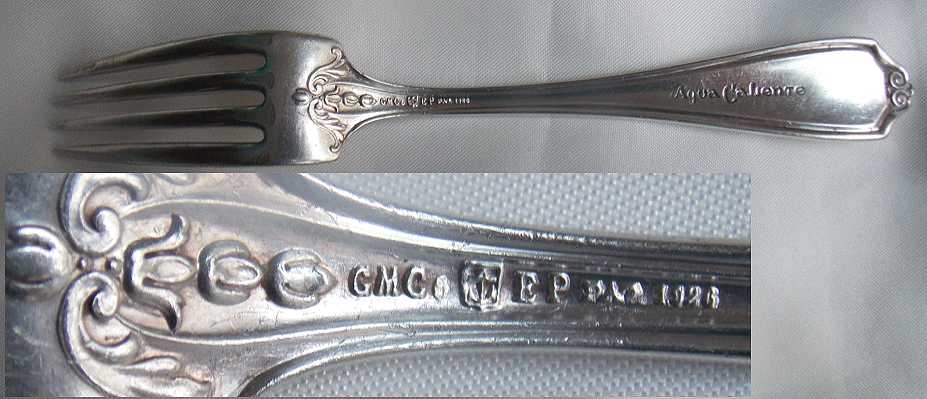
in the upper-right. Gorham Company Silverplate fork.
The fork is marked GM Co. There
is a stamped anchor, then the letters EP, then Pat 1926.
It is 6 3/4" in length.
It went for $57 plus postage on
eBay march 2014.
(GM Co EP
is the trademark by GORHAM MFG. CO. in PROVIDENCE, RI; EP is ELECTROPLATED
METAL WARE.)
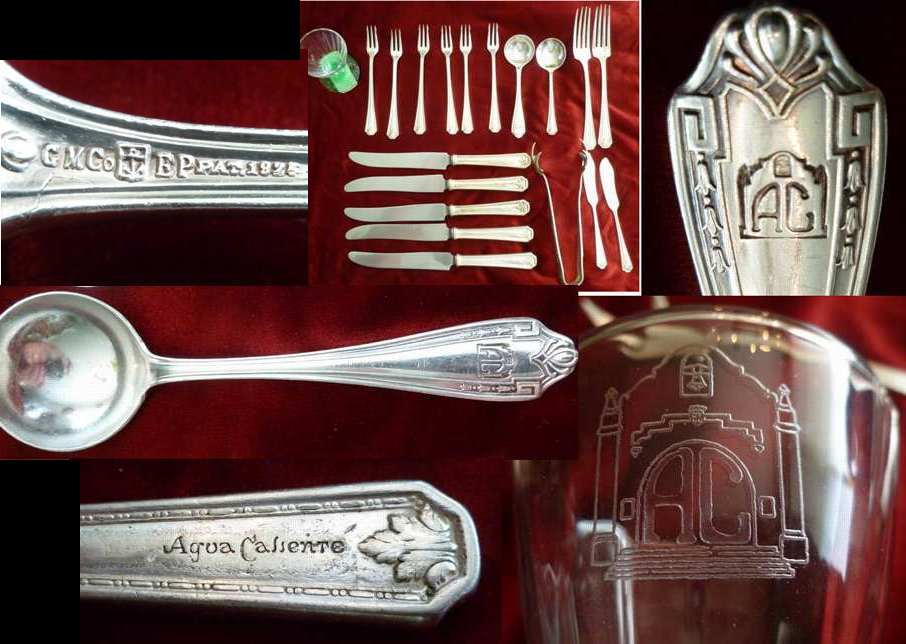
Silverware and glassware from the resort.
From a family whose relatives played in a band there
in the 1930s.
All but the tongs have "AC" or "Agua
Caliente" on them. The silverware is marked "Simeon
L. & George H. Rogers Company AI."
and "International Silver Co." See
the picture above this one for more on the G M Co trademark.
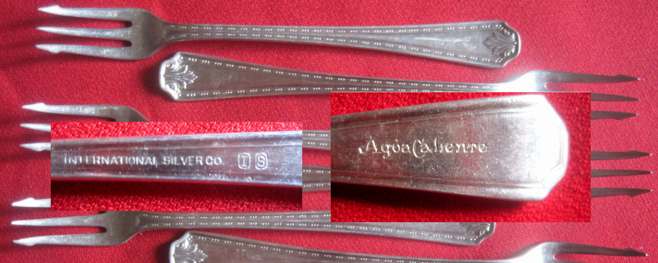
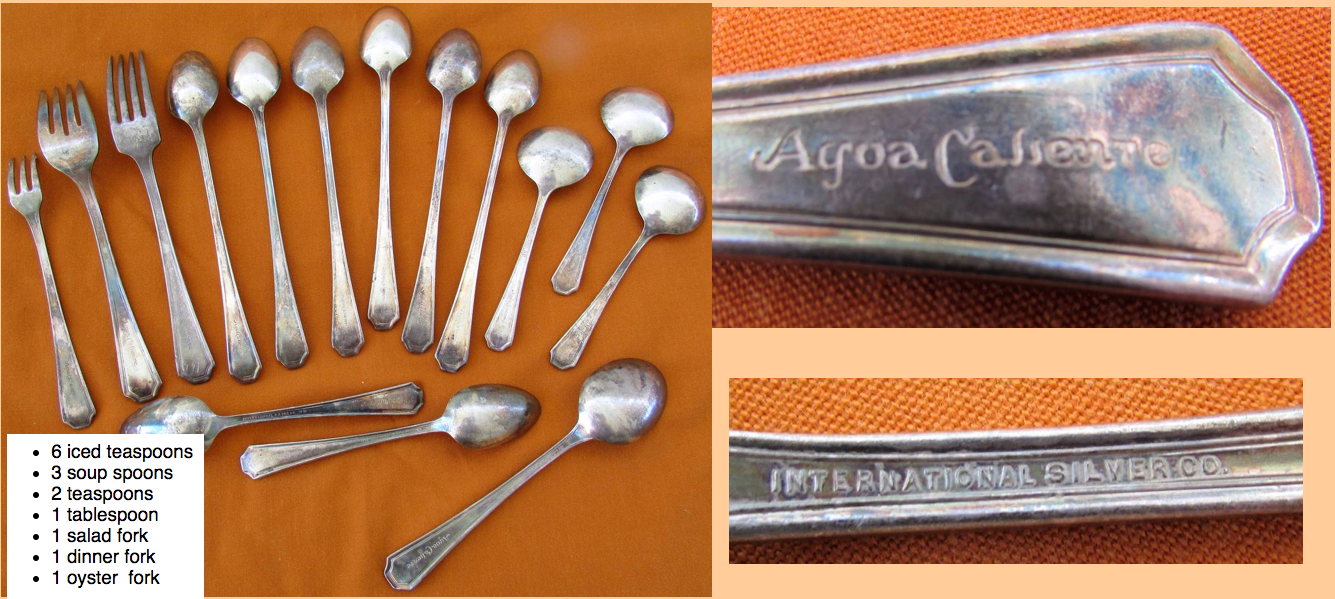
"INTERNATIONAL SILVER CO," PATTERN: ROOSEVELT,
SEAFOOD FORKS - 5 7/8,"
ALL ARE STAMPED ON THE BACK: "AGUA CALIENTE."
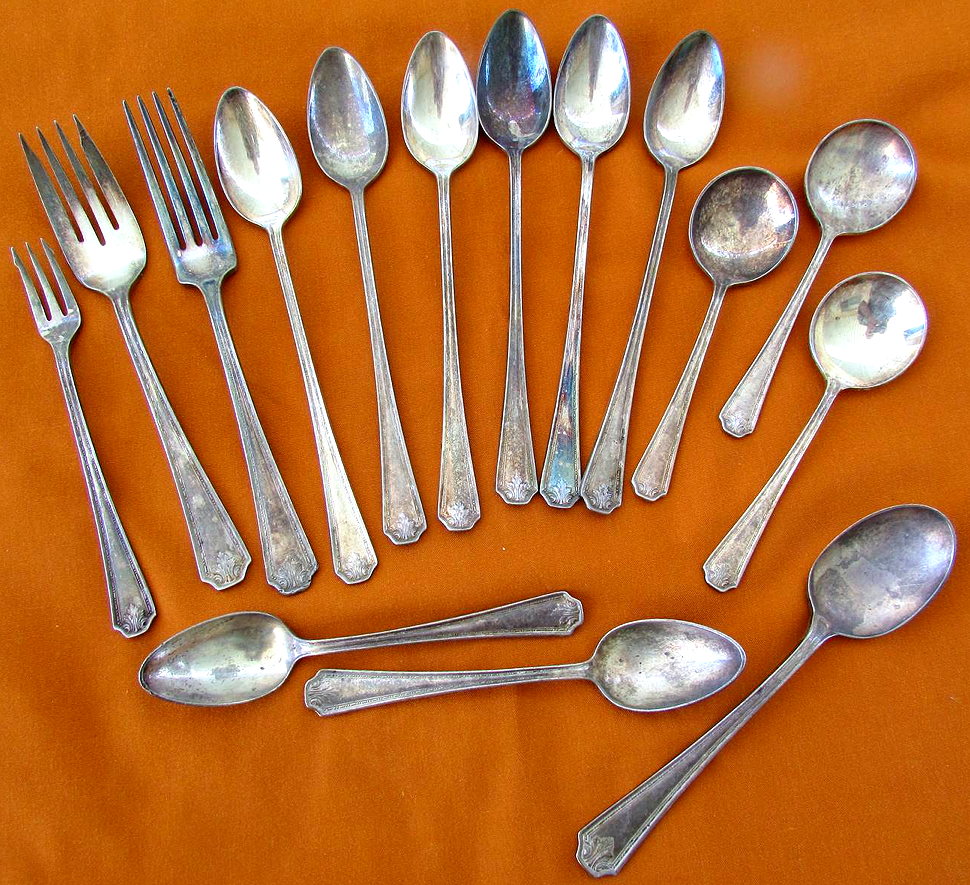 More flatware from the resort.
 Click
here to see the back of the silverware, a close-up of the "Agua Caliente" engraving.
the name "International Silver Co." (most have an "IS" added), and the
names of the 15 pieces shown above that I bought in May 2017.
There are 7 different pieces: clockwise from upper left: oyster fork, salad fork, dinner fork, iced teaspoon, soup spoon,
tablespoon and teaspoon. One expert told me, �These are the
Roosevelt pattern by International Silver and definitely have the
monogram
to be used at the resort (not souvenirs)� �.. The pattern itself was produced by International. �
The resort would have ordered the silverware from International and had them engrave it.�
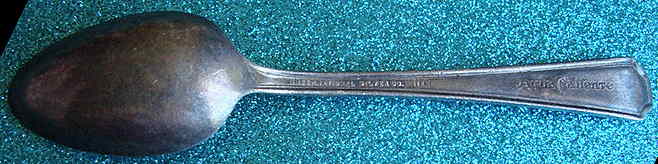 "AGUA CALIENTE" teaspoon, the same size, words, marks, leaf, font-style as the seafood forks above.
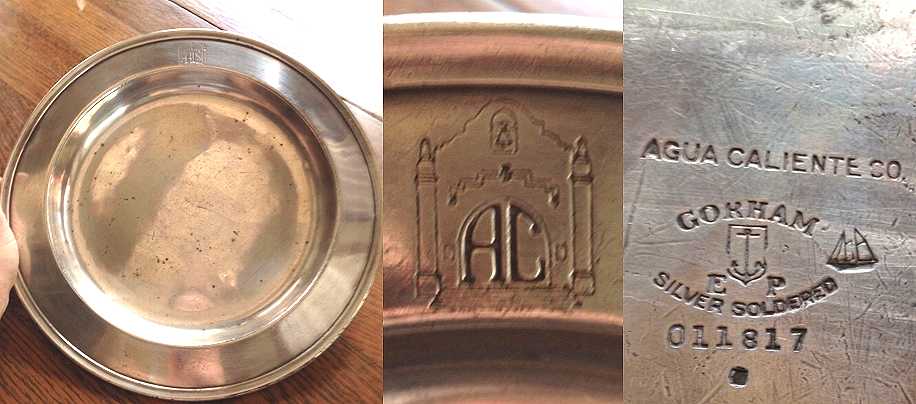
Agua Caliente Silver Charger Plate, Made by Gorham 011817.
Sept 2014, it went for $163 plus shipping at eBay auction.
Measures 11" across. Note: Charger plates or service
plates are larger plates used during full course dinners or to dress
up special events like parties and weddings.
They are not used for food -- the food plates rest atop them.
Note the "AC"-Bldg logo atop the face of the plate in left-hand
picture.
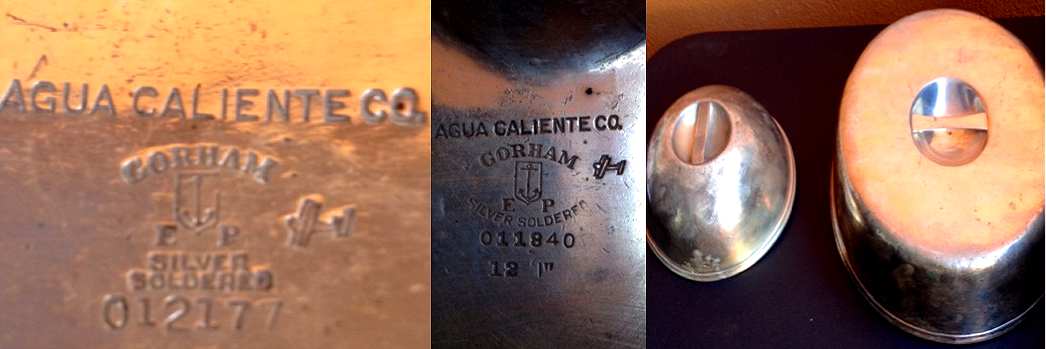
Agua Caliente Plate Covers, used in upscale restaurants to keep
food dishes protected and warm.
"Silver Soldered" is found on the back or bottom of many silver plate
pieces. It simply means that components of a piece were connected together
by soldering with an alloy containing silver.
It does not add any significant value to a piece. It is an alloy with
relatively little silver in it.... EP is ELECTROPLATED
METAL WARE.
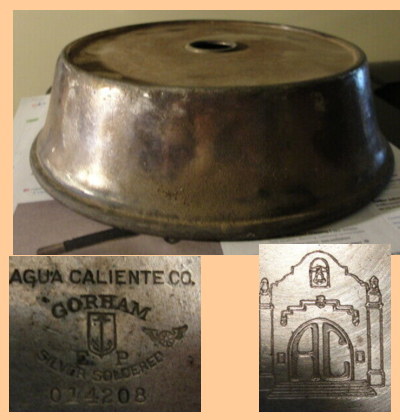
Another "Agua Calinte Co." Silver Plate Plate Cover by Gorham.
"8"W x 2 1/4"T Heavy Silver Plate Plate Covers by Gorham Silver. Code dated 1931."
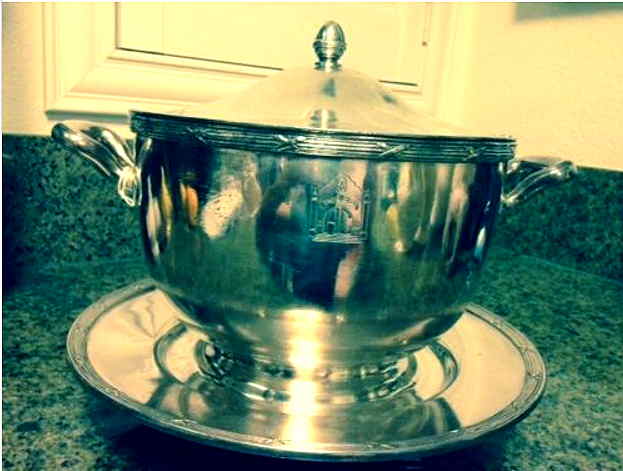
Seller said, �This beautiful Agua Caliente tureen is in very good condition especially given its age!
I have collected restaurant/hotel silver for many years & have never come across an item like this.
The [Agua Caliente] logo on front is crisp. It is very heavy (at least 5+ lbs) & large. Dimensions are as follows-
approx 12 3/4" wide (handle to handle), 9 1/4" across bowl, 3 1/4" wide underplate, 6 1/2" tall w/out lid, & 9" tall w/lid.
Marked on bottom as follows- Agua Caliente Co. Gorham w/an anchor in a shield plus a hammer
E P silver soldered 014757. 8 pint�
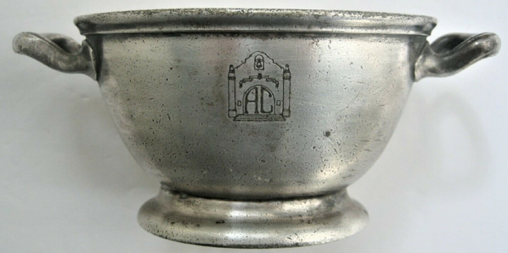
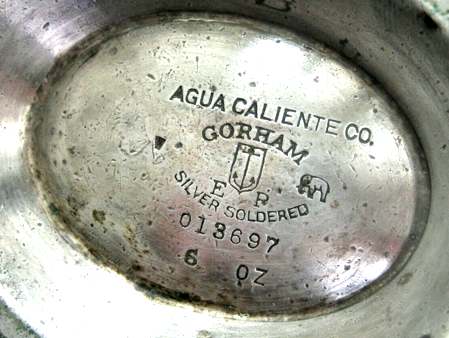 Agua Caliente sugar bowl
. Picture to right is the bottom of the silverplate bowl. The seller says,
"This fine collectible sugar bowl measures 3 1/4 inches in width x 5 3/4 inches in length (at the handles)
and is 2 1/2 inches in height". Sold for $112.50 on eBay, Feb. 2020.
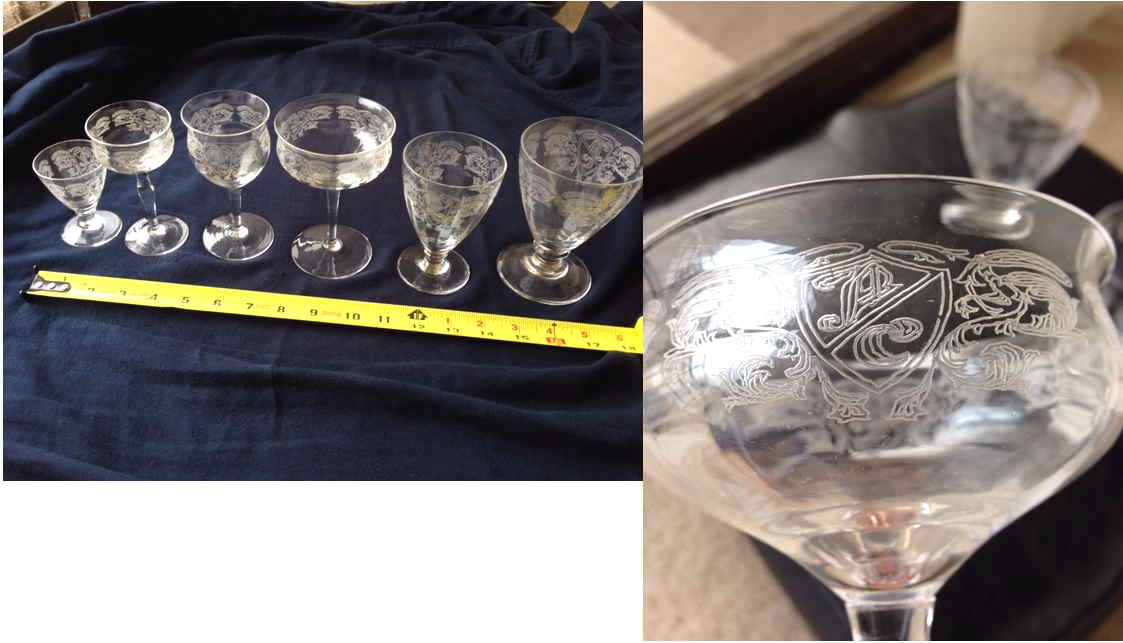
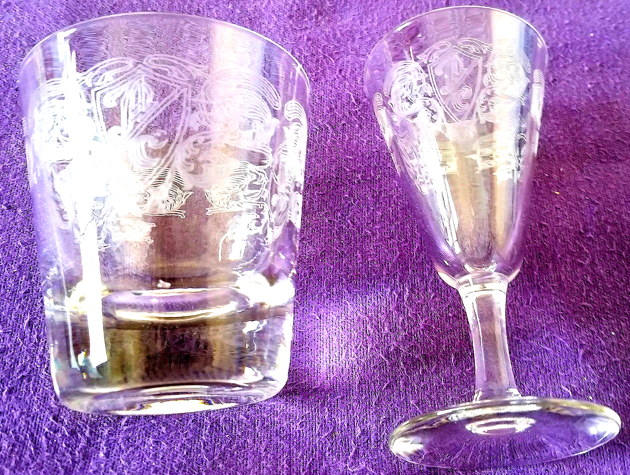
Crystal glassware (top 2 pictures), owned by the family that was in the restaurant supply business and handled some of the liquidation. Note the "A/C" logo on the right. ... .. Bottom
picture: crystal highball and sherry glasses with A/C logo.
|
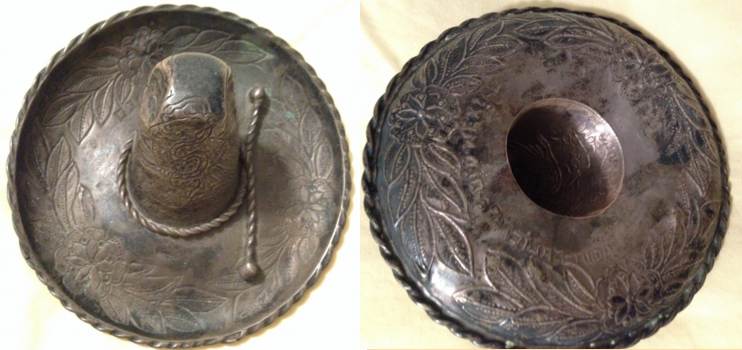
Agua Caliente Silver Sombrero Ashtray or more likely a Paperweight.
Rightside-up on left. Underside-up on right.
Engraved on it is: "AUGA-CALIENTE-OLD-MEXICO," "STERLING," and "SILVER." About 3 inches wide.
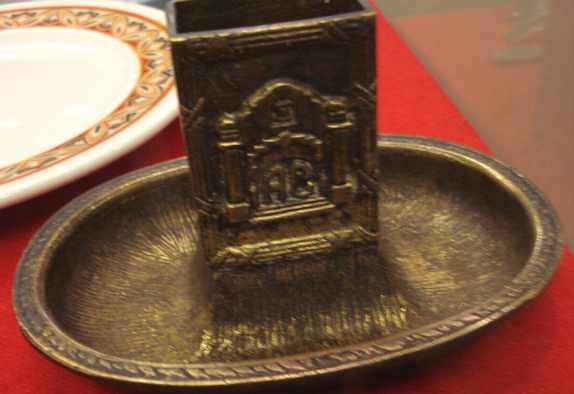
1929-1934)Metal ashtray with built-in matches holder. Wonderful
piece. Note the "AC"-Bldg logo. Source.
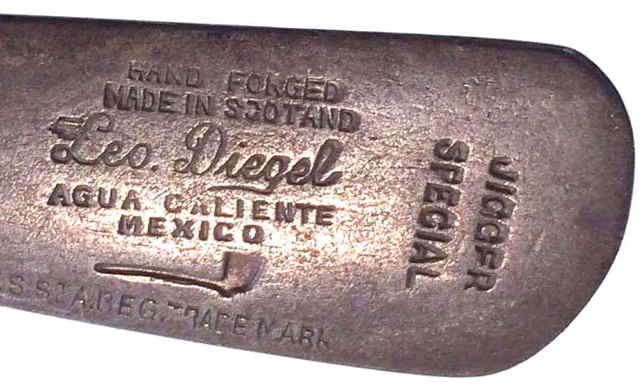
| Face of jigger golf club issued while Leo Diegel was the golf pro at Agua Caliente (1929-34). Made in St. Andrews, Scotland, and marked with the Tom Stewart pipe logo. |
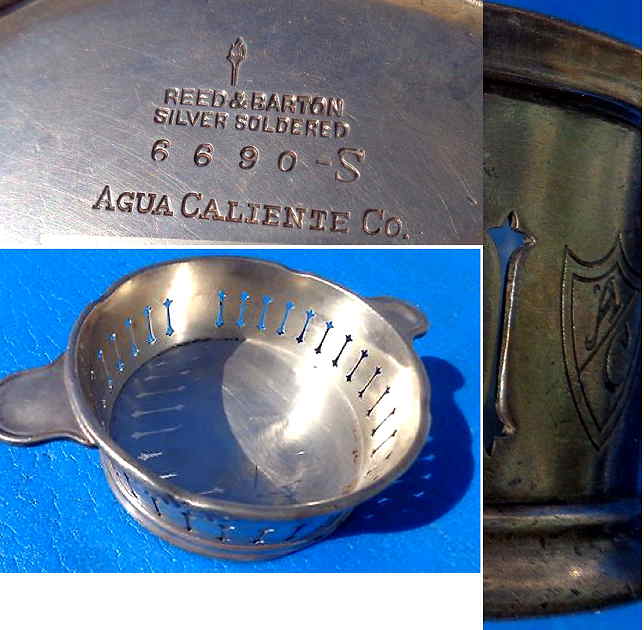
and table linens.
Wine coaster made
by Reed Barton and marked on the bottom "Reed & Barton Silver
Soldered 6690-S Agua Caliente Co" and has a date symbol for the year
1929. Note the "A/C" engraved logo on the side, seen in the rightmost picture above. The coaster is 5� in diameter and 2� tall and has 2 handles and weighs about 1
pound, per seller. Wine bottles and glasses were put into/atop
such coasters to protect wood tables and table linens.
|
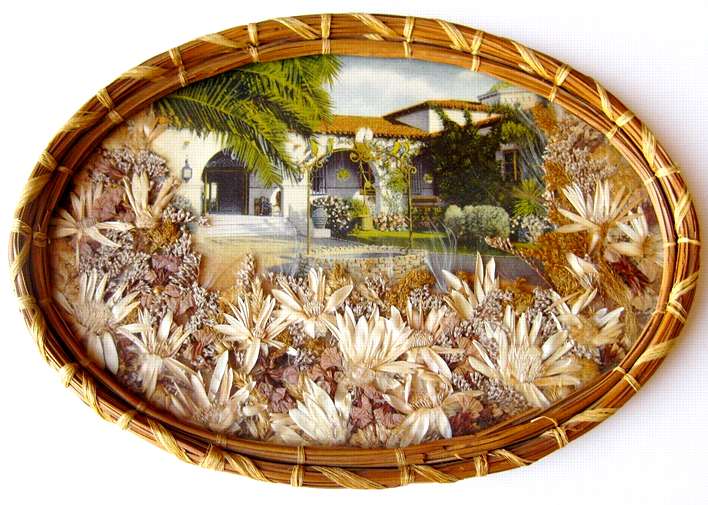
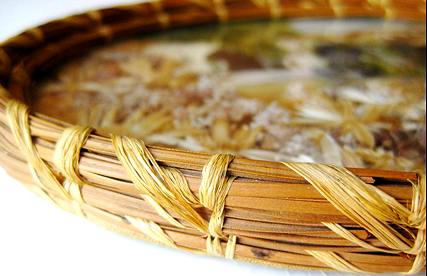
Beautiful 1930s hand-made SERVING TRAY featuring a
photo of the Agua Caliente Casino, a glass surface over dried flowers,
sided with
rare Torrey Pine (click here
for view of side). Probably not offered through the resort, but
worth displaying here. It is 8-3/8" x 5-7/8."
Details are on the label on the back. It notes,
"These trays are hand made of the needles of the Torrey Pine Tree
by Mrs M.A. Nicol,
San Diego, Calif. The Torrey Pine was discovered in 1850,
named after John Torrey of NY. It grew in two places in California,
almost extinct now."
Please feel
free to
browse my web site
and to email me:
(removed email address)
|
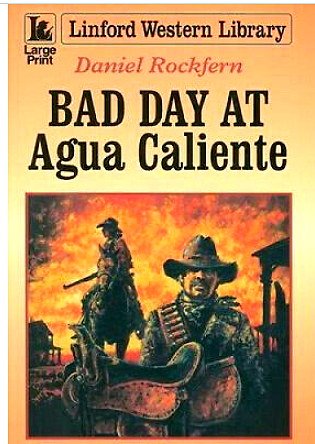 Hardcover book, 2007.
"The Justice Department wanted Yancey Blantine badly.
The killer and his renegade crew had wiped out a town and slaughtered everyone in it
before they ran for the shelter of Mexico.
The Attorney General gave the order to follow Blantine's trail and bring him in alive".
My email address:
(removed email address)
--------------------------------------------------------------------------------------------------------
 This counter was added April 22, 2016;
hits are to this page only.
This counter was added April 22, 2016;
hits are to this page only.
Click the above Counter box to see more information and countries/flags.
Home Page: ordering
info.,policies (satisfaction guaranteed, etc.), e-mail, etc.
Site
Map
� 2010 thru 2016 by Robert Eisenstadt
all rights reserved